Contrary to popular belief, houseplants are fundamentally ineffective at cleaning the air of an entire room or home.
- Scientific studies show you would need a biologically unfeasible number of plants—hundreds, even thousands—to match the air-cleaning performance of simple ventilation.
- Factors like low humidity, poor placement, and overwatering can negate any minor benefits and may even introduce mold into your environment.
Recommendation: Shift focus from the myth of whole-home air purification to the proven, significant mental health and productivity benefits of biophilic design, and use plants strategically to create small, localized ‘clean air zones’.
For any health-conscious individual, the promise of a “natural” solution to indoor air pollution is alluring. We are constantly exposed to a cocktail of Volatile Organic Compounds (VOCs) like formaldehyde and benzene from furniture, paints, and cleaning products. The idea, popularized by a 1989 NASA study, that a few houseplants can act as living air purifiers, diligently scrubbing these toxins from our environment, has taken deep root in public consciousness. It suggests an easy, aesthetic, and green alternative to expensive mechanical purifiers.
However, this narrative, while appealing, often omits critical context about scale, airflow, and the basic biology of both plants and buildings. When we move from the sealed laboratory conditions of the original study to the dynamic environment of a real home, the air-purifying capabilities of plants diminish dramatically. The scientific consensus today is that relying on plants for meaningful air purification is a fallacy. But if the key isn’t their ability to purify a whole room, what is their true value? The answer is more nuanced and perhaps more profound, involving localized air effects, biophilic design, and measurable psychological well-being.
This article moves beyond the myth to provide a fact-based evaluation of what plants can—and cannot—do for your indoor environment. We will dissect the science behind air purification claims, compare plants to modern technology, and uncover their most significant, evidence-backed benefits for your health.
Summary: A Scientific Look at Houseplants and Air Quality
- Why You Would Need 100 Plants to Replicate NASA’s Air Purifying Results?
- How to Arrange Plants to Create a Localized Clean Air Zone?
- HEPA Purifier vs Green Wall: Which Removes Allergens More Effectively?
- The Soil Moisture Mistake That Increases Indoor Mold Spores
- How to Keep Stomata Open to Maximize Toxin Absorption at Night?
- Desk Plants or Green Walls: Which Boosts Employee Productivity More?
- The Vent Placement Error That Desiccates Foliage in 24 Hours
- Why Vibrant Biophilic Spaces Improve Mental Health in Urban Apartments?
Why You Would Need 100 Plants to Replicate NASA’s Air Purifying Results?
The foundational myth of air-purifying plants stems from a misunderstanding of scale. The original NASA experiments were conducted in small, sealed chambers—typically less than one cubic meter—with no air exchange. In this controlled setting, a single plant could indeed significantly reduce VOC concentrations. However, your home is not a sealed chamber. It has drafts, open windows, and HVAC systems, all of which contribute to a concept known as the air exchange rate. This constant introduction of new air and dilution of existing air renders the slow-working purification of plants almost negligible.
To quantify this, scientists use a metric called the Clean Air Delivery Rate (CADR), which measures how much clean air a purifier provides. Mechanical purifiers have CADRs of hundreds of cubic meters per hour. In stark contrast, a 2019 review of decades of research found that potted plants perform poorly. As Cummings & Waring noted in the Journal of Exposure Science & Environmental Epidemiology, “The distribution of single-plant CADR spanned orders of magnitude, with a median of 0.023 m³/h, necessitating the placement of 10-1000 plants/m² of a building’s floor space” to compete with a typical building’s air exchange. This is the equivalent of a dense forest in your living room.
The conclusion is stark: the rate at which plants remove VOCs is orders of magnitude slower than the rate at which new air is introduced into your home. Therefore, relying on a few decorative plants to clean the air of an entire room is, from a scientific standpoint, ineffective. The impact is simply too small to be meaningful at a whole-home scale.
How to Arrange Plants to Create a Localized Clean Air Zone?
While plants fail as whole-room purifiers, the concept of a localized clean air zone holds more promise. This strategy abandons the goal of cleaning an entire house and instead focuses on creating a small “pocket” of cleaner air in the area you occupy most, such as around your desk or beside your bed. The principle relies on proximity: by grouping several plants close to your breathing zone, you can potentially benefit from the small amount of VOC removal they do perform before the toxins are diluted by the room’s overall air volume.
To create such a zone, arrangement is key. A single, isolated plant is useless. Instead, group 5 to 10 plants of varying sizes together to create a dense cluster. This density helps to reduce air mixing with the rest of the room. Incorporating a small, quiet desk fan can enhance this effect. By directing a gentle, continuous airflow from the plant cluster towards your face, you are essentially creating a personal-scale bi-filtration system, pulling the air that has been processed by the plants’ leaves and root-zone microbes directly into your breathing area.
This approach requires a mental shift. You are not “cleaning the room”; you are engineering a micro-environment. The goal is to maximize the dose of plant-filtered air you receive personally. This strategy is most effective in static environments where you spend long periods, like a home office or a reading nook. The effect is modest and difficult to measure without sensitive equipment, but it represents the only plausible way to leverage plants for any degree of air quality improvement.
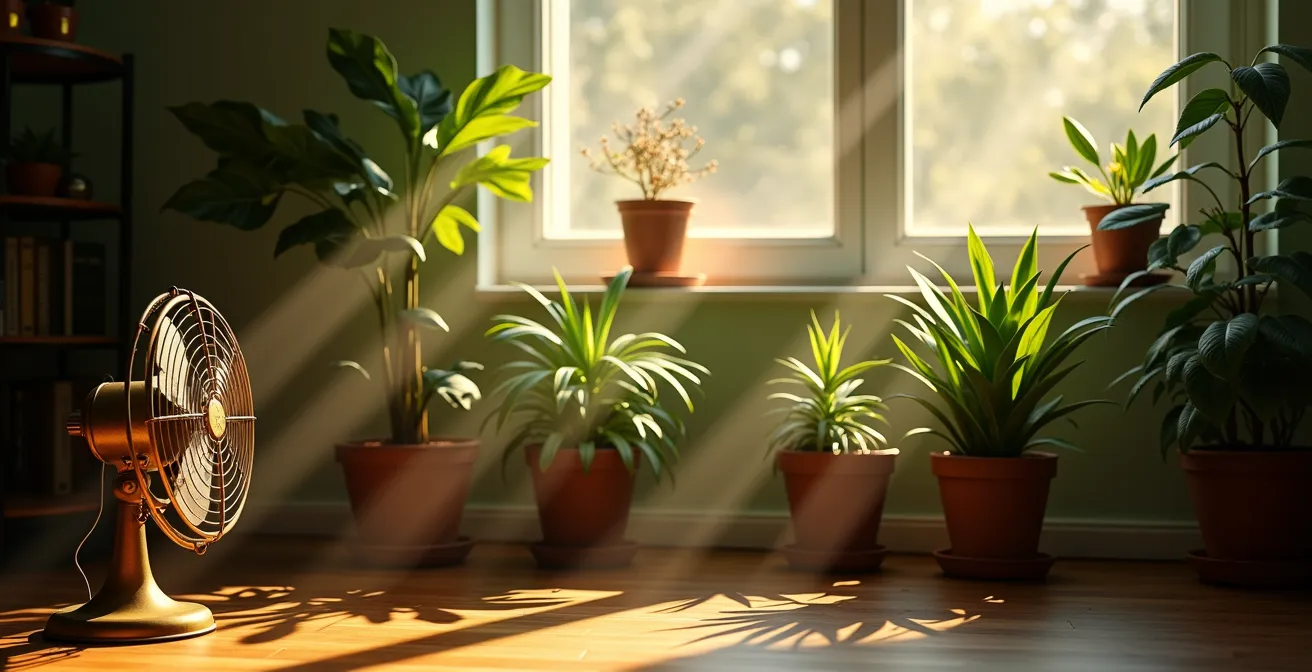
As this visualization suggests, the strategic placement and grouping of foliage are paramount. It’s about creating an intentional ecosystem, not just random decoration. By thinking in terms of air currents and proximity, you can design a space that maximizes the potential, however small, of your plants’ natural processes.
HEPA Purifier vs Green Wall: Which Removes Allergens More Effectively?
When the primary concern is allergens like dust, pollen, and pet dander, the comparison between plants and technology becomes unambiguous. High-Efficiency Particulate Air (HEPA) filters are the gold standard for a reason. They are designed to capture 99.97% of airborne particles down to 0.3 microns in size. Plants, including elaborate green wall systems, have a negligible measurable impact on particulate matter like PM2.5 or common allergens.
A green wall is essentially a vertical garden, sometimes with integrated fans to pull air through the soil medium. While they are powerful biophilic elements, their primary air cleaning mechanism targets VOCs, not particulates. The leaf surfaces and soil can trap a minuscule amount of dust, but they cannot compete with the filtration capacity of a HEPA purifier, which can cycle the air in a room multiple times per hour (known as Air Changes Per Hour or ACH). A green wall’s equivalent ACH is effectively zero for particulates.
The choice between these two options depends entirely on your goal. If you are an allergy sufferer or concerned about airborne particles, a HEPA purifier is the only effective solution. If your goal is to reduce certain gaseous VOCs and create a strong biophilic and aesthetic statement, a green wall could be considered, but with a clear understanding of its high cost and maintenance requirements. The two are not interchangeable.
This comparative analysis from a study on indoor air quality technologies highlights the fundamental differences in performance, cost, and maintenance between these systems.
| Criteria | HEPA Air Purifier | Green Wall System |
|---|---|---|
| Particle Removal (PM2.5) | 99.97% efficiency | Negligible measurable impact |
| VOC Removal Rate | Limited (requires carbon filter) | 9-85% depending on compound |
| Air Changes Per Hour | 4-6 ACH typical | <0.1 ACH equivalent |
| Initial Cost | $200-800 | $2000-10000 |
| Annual Maintenance | $50-200 (filter replacement) | $500-2000 (water, pruning, replacement) |
| Energy Consumption | 40-100W continuous | Passive (active walls: 20-50W for fans) |
The Soil Moisture Mistake That Increases Indoor Mold Spores
In the quest for “cleaner” air, it’s possible to inadvertently make it worse. One of the most common mistakes with houseplants is overwatering. Persistently damp soil is the perfect breeding ground for mold and fungi. These microorganisms release spores into the air, which are themselves a significant indoor pollutant and a potent trigger for allergies and asthma. So, while you may be hoping your peace lily is absorbing toxins, its soggy soil could be actively releasing biological contaminants.
This risk undermines the entire premise of using plants for health. The very conditions that some high-performing VOC-removing plants prefer (moisture and humidity) are also ideal for mold growth. Furthermore, plant health is directly tied to purification efficiency. A plant stressed by root rot from overwatering is not performing at its peak.
Case Study: Stressed Spider Plant Efficiency
A 2020 study published in PubMed examined how spider plants (Chlorophytum comosum) handled formaldehyde exposure. After an initial 7-day exposure, the plants’ physiological health declined. When re-exposed later, these stressed plants showed a 35-50% reduced efficiency in removing the toxin. This demonstrates that any environmental stress, including that from improper watering, directly compromises a plant’s already limited air-purifying capacity.

To mitigate this risk, proper watering technique is non-negotiable. Always allow the top 1-2 inches of soil to dry out completely between waterings. Ensure every pot has adequate drainage holes to prevent water from stagnating at the roots. For particularly susceptible environments, consider top-dressing the soil with a layer of sand or inorganic material like LECA to discourage surface mold growth. Choosing drought-tolerant plants like snake plants or ZZ plants over moisture-loving ferns can also significantly reduce the risk.
How to Keep Stomata Open to Maximize Toxin Absorption at Night?
The primary mechanism for gaseous toxin removal by plants is through tiny pores on their leaves called stomata. During photosynthesis, these stomata open to take in carbon dioxide (CO2), and in the process, they also absorb airborne VOCs. For most plants, this process occurs during the day when light is available. However, a special class of plants utilizes a different photosynthetic pathway known as Crassulacean Acid Metabolism (CAM).
CAM plants, which are typically native to arid environments, have evolved to open their stomata at night to minimize water loss during the hot day. This unique trait makes them theoretically ideal for bedrooms, as they are “working” to absorb CO2 and VOCs while you sleep. The most common examples of CAM plants include the Snake Plant (Sansevieria trifasciata), ZZ Plant (Zamioculcas zamiifolia), and many species of aloe and cacti. While the overall impact on air quality is still subject to the scale limitations we’ve discussed, optimizing the performance of these specific plants is a sound strategy for a localized bedroom air zone.
To maximize the efficiency of CAM plants, you must provide the right environmental cues. They thrive on a distinct temperature drop between day and night, which signals the stomata to open. Bright, indirect light during the day is also crucial, as it allows the plant to “charge up” the energy needed for its nighttime processes. Proper watering is also essential; as desert plants, they are highly susceptible to overwatering and root rot, which will shut down their metabolic functions.
Action Plan: Optimizing CAM Plants for Nighttime Purification
- Select appropriate CAM plants: Focus on Snake Plants, ZZ Plants, or specific Dracaena varieties known for this metabolism.
- Position plants effectively: Place them within 3-5 feet of your sleeping area to maximize your exposure to any localized air effects.
- Maintain temperature fluctuations: Encourage a natural nighttime temperature drop of 5-8°F (3-5°C) in the room to enhance CAM efficiency.
- Water sparingly: Allow the soil to dry out completely. CAM plants typically require 50% less water than standard tropical houseplants.
- Provide bright daytime light: Ensure plants receive several hours of bright, indirect sunlight to build up the necessary energy reserves for nighttime activity.
Desk Plants or Green Walls: Which Boosts Employee Productivity More?
As the air purification capabilities of plants have been critically re-evaluated, the focus of research has shifted. Leading scientists in the field now advocate for a different perspective. In their influential 2019 paper, Cummings and Waring suggested that “Future experiments should shift the focus from potted plants’ (in)abilities to passively clean indoor air, and instead investigate… biophilic productivity and well-being benefits.” This is where plants truly shine.
The debate between individual desk plants and large-scale green walls in a corporate setting is less about air quality and more about psychology, culture, and cost. A green wall is a major architectural feature. It serves as a powerful statement about a company’s commitment to biophilic design, creating a “wow factor” and a calming natural backdrop for an entire space. However, it is a passive experience for most employees and comes with a significant installation and maintenance budget.
Individual desk plants, on the other hand, offer a more personal and interactive benefit. They give employees a sense of control and ownership over their immediate workspace. The act of caring for a plant, watering it, and watching it grow can provide micro-moments of mindful disengagement from work, reducing stress and improving focus. This personal connection often leads to a greater perceived benefit than a passive green wall.
Case Study: Biophilic Design in UK Offices
A review of biophilic design implementations in UK corporate offices found that the choice between desk plants and green walls was driven by culture and budget, not air quality metrics. Companies discovered that desk plants, costing under £50 per employee, fostered personal engagement and a sense of ownership. In contrast, green walls, often requiring a £10,000+ investment, were used as large-scale architectural statements to define communal areas. The “better” choice depended on whether the goal was to provide a personal wellness tool or to make a broad environmental statement.
Ultimately, both approaches boost well-being, but through different mechanisms. For direct impact on an individual employee’s daily stress and engagement, the simple desk plant is often more powerful and cost-effective. For transforming the overall atmosphere of a large space, the green wall is unmatched.
The Vent Placement Error That Desiccates Foliage in 24 Hours
Even if plants are used for purely aesthetic or psychological reasons, their health is paramount. A common and devastating error is placing plants in the direct path of an HVAC vent. The constant stream of dry, heated, or cooled air creates an environment of extreme stress for any plant. This airflow drastically increases the rate of transpiration (water loss from leaves), leading to brown, crispy edges, leaf drop, and eventual death, often within days.
This placement mistake also directly sabotages any minor air-purifying potential. Plant stomata close in response to low humidity and excessive airflow to conserve water. When stomata are closed, they cannot absorb CO2 or VOCs. In fact, environmental studies indicate that plants in environments with less than 30% relative humidity can show a 50% reduced VOC uptake. Placing a plant near a vent creates a micro-desert that shuts down its metabolic functions.
Understanding your home’s HVAC zones is critical for plant survival and performance. Not all plants are equally susceptible. Hardy, succulent-like plants such as the Snake Plant or ZZ Plant may tolerate being in an area of indirect airflow, while more delicate tropicals like Calatheas or Ferns require sheltered corners far from any vents.
| HVAC Zone | Distance from Vent | Suitable Plants | Survival Rate |
|---|---|---|---|
| Zone 1 – Direct Airflow | 0-2 feet | Artificial only | 0% for live plants |
| Zone 2 – Indirect Flow | 2-6 feet | Snake Plant, ZZ Plant, Dracaena | 70-80% |
| Zone 3 – Sheltered | 6+ feet/corners | Ferns, Calathea, Peace Lily | 90-95% |
Before placing any plant, observe the airflow in your home. Hold a tissue or a lighter near vents to see the direction and strength of the air current. This simple act can be the difference between a thriving green companion and a withered, desiccated casualty.
Key Takeaways
- Relying on plants for whole-home air purification is a myth; you would need an impractical number (100+) to have a meaningful effect.
- The true, evidence-backed value of indoor plants lies in their significant psychological benefits, reducing stress and improving well-being (biophilia).
- For any minor air quality benefit, plants must be grouped densely in a “localized clean air zone” near your personal breathing space, not scattered as decoration.
Why Vibrant Biophilic Spaces Improve Mental Health in Urban Apartments?
The most significant, scientifically-backed reason to fill your home with plants has little to do with VOCs and everything to do with your brain. This is the principle of biophilia—the innate human tendency to seek connections with nature. In increasingly urban and sterile environments, houseplants can serve as a vital link to the natural world, with profound effects on mental health.
Research has consistently shown that interaction with indoor plants can reduce both physiological and psychological stress. The simple act of looking at greenery can lower blood pressure, reduce levels of the stress hormone cortisol, and improve mood. A 2017 Korean study looking at new office buildings found that while plants had a minimal effect on particulate matter, their presence was strongly correlated with reduced sick building syndrome symptoms and improved task performance among occupants. The researchers concluded the psychological benefits were more significant than the air purification effects.
This finding is echoed by decades of research, including work related to the original NASA studies. As a NASA Spinoff Report on the technology transfer highlights, “Research has suggested that plants play a psychological role in welfare, and that people actually recover from illness faster in the presence of plants.” This is not about air chemistry; it’s about a deep-seated psychological response to nature that promotes healing and tranquility.
Case Study: The Psychological Impact in New Buildings
A 2017 study published in the journal Sustainability investigated buildings less than 3 years old, which often have high VOC levels. It found that while plants showed negligible impact on airborne particle removal due to the strong influence of outdoor air exchange, they did reduce specific VOCs by 9-85%. More importantly, researchers noted that the psychological benefits, including reduced stress and increased perceived well-being, were far more significant and consistent than the variable air purification effects. This supports the hypothesis that biophilia is the primary health benefit of indoor plants.
For the health-conscious individual living in a concrete-dominated urban landscape, creating a vibrant biophilic space is a powerful mental health intervention. It’s about intentionally designing an environment that calms the nervous system and fosters a connection to life. Forget the myth of air purification and embrace the proven reality of psychological wellness.
Frequently Asked Questions on Plants and Indoor Air
What causes mold growth on potted plant soil?
Overwatering creates ideal conditions for mold growth. When soil remains constantly moist, it promotes fungal development that can become airborne and trigger allergies. This is a primary risk of keeping houseplants indoors.
How can I prevent mold without harming my plants?
To prevent mold, ensure every pot has proper drainage holes. Critically, you must allow the top layer of soil to dry out between waterings. You can also improve air circulation around your plants and consider adding a top layer of sand or LECA (Lightweight Expanded Clay Aggregate) on the soil to create a drier surface.
Are certain plants more prone to mold issues?
Yes. Plants that require consistently moist soil, such as many ferns and peace lilies, carry a higher risk of developing soil mold compared to drought-tolerant plants like snake plants, succulents, and ZZ plants, which prefer their soil to dry out completely.