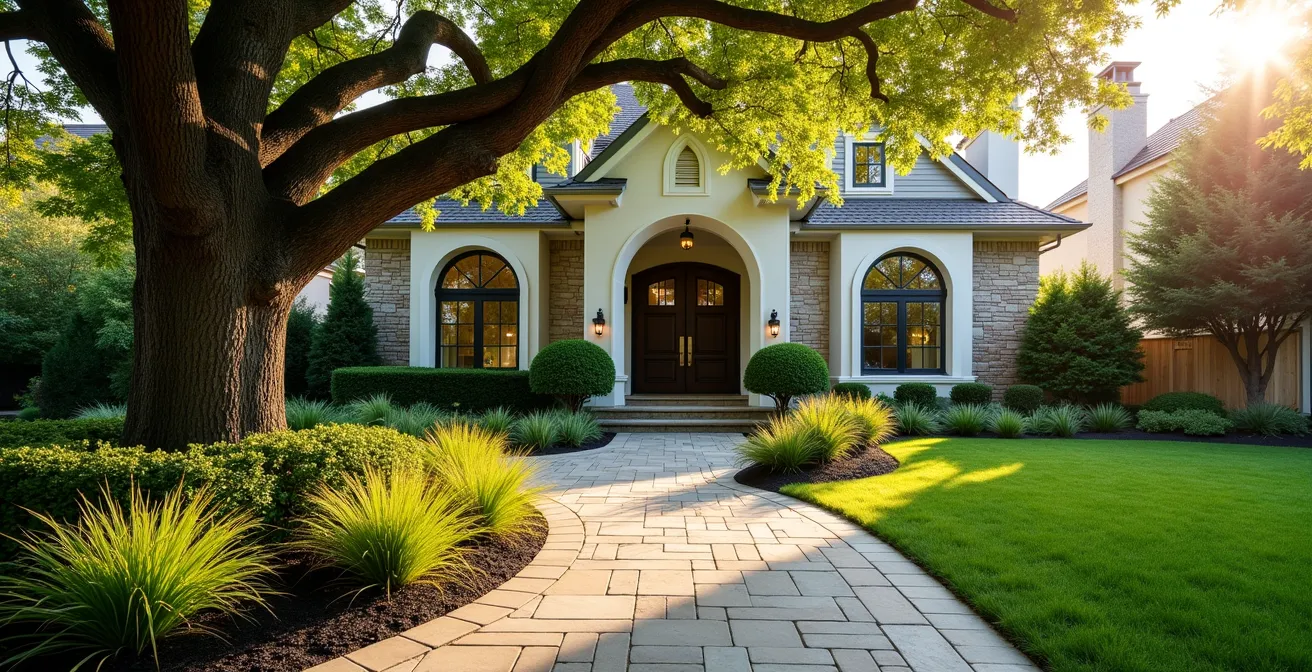
Strategic landscaping is not about aesthetics; it’s a calculated investment that directly impacts your home’s appraised value.
- Mature trees and well-designed hardscapes are viewed as long-term assets, not just decorations, offering quantifiable returns.
- Smart plant choices and proper placement mitigate major risks, preventing costly inspection issues that devalue a property.
Recommendation: Shift your focus from simple curb appeal to ROI-driven projects by creating a phased, budget-conscious landscape plan that prioritizes structural value and risk reduction.
For homeowners preparing to sell, the term “curb appeal” often conjures images of fresh mulch and colorful annuals. While these touches are pleasant, they represent a surface-level understanding of how exterior landscaping truly impacts a property’s bottom line. The common advice to simply “tidy up the yard” overlooks the strategic, financial calculations that a real estate appraiser makes. They see beyond the flowers to the structural assets, the long-term maintenance implications, and the potential liabilities hidden in plain sight.
The difference between a home that sells at a premium and one that languishes on the market often lies in this deeper layer of landscape strategy. It’s not just about looking good for a showing; it’s about demonstrating tangible, long-term value. But what if the real key to unlocking that 15% increase in value wasn’t just in what you add, but in what you avoid? What if the most valuable “plantings” are the ones that solve problems like noise, privacy, or energy consumption?
This guide moves beyond the platitudes of curb appeal to give you an appraiser’s perspective. We will deconstruct the elements that add quantifiable value, from the financial weight of a single mature tree to the critical choice between lawn and hardscape. We’ll also flag the common but costly errors that can scare off inspectors and torpedo a sale. By the end, you will have a blueprint for making strategic landscaping decisions that deliver a measurable return on investment.
To help you navigate these strategic decisions, this article breaks down the key value drivers and potential pitfalls. Explore the topics below to learn how to think like an appraiser and maximize your property’s financial potential through smart landscaping.
Summary: A Strategic Guide to Landscaping for Property Value
- Why Mature Trees Are Worth Thousands More Than New Saplings?
- How to Design a Front Walkway That Invites Buyers In?
- Perennial Beds or Annual Borders: Which Appeals More to Modern Buyers?
- The Planting Error Near Walls That Scares Off Home Inspectors
- How to Plant Green Screens to Block Noise From Busy Streets?
- Lawn or Hardscape: Which Investment Adds More Value in Phase One?
- Why Water Pooling Near Your Foundation Threatens Structural Integrity?
- How to Create a Professional Landscape Design Plan on a DIY Budget?
Why Mature Trees Are Worth Thousands More Than New Saplings?
From an appraiser’s viewpoint, a mature tree is not just a plant; it’s a structural asset with a clear monetary value. While a new sapling is a small, upfront cost, a large, healthy tree contributes to a home’s value in ways that are both tangible and intangible. The most direct financial impact comes from energy savings. According to the Arbor Day Foundation, strategically placed trees can result in a 30% reduction in air conditioning needs and save 20-50% on heating costs by acting as a natural windbreak. This translates into hundreds of dollars in verified annual savings, a figure that directly influences a home’s perceived value.
This valuation is formalized by industry experts. As a guideline for appraisers and insurers, the Council of Tree and Landscaping Appraisers states that a mature tree can have an appraised value of between $1,000 and $10,000. This figure accounts for the tree’s species, condition, and location. The ROI is demonstrated in real-world scenarios; for example, one case study showed a family saving approximately $400 annually on cooling costs due to three large shade trees. As documented in an analysis by GV Tree Service, this amounts to $8,000 in energy savings alone over 20 years, proving that a mature tree is a long-term, high-return investment that far outweighs the cost of planting a new one.
Beyond direct financial returns, these established trees provide immediate shade, privacy, and a sense of permanence that new plantings cannot. They frame the property, enhance its scale, and contribute to a neighborhood’s established character—all factors that resonate strongly with prospective buyers and justify a higher asking price. A sapling represents a future promise, but a mature tree is an immediate, quantifiable asset.
How to Design a Front Walkway That Invites Buyers In?
The journey from the street to the front door is a critical first impression that sets the tone for a potential buyer’s entire viewing experience. A simple, straight concrete path does the job, but it doesn’t create value. A thoughtfully designed walkway, however, acts as a formal invitation, guiding visitors and building anticipation. The key is to think of it not just as a path, but as a landscaped experience. Using high-quality materials is a proven investment; for instance, studies show that natural flagstone walkways can provide a 100% return on investment when properly integrated with surrounding plantings.
Creating a high-value walkway involves several strategic elements. First, introduce deliberate curves. Unlike a straight line that rushes the eye to the door, gentle curves slow the journey, encouraging a buyer to take in the architecture and surrounding garden. This creates a more relaxed and welcoming feel. Second, consider a transition of materials to signal a shift from public to private space—for example, moving from a standard concrete sidewalk to elegant pavers and then to natural stone near the entrance. This layering adds sophistication and perceived value.
Finally, engage more than just the sense of sight. Bordering the path with fragrant, low-maintenance herbs like lavender and rosemary creates a memorable sensory experience. At night, safety and ambiance are paramount. While a significant investment, installing professional pathway lighting not only enhances security but also adds a dramatic, high-end look that makes the property stand out. Each of these elements—material choice, path design, and sensory details—transforms the walkway from a mere utility into a feature that actively contributes to the home’s curb appeal and, ultimately, its market value.
Perennial Beds or Annual Borders: Which Appeals More to Modern Buyers?
When staging a home for sale, homeowners often rush to plant vibrant annuals for a quick pop of color. While effective for a photograph, this strategy can signal “high maintenance” to a savvy buyer. Modern buyers, particularly those in younger demographics, increasingly prioritize low-maintenance, sustainable living. From an appraiser’s perspective, established perennial beds represent a far greater value. They signify a mature, well-planned garden that requires less work and water once established—a significant selling point.
The image below showcases a layered perennial garden. Note the mix of textures, heights, and foliage colors, which provide visual interest throughout the year, not just for a few months. This is the kind of four-season structure that annuals can’t offer.

The long-term financial equation heavily favors perennials. While their initial cost per plant is higher, they return year after year, eliminating the recurring expense and labor of replanting annuals. This distinction is critical for buyers who see a garden not just as a feature, but as a line item in their future budget. The following table breaks down the core differences in how these planting choices are perceived at the point of sale.
| Feature | Perennial Beds | Annual Borders |
|---|---|---|
| Initial Cost | Higher ($150-$1,850 per plant) | Lower ($20-$50 per flat) |
| Maintenance Appeal | Low-maintenance (major selling point) | High-maintenance (potential deterrent) |
| Year-Round Interest | Four-season structure | Seasonal color only |
| Buyer Perception | Established, mature garden | Temporary staging element |
| Water Requirements | Lower once established | Constant watering needed |
| ROI for Home Sales | Higher long-term value | Quick color for showings |
Ultimately, while annuals can be a useful tool for temporarily filling gaps, the core of a value-adding landscape lies in well-designed perennial beds. They project an image of a permanent, thoughtfully cared-for home, which is a powerful psychological trigger for buyers.
The Planting Error Near Walls That Scares Off Home Inspectors
While beautiful landscaping adds value, the wrong plant in the wrong place can actively subtract it by creating red flags for a home inspector. The single most costly and common mistake is planting trees with aggressive root systems too close to the house. A charming willow or a fast-growing poplar might seem like a good idea for quick shade, but their roots can invade plumbing lines and, most alarmingly, compromise the home’s foundation. This is not a hypothetical risk; it’s a frequent and expensive reality.
A stark case study from Fairfax illustrates this danger perfectly: a homeowner discovered their beautiful willow, planted just 12 feet from the house, had roots lifting the foundation. As noted by industry experts, the subsequent removal and foundation repair cost them $8,000—a devastating financial blow that turned a landscape feature into a major liability. This is precisely the kind of issue that makes buyers walk away or demand significant price reductions.
Other seemingly innocent practices can also create problems. Piling mulch directly against foundation walls, a common homeowner habit, traps moisture and can act as a “bridge” for termites to enter the home’s structure. Similarly, climbing vines like English Ivy, while romantic in appearance, can destroy mortar and trap moisture against siding, leading to rot and pest infestations. An inspector is trained to spot these tell-tale signs of potential future damage, and their report will reflect that risk. To avoid these costly mistakes, follow a clear set of preventative guidelines.
Inspector’s Checklist: Foundation Planting Safety
- Root System Check: Avoid trees with aggressive roots (willows, poplars, silver maples) within 20 feet of the foundation. Choose smaller, less invasive species for planting near structures.
- Mulch Gap: Maintain a 6-inch gap between any mulch or soil and the foundation siding to prevent moisture buildup and termite access.
- Vine Removal: Remove destructive climbing vines like English Ivy from walls. Opt for trellises set away from the house if you want a climbing plant effect.
- Shrub Pruning: Keep all shrubs pruned at least 12 inches away from siding to allow for proper air circulation and prevent moisture-related damage.
- Grading Verification: Ensure the soil slopes away from the foundation at a rate of 6 inches for every 10 horizontal feet to direct water away from the structure.
How to Plant Green Screens to Block Noise From Busy Streets?
A property’s value is not only determined by what you can see but also by how it feels to live there. For homes on or near busy roads, noise pollution can be a major deterrent for buyers and a significant factor in appraisal. A simple fence can help, but a “green screen”—a living wall of carefully selected plants—is a far more effective and attractive solution that adds value on multiple fronts. By absorbing sound waves, blocking unsightly views, and creating a sense of tranquil seclusion, a green screen can transform a noisy, exposed yard into a private oasis.
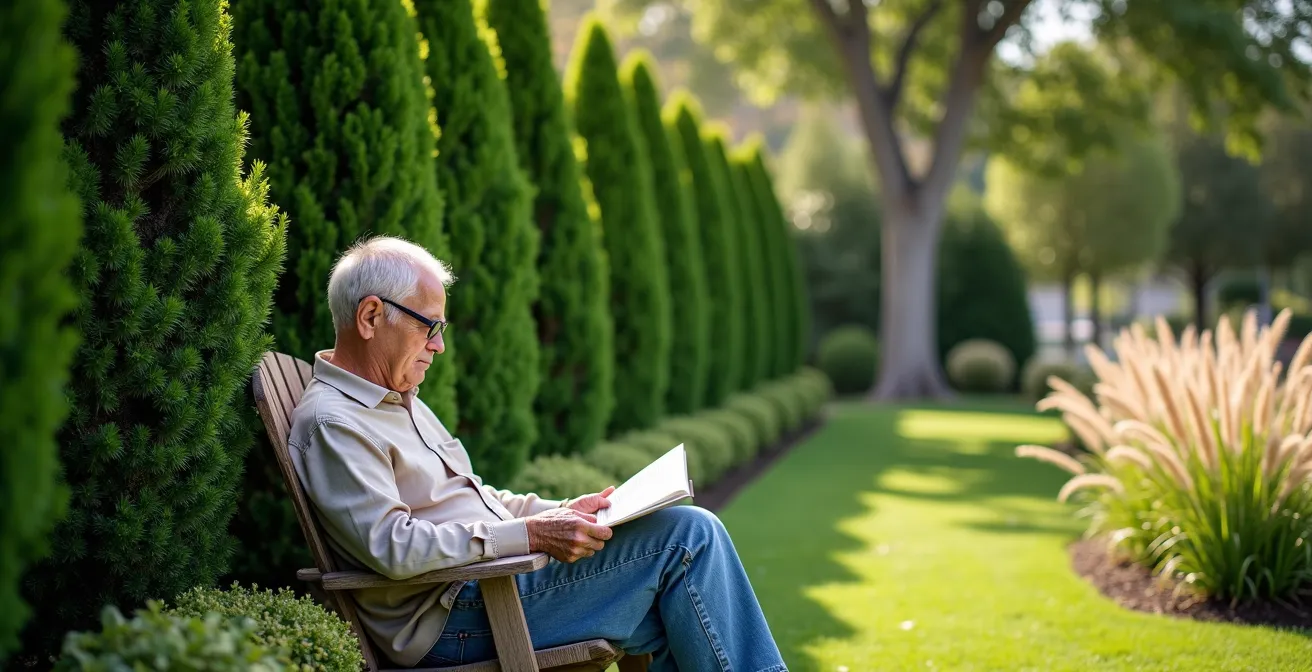
The most effective green screens use a multi-layered approach rather than a single row of trees. This strategy combines different types of plants to block sound at various frequencies. The design typically includes:
- An initial earthen berm or low wall to deflect sound upwards.
- A primary layer of tall, dense evergreens like Arborvitae or Spruce to act as the main sound and windbreak.
- A mid-layer of broadleaf evergreens like Holly or Laurel, whose large leaves are excellent at absorbing and scattering sound waves.
- A foreground layer of shrubs or ornamental grasses to fill any gaps at the lower level.
The image below illustrates this layered concept, showing how a combination of plant types creates a dense, visually appealing barrier that provides a sense of peace and privacy.
This functional landscaping also offers other benefits. A dense planting of trees and shrubs creates a microclimate, offering shade and releasing water vapor that can have a notable cooling effect. In fact, large-scale tree plantings in urban areas can contribute to an up to 10°F temperature reduction in the immediate vicinity. For a homebuyer, a well-designed green screen isn’t just a row of trees; it’s a tangible improvement to their quality of life, a feature worth paying a premium for.
Lawn or Hardscape: Which Investment Adds More Value in Phase One?
When planning a backyard overhaul, homeowners face a fundamental choice: invest in a lush, green lawn or a durable, functional hardscape like a patio or deck? From a pure ROI perspective, the answer is nuanced and depends heavily on the target buyer. A well-maintained lawn can offer a surprisingly high return, but a hardscape adds usable, year-round living space that is increasingly in demand. An appraiser will weigh the costs, benefits, and buyer appeal of each.
A pristine lawn is the classic symbol of a well-cared-for home. For families with children, it offers invaluable play space. The upfront cost is relatively low, and the visual impact is immediate. However, the long-term maintenance costs in terms of water, fertilizer, and time can be a significant deterrent for busy professionals or eco-conscious buyers. Conversely, a hardscape patio has a much higher initial installation cost but boasts very low maintenance and extends the home’s living area into the outdoors, creating a coveted “outdoor room.”
As real estate expert Michael Azzam notes in an interview with HomeLight, “Any sort of outdoor space that you can entertain on adds a decent amount of tangible value.” This highlights the modern buyer’s desire for functional, entertainment-ready spaces. The following table provides a direct comparison of the investment factors for each option:
| Investment Factor | Lawn Installation | Hardscape Patio |
|---|---|---|
| Upfront Cost | $1,000-$3,000 for 5,000 sq ft | $7,320 average professional installation |
| ROI at Sale | 217% for well-maintained lawn | 60-70% cost recovery |
| 5-Year Maintenance Cost | $700/year ($3,500 total) | $100/year ($500 total) |
| Appeal to Families | High – play space for children | Medium – limited active use |
| Appeal to Professionals | Low – maintenance burden | High – outdoor entertaining space |
| Usable Square Footage Added | Seasonal use only | Year-round ‘outdoor room’ |
For a phase one investment, a hardscape patio often represents a more strategic choice for adding durable, functional value. While the immediate ROI percentage might seem lower than a perfect lawn, it creates a high-demand feature that appeals to a broad range of buyers and requires minimal upkeep, making it a safer long-term bet.
Why Water Pooling Near Your Foundation Threatens Structural Integrity?
Of all the potential landscape-related issues, none is more alarming to a home inspector or buyer than water pooling near the foundation. This is a giant red flag that signals a risk of catastrophic damage. Persistent moisture against a foundation can lead to hydrostatic pressure, causing cracks, leaks, and basement flooding. Over time, it can erode the soil supporting the foundation, leading to settling and severe structural failure. What a homeowner sees as a simple puddle, an appraiser sees as a multi-thousand-dollar liability.
The cost of ignoring drainage issues is exponentially higher than the cost of preventing them. A simple fix like installing downspout extenders can cost less than a hundred dollars, while emergency foundation repairs can easily run into the thousands. As one analysis points out, the cost difference is stark: emergency tree removal and water damage can cost $1,500 to $5,000 or more, whereas preventative measures are a fraction of that. Proactively managing water flow away from your home is one of the highest-ROI maintenance tasks you can perform.
Fortunately, many effective drainage solutions can be integrated beautifully into a landscape design, turning a problem into a feature. Before listing a property, addressing any signs of water pooling is non-negotiable. High-ROI fixes include:
- Downspout Extenders: A simple, inexpensive fix to direct roof runoff at least 6 feet away from the foundation.
- Regrading Soil: Ensuring the ground slopes away from the house is a fundamental solution that can cost a few hundred to a thousand dollars but prevents major issues.
- Dry Creek Beds: A decorative and effective way to channel excess water through the yard using river rocks and landscape fabric.
- French Drains: A more intensive but highly effective subsurface solution for areas with significant water problems.
- Rain Gardens: A beautiful and eco-friendly feature that uses water-loving plants to absorb runoff in a designated shallow depression.
Addressing drainage is not just about maintenance; it’s about protecting the core value and structural integrity of your property. No amount of beautiful planting can compensate for a compromised foundation.
Key takeaways
- Think Like an Appraiser: Focus on landscaping elements that function as long-term assets (mature trees, hardscapes) rather than temporary cosmetic fixes.
- Prioritize Risk Mitigation: The highest ROI can come from preventing costly problems. Proper plant placement and effective water management protect your home’s structural integrity.
- Invest in Low Maintenance: Modern buyers value their time. Choosing established perennials and durable materials signals a lower long-term cost of ownership, a major selling point.
How to Create a Professional Landscape Design Plan on a DIY Budget?
Investing in landscaping without a coherent plan is the single biggest mistake a homeowner can make. As the experts at BobVila.com famously stated in This Old House, “The biggest landscaping mistake that homeowners make is not having a coherent plan.” A haphazard approach leads to a disjointed look, wasted money, and missed opportunities. A professional-level plan, however, doesn’t have to come with a professional-level price tag. By combining smart, targeted expert advice with DIY execution, you can create a high-impact design that maximizes your return on investment.
As a benchmark, the American Society of Landscape Architects recommends homeowners invest 10% of their home’s value in landscaping. To ensure that 10% is spent wisely, a plan is essential. The strategy is to leverage professional expertise for the most critical part—the design—and then execute the labor yourself. Consider hiring a landscape designer for a one-hour consultation. For a modest fee, you can have an expert review your property, discuss your goals, and help you refine your DIY plan, preventing costly errors before you even break ground.
With a solid concept in hand, you can use technology and design principles to bring it to life on a budget. Free design apps with Augmented Reality (AR) allow you to visualize plant placements before you buy. Adhering to the simple “rule of three”—grouping plants in odd numbers—instantly creates a more natural and visually appealing arrangement. Instead of adding expensive new structures, identify existing features like a large rock or a unique tree and make them focal points. Finally, phase your implementation over several seasons. Focus on the highest-impact areas first, like the foundation plantings and front walkway, spreading the cost over time while building value methodically.
By implementing these value-focused strategies, you can transform your landscape from a simple yard into a powerful financial asset. The next logical step is to begin sketching out a phased plan for your own property, starting with the highest-impact, lowest-risk projects.