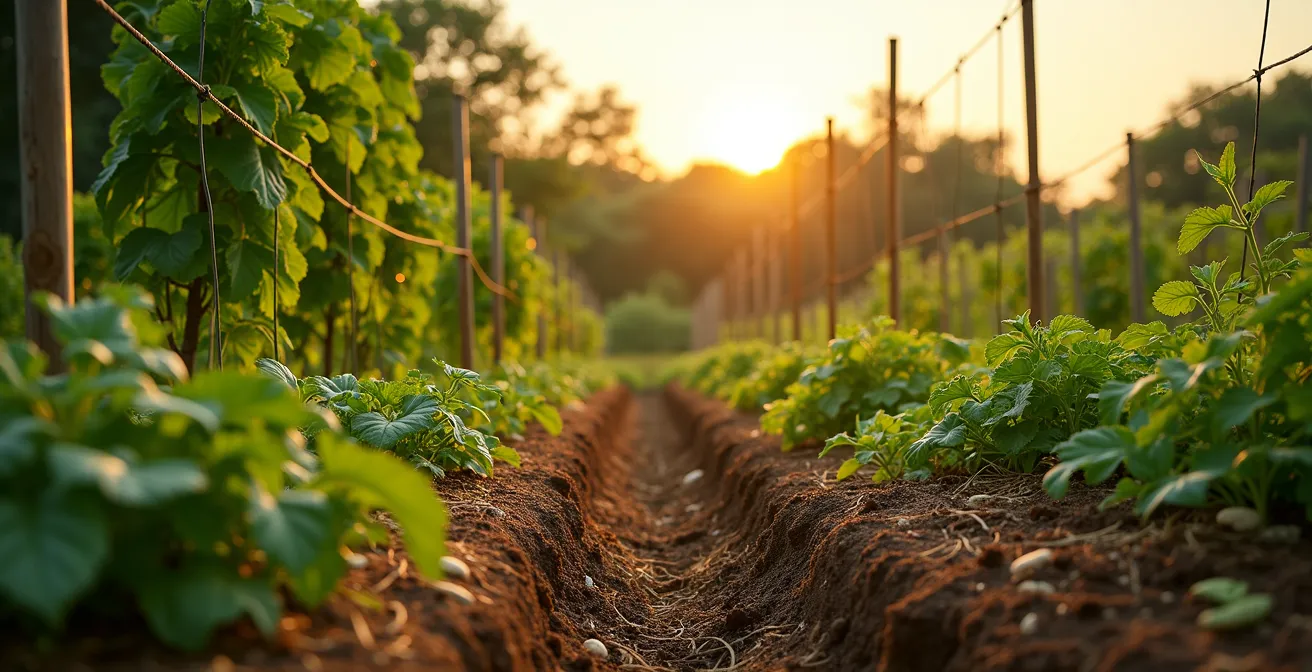
Achieving consistently high vegetable yields isn’t about isolated organic ‘tricks’; it’s about systematically managing your soil as a living ecosystem.
- Success depends on understanding and controlling nutrient cycles, particularly the Carbon-to-Nitrogen (C:N) ratio of your inputs.
- Actively steering your soil’s biology—choosing whether to foster fungal or bacterial dominance—is critical for matching the needs of your crops.
Recommendation: Stop treating symptoms (pests, diseases) and start building a resilient soil food web through strategic crop rotation, cover cropping, and mulching.
Many food growers make the admirable switch to organic methods, primarily by eliminating chemical sprays. While this is a crucial first step, it often leads to a plateau of frustration: yields stagnate, and pests or diseases like tomato blight still wreak havoc. The common advice—”add compost” or “rotate crops”—feels vague and disconnected from the results seen in professional organic systems. This gap exists because a “no spray” approach is passive avoidance, not active, systemic management.
The transition to truly productive organic horticulture requires a paradigm shift. Instead of viewing soil as a neutral medium to which we add nutrients, we must treat it as a dynamic, living ecosystem—the soil food web. The real work lies not in “feeding the plants,” but in cultivating the vast underground network of bacteria, fungi, and other microbes that do the work for you. This involves understanding the nuanced mechanisms behind practices like cover cropping, the specific biological role of compost tea, and how different types of mulch can completely alter the soil environment.
This guide moves beyond the platitudes. We will dissect the science behind why these advanced practices work, enabling you to make informed, strategic decisions. By embracing the role of a soil ecosystem manager, you can unlock the full potential of your garden, leading to healthier plants and significantly higher vegetable yields. It’s time to stop fighting nature and start directing it.
For those who prefer a visual introduction, the following video demonstrates the powerful “no-dig” method using cardboard and compost—a foundational technique for preserving and building the very soil structure we aim to enhance.
To navigate these advanced concepts, this article is structured to address specific, high-impact questions. Each section breaks down a core principle of systemic soil management, providing the knowledge you need to build a truly productive organic garden from the ground up.
Summary: Mastering Systemic Soil Health for Abundant Yields
- Why Planting Tomatoes in the Same Spot Encourages Blight?
- Clover or Rye: Which Cover Crop Fixes More Nitrogen in Winter?
- Aerated Compost Tea: Magic Elixir or Bacterial Soup?
- The Monoculture Mistake That Invites Pest Swarms
- Straw vs Wood Chips: Which Mulch Feeds Fungi vs Bacteria?
- Why Too Much Nitrogen Sacrifices Fruit for Green Leaves?
- Pine Straw or Rubber Mulch: Which Is Truly Sustainable?
- How to Create Nutrient-Rich Soil Composition for Vegetable Gardens?
Why Planting Tomatoes in the Same Spot Encourages Blight?
Planting tomatoes in the same location year after year is a direct invitation to diseases like early and late blight. This isn’t just bad luck; it’s a predictable outcome of disrupting the soil food web. Pathogens that cause blight, such as Phytophthora infestans, can survive in the soil and on plant debris over winter. When you replant a susceptible host in the same spot, you provide these dormant pathogens with an immediate and abundant food source, allowing their populations to explode. This creates a disease cycle that intensifies with each season, making control nearly impossible.
A healthy soil ecosystem relies on microbial diversity. When one type of plant is grown repeatedly, it selectively feeds a narrow range of soil microbes, while starving others. This lack of diversity allows pathogenic organisms to proliferate without the natural checks and balances provided by a robust community of beneficial microbes. The principle of competitive exclusion—where beneficial organisms occupy space and resources, thus preventing pathogens from gaining a foothold—breaks down. In essence, you are creating the perfect habitat for the disease.
Effective crop rotation is the systemic solution. By moving your tomatoes to a new location each year (ideally on a 3-4 year cycle), you break the disease lifecycle. Pathogens left behind in the soil from the previous year emerge to find no suitable host, causing their populations to decline naturally. Planting a non-related crop, like brassicas or legumes, in the old spot not only starves the blight pathogens but also fosters a different set of beneficial microbes, actively rebuilding the soil’s defensive capabilities.
Action Plan: Restorative Rotation for Blight Prevention
- Year 1 (Post-Infection): Remove all infected plant debris. Incorporate high-quality compost to boost beneficial microbe populations and begin rebuilding soil structure.
- Year 2 (Biofumigation): Plant brassicas like cabbage, broccoli, or mustard. Their roots release compounds that can naturally suppress soil-borne pathogens.
- Year 3 (Nutrient Rebuild): Grow nitrogen-fixing legumes (beans, peas, vetch) or a small grain cover crop to replenish soil nutrients and add diverse organic matter.
- Year 4 (Return with Protection): Reintroduce tomatoes to the now-amended soil. Consider adding a Trichoderma-based inoculant for an extra layer of disease suppression.
- Ongoing Maintenance: Apply a 1-inch layer of compost annually to continuously feed the beneficial soil organisms that protect your plants.
Clover or Rye: Which Cover Crop Fixes More Nitrogen in Winter?
Choosing a winter cover crop is a critical decision in organic nutrient management, but the choice between clover and cereal rye is not about which is “better”—it’s about understanding their completely different functions. Legumes like crimson clover and hairy vetch are nitrogen-fixers. They host symbiotic bacteria in their root nodules that pull nitrogen gas from the atmosphere and convert it into a plant-available form. Cereal rye, on the other hand, is a nitrogen scavenger. It does not create new nitrogen; instead, its deep, fibrous root system excels at capturing and holding residual nitrogen in the soil that would otherwise be lost to leaching over the winter.
The key to harnessing these crops is understanding their Carbon-to-Nitrogen (C:N) ratio, which dictates how quickly their nutrients become available after termination. Legumes like vetch have a low C:N ratio (around 11:1), meaning they decompose rapidly and release their stored nitrogen quickly. In fact, research from Illinois demonstrates that hairy vetch releases 70 lbs N/acre within 4 weeks of termination. Cereal rye has a very high C:N ratio (40:1 or higher), so it decomposes slowly. The soil microbes that break it down actually consume nitrogen from the soil to do so, a process called immobilization, which can temporarily rob the next crop of nitrogen if not managed correctly.
This is where a systemic approach shines. Planting a polyculture, or a mix of rye and a legume, often provides the best of both worlds. The rye provides excellent erosion control and weed suppression, while the legume fixes nitrogen. The resulting mix has a balanced C:N ratio, leading to a more stable, sustained release of nutrients for the subsequent cash crop. This avoids the “nitrogen dump” of a pure legume stand and the potential nitrogen tie-up of a pure rye stand.
The following table, based on university extension data, breaks down these dynamics to help you make a strategic choice based on your soil’s needs and your next crop’s demands. As shown by a Washington State University analysis, a monoculture is not always the most effective strategy.
| Cover Crop System | Nitrogen Fixation | C:N Ratio | Release Pattern | Best Application |
|---|---|---|---|---|
| Hairy Vetch Solo | 150 lbs N/acre | 11:1 (Low) | Fast (70 lbs in 4 weeks) | Heavy nitrogen feeders |
| Crimson Clover | 120 lbs N/acre | 15:1 (Low) | Moderate-Fast | Spring vegetables |
| Cereal Rye Solo | 0 (scavenger) | 40:1 (High) | Slow (may immobilize N) | Erosion control, weed suppression |
| Rye-Vetch Mix (70/30) | 80-100 lbs N/acre | 20:1 (Balanced) | Moderate, sustained | Balanced system approach |
Aerated Compost Tea: Magic Elixir or Bacterial Soup?
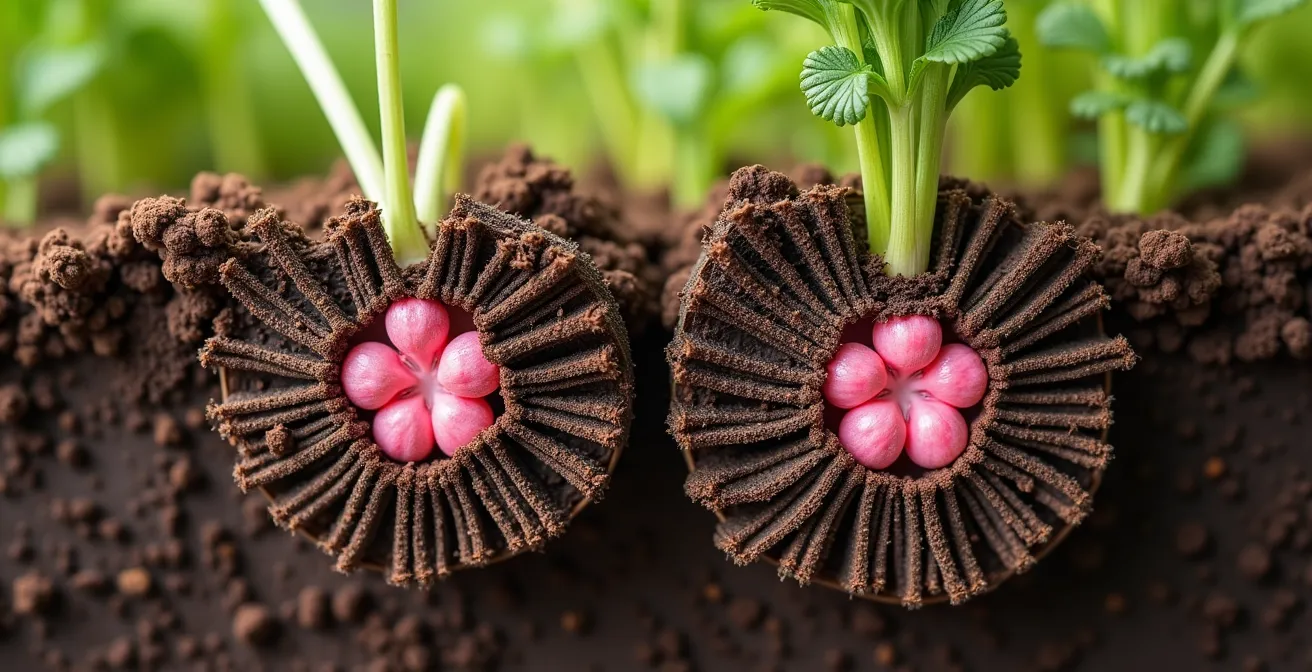
Aerated compost tea is one of the most misunderstood practices in organic gardening. It is often mistakenly promoted as a liquid fertilizer or a “compost extract.” In reality, its primary purpose is not to feed the plant but to act as a microbial inoculant. The goal is to brew a concentrated, living solution of beneficial bacteria, fungi, protozoa, and nematodes and apply it to plant surfaces and the soil. This massive influx of beneficial life works to prevent disease through the principle of competitive exclusion: by colonizing leaf surfaces, the “good” microbes leave no room and no food for pathogenic organisms to establish themselves.
As a leading soil microbiologist, Dr. Elaine Ingham, states, the function is clear. Her research at the Soil Food Web Institute has been foundational in this area:
Compost tea is not a fertilizer but a microbial inoculant whose goal is to colonize plant surfaces to prevent disease through competitive exclusion.
– Dr. Elaine Ingham, Soil Food Web Institute Research
The effectiveness of a compost tea is entirely dependent on the quality of the starting compost and the brewing process. A good tea is a living, breathing ecosystem. A bad tea—brewed too long, without enough oxygen, or from poor compost—is little more than a foul-smelling bacterial soup that can even be harmful. The brewing conditions can be tailored to select for different types of organisms. Adding simple sugars like molasses encourages a bacterial-dominant brew, which is ideal for annual vegetables. Adding more complex, carbon-rich food sources like ground oats or humic acid encourages a fungal-dominant brew, which is better suited for perennials, shrubs, and trees that thrive in a fungal soil environment.
Therefore, compost tea is not a magic elixir but a technical tool. It requires an understanding of the biology you are trying to foster. When brewed and applied correctly—within hours of brewing to ensure microbial viability—it can be a powerful, proactive tool for disease suppression. It is a supplement to, not a replacement for, the foundational work of building healthy soil with high-quality compost and organic matter.
The Monoculture Mistake That Invites Pest Swarms
Growing a large block of a single crop—a monoculture—is the agricultural equivalent of laying out a welcome mat for pests. In nature, plants grow in diverse communities. This diversity creates a complex landscape that confuses pests and supports a stable population of beneficial insects, spiders, and birds that prey on them. A monoculture, by contrast, is an unnaturally simplified system. It provides an uninterrupted, all-you-can-eat buffet for specialist pests that feed on that specific crop, allowing their populations to explode rapidly.
This simplified environment also lacks the necessary resources to sustain a healthy population of natural enemies. Without a variety of flowers providing nectar and pollen throughout the season, or different plant structures for shelter, beneficial insects cannot thrive. When a pest outbreak occurs, there is no resident “army” of predators to keep it in check. This forces the grower into a reactive cycle of intervention, whereas a diverse system has built-in, self-regulating resilience.
Breaking up monocultures is a cornerstone of advanced organic pest management. The strategy is to introduce diversity at multiple scales. This can be as simple as intercropping, where rows of different vegetables are planted side-by-side. For example, planting aromatic herbs like basil near tomatoes can help repel tomato hornworms. A more advanced approach is to establish dedicated “insectary” plantings—strips or patches of flowering plants like alyssum, dill, and yarrow that are specifically chosen to attract and support beneficial predators and parasitoids.
The difference in biodiversity is not trivial; it is a measurable ecological advantage. By moving away from the monoculture model, you are not just planting different things; you are actively building a more stable and resilient farm-scape. The data confirms that an average of 30% more species inhabit organic farms compared to conventional monocultures, and this increased biodiversity is a primary driver of natural pest control.
Straw vs Wood Chips: Which Mulch Feeds Fungi vs Bacteria?
Mulching is a fundamental organic practice, but treating all mulches as equal is a significant mistake. The type of mulch you choose actively steers the biology of your soil, favoring either a bacterial-dominant or a fungal-dominant ecosystem. This choice should be dictated by the type of plants you are growing. Annual vegetables and leafy greens thrive in soils dominated by bacteria, while perennials, shrubs, and trees prefer a fungal-dominated soil. This follows the natural pattern of ecological succession.
The determining factor is the material’s Carbon-to-Nitrogen (C:N) ratio. * Low C:N Mulches (e.g., Grass Clippings, Alfalfa): These materials are “green,” high in nitrogen, and break down quickly. They are a primary food source for soil bacteria, leading to a rapid release of nutrients. This makes them ideal for fast-growing, nitrogen-hungry annuals. * High C:N Mulches (e.g., Straw, Wood Chips): These “brown” materials are woody, high in carbon, and decompose slowly. They are the preferred food for soil fungi, which are the only organisms that can efficiently break down tough compounds like lignin and cellulose. This slow decomposition builds stable soil organic matter and creates the fungal environment that woody perennials love.
Using the wrong mulch can be counterproductive. Applying fresh, high-carbon wood chips around your annual vegetables can cause nitrogen immobilization. The fungi and bacteria working to decompose the wood chips will pull available nitrogen from the top layer of soil, temporarily starving your crops. Conversely, using only fast-decomposing bacterial foods like grass clippings around your fruit trees fails to build the long-term, stable fungal network those trees need for nutrient uptake and disease resistance.
This table, derived from data from Penn State Extension, clarifies how to match your mulch to your crop’s biological needs.
| Mulch Type | C:N Ratio | Dominant Microbes | Decomposition Rate | Best Use |
|---|---|---|---|---|
| Wheat Straw | 80:1 | Bacteria | 6-12 months | Annual vegetables |
| Wood Chips | 200-500:1 | Fungi | 2-4 years | Perennial fruits, trees |
| Grass Clippings | 20:1 | Bacteria | 2-4 weeks | Quick nitrogen boost |
| Pine Needles | 60-110:1 | Fungi | 12-24 months | Acid-loving plants |
Why Too Much Nitrogen Sacrifices Fruit for Green Leaves?
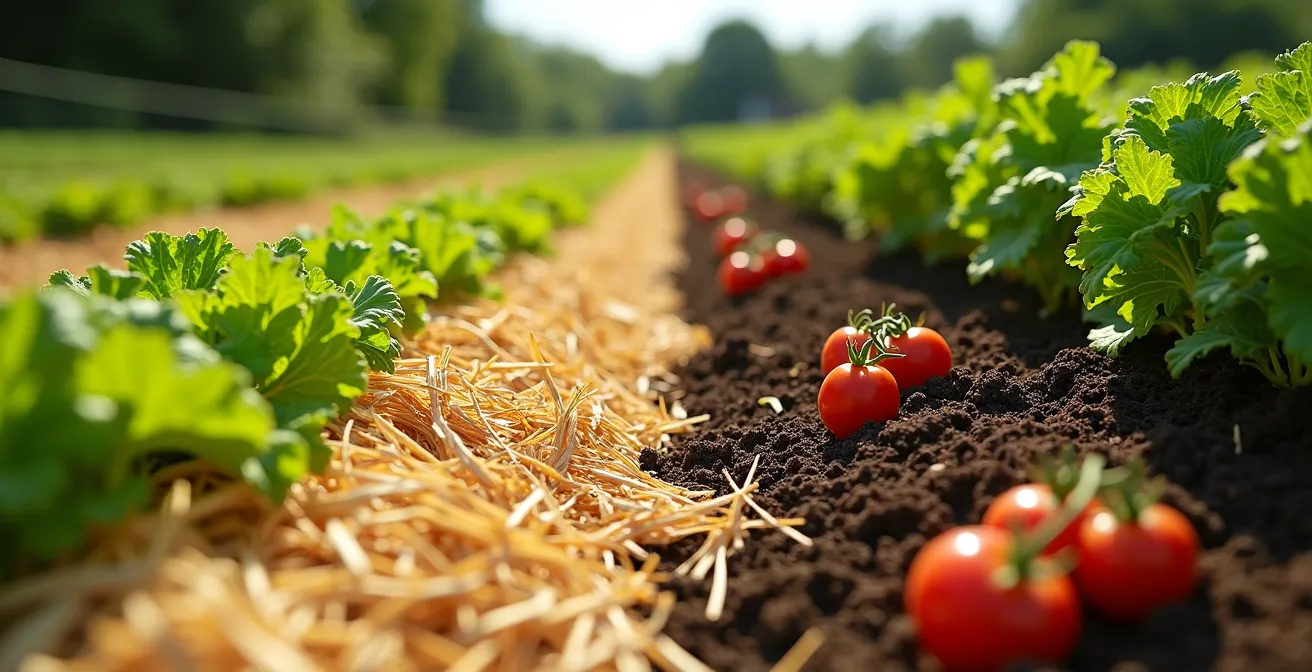
One of the most common frustrations for vegetable growers is a garden full of lush, beautiful green foliage but with very little fruit. This is a classic symptom of excessive nitrogen. Nitrogen is a primary driver of vegetative growth—the production of leaves and stems. When it is available in overabundance, particularly early in the season, it signals to the plant to invest all its energy into growing bigger, not into its reproductive cycle (flowering and fruiting).
Plants have a finite amount of energy, which they allocate based on environmental and hormonal cues. A heavy dose of high-nitrogen fertilizer essentially tricks the plant into “thinking” it needs to outcompete its neighbors for sunlight, leading to a frenzy of leaf production. This comes at the direct expense of producing flowers and, subsequently, fruit. The plant’s internal nutrient balance is also disrupted. An excess of nitrogen relative to other crucial nutrients like phosphorus (essential for energy transfer and flowering) and potassium (vital for fruit development and water regulation) throws the entire system out of whack.
The solution is not to eliminate nitrogen but to manage it strategically. This means providing sufficient nitrogen early on to establish a healthy plant structure, but then reducing the nitrogen supply and ensuring adequate phosphorus and potassium are available as the plant enters its flowering and fruiting stage. This is why building soil with balanced compost is superior to using high-nitrogen chemical fertilizers. Compost releases its nutrients slowly and in a more balanced ratio. Furthermore, building soil organic matter provides a powerful, long-term benefit; in fact, University of Missouri research shows potential for a 12% yield increase for every 1% increase in soil organic matter, due to improved nutrient and water holding capacity.
Action Plan: Balancing Nitrogen for Optimal Fruiting
- Test Before Planting: Always start with a soil test to establish your baseline nitrogen (N), phosphorus (P), and potassium (K) levels. Don’t guess.
- Split Applications: For heavy-feeding crops like tomatoes, apply roughly half of the required nitrogen pre-plant and the remainder as a side-dressing when the first fruits are about the size of a nickel.
- Monitor Ratios: Aim for a balanced N:P:K ratio in your amendments. A 3:1:2 ratio is a good general target for promoting both healthy growth and robust fruiting.
- Switch Inputs at Flowering: As plants begin to flower, transition from higher-nitrogen amendments (like blood meal) to those richer in potassium (like langbeinite or greensand) to support fruit set and development.
- Supplement Micronutrients: Use foliar sprays of calcium during fruit development, especially for tomatoes and peppers, to prevent blossom end rot, which is a calcium uptake issue often exacerbated by nutrient imbalances.
Pine Straw or Rubber Mulch: Which Is Truly Sustainable?
The choice between pine straw and rubber mulch highlights a fundamental divide in the philosophy of gardening. One is an active participant in the soil ecosystem, while the other is an inert, and potentially harmful, covering. True sustainability in the garden is not just about using recycled materials; it’s about supporting and participating in the natural life cycle of the soil food web.
Pine straw is a natural, organic material. As it slowly decomposes, it provides a steady food source for the fungal life in the soil, which is crucial for building stable soil structure. It contributes organic matter, helps maintain a slightly acidic pH favored by many plants, improves water retention, and moderates soil temperature. It is an active, beneficial component of the garden ecosystem. Its role aligns perfectly with the principles of sustainable horticulture, where every input should ideally contribute to the long-term health of the soil.
Case Study: Long-term Mulch Impact on Soil Biology
A multi-year comparison on organic farms provided a stark contrast. Garden beds using pine straw mulch maintained a visibly active soil food web, with abundant earthworms and fungal mycelium, and showed improved water retention year after year. The decomposing straw contributed an estimated 2-3% to soil organic matter annually. In stark contrast, beds covered with recycled rubber mulch became biological “dead zones.” After two years, there was virtually no earthworm or microbial activity directly beneath the rubber. Furthermore, soil tests indicated potential for zinc contamination from the leaching of chemicals from the rubber, creating an inert and potentially toxic environment for plant roots.
Rubber mulch, typically made from shredded tires, is marketed as a “permanent” and sustainable solution because it diverts waste from landfills. However, in a garden context, it is profoundly unsustainable. It does not decompose, so it adds no organic matter or nutrients to the soil. It creates an impenetrable barrier that smothers the soil, preventing air and water exchange and killing the microbial life beneath it. As noted by experts like Dr. Jeff Lowenfels, this inertness is its greatest failing.
A sustainable mulch must participate in the soil food web. Pine straw feeds the soil; rubber mulch is inert, creating a dead zone beneath it.
– Dr. Jeff Lowenfels, Teaming with Microbes
Therefore, from a systemic, soil-first perspective, the choice is clear. Pine straw is a truly sustainable option that builds soil health over time. Rubber mulch, despite its recycled origins, is an unsustainable practice that degrades the very foundation of a healthy garden.
Key Takeaways
- True organic yield comes from managing soil as a living system, not just avoiding chemicals.
- Strategic use of cover crops, mulch, and crop rotation actively steers soil biology and nutrient cycles.
- Understanding the C:N ratio of inputs is critical for controlling nutrient release and feeding the correct microbes for your crops.
How to Create Nutrient-Rich Soil Composition for Vegetable Gardens?
Creating nutrient-rich soil is not a one-time task but a continuous process of stewardship. It is the culmination of all the principles we have discussed: managing disease cycles through rotation, building nitrogen with cover crops, steering biology with mulch, and balancing nutrients for fruiting. The ultimate goal is to build a high level of stable soil organic matter (SOM). SOM is the dark, spongy, life-filled heart of fertile soil. It acts like a sponge, holding water and nutrients, and it provides the habitat and food for the entire soil food web.
A simple yet powerful framework for this process is the “Three M’s” approach: Microbes, Minerals, and Matter. * Matter: This is the foundation. You must ensure a constant flow of diverse organic materials. This includes leaving crop residues on the soil, applying compost, and maintaining a 2-3 inch layer of mulch (the *right* kind of mulch for your crops). * Microbes: High-quality compost is your primary source of a diverse microbial community. You can supplement this with compost teas or by inoculating your garden with a small amount of rich, healthy soil from a nearby forest to introduce native fungal species. * Minerals: While organic matter provides the major nutrients, soils can become depleted of essential trace minerals over time. An annual application of a broad-spectrum rock dust or mineral amendment (like azomite or greensand) helps to remineralize the soil, providing the dozens of trace elements plants need for robust health and disease resistance.
This systemic approach is gaining recognition globally as the key to sustainable food production. The growth is substantial, as the latest IFOAM report shows 96 million hectares under organic management globally, a massive increase that reflects a worldwide shift towards these soil-centric practices. By consistently applying these principles, you move from being a simple grower to a true soil ecosystem manager, creating a resilient, self-regulating, and highly productive garden for years to come.
Start implementing these systemic strategies today. Begin by testing your soil, planning a 3-year crop rotation, and selecting a cover crop for the upcoming off-season to transform your garden’s long-term health and productivity.