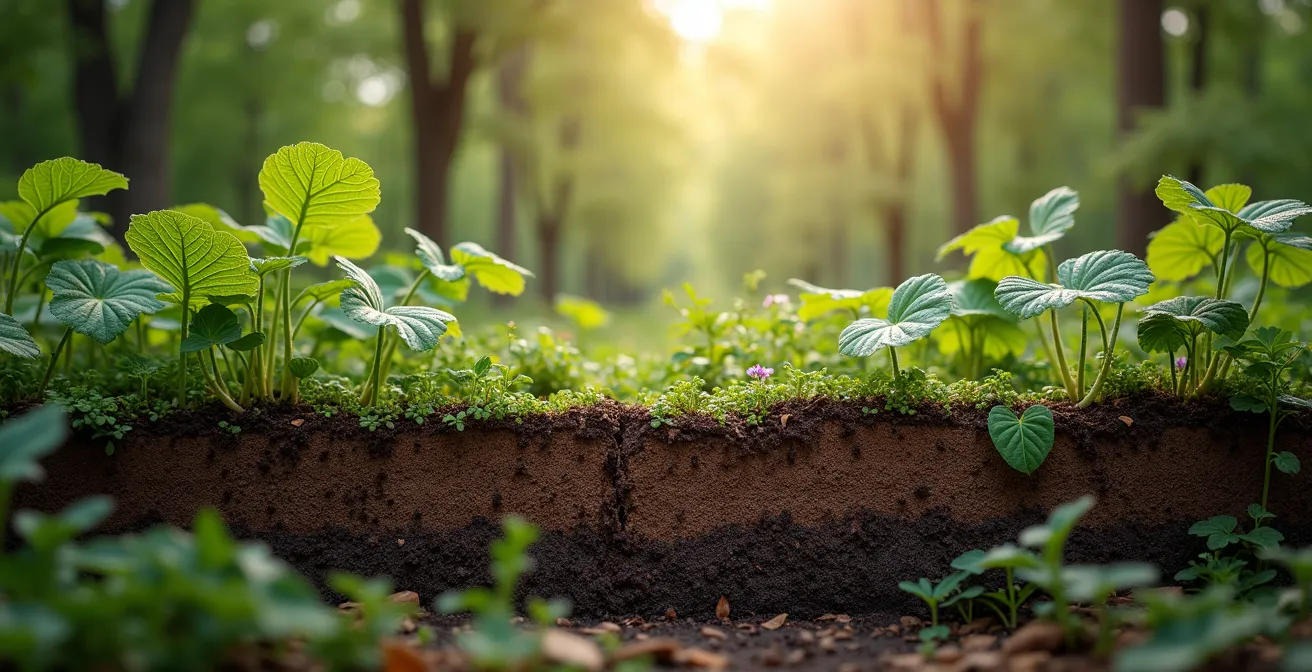
True regeneration isn’t about following a checklist of principles; it’s about healing your land by treating your soil as a living organism.
- Most permaculture guides focus on abstract designs, but the real work happens underground by building a “carbon sponge” that holds water and life.
- Common practices like the “Three Sisters” can fail without understanding your specific climate, and using fresh manure can do more harm than good if not properly composted.
Recommendation: Shift your focus from “building a garden” to “feeding your soil’s metabolism” with diverse organic matter, and your land will begin to heal itself.
As a landowner staring at degraded, tired soil, it’s easy to feel overwhelmed. You’ve likely heard about permaculture, a design philosophy promising a lush, self-sustaining paradise. Many guides will hand you a list of its 12 principles or show you abstract diagrams of zones and sectors. They’ll tell you to make compost, use mulch, and plant guilds. While this advice isn’t wrong, it often misses the most crucial element: the ‘why’. It treats your land like a schematic to be assembled rather than a living being to be healed.
The conventional approach scratches the surface. It might mention techniques like Hugelkultur or cover cropping, but rarely dives into the deep soil biology that makes them work. This leaves you applying techniques without understanding the context, leading to frustrating failures and the feeling that you’re just not “getting it.” The secret to transforming your property doesn’t lie in mimicking a design, but in kick-starting your soil’s own natural processes.
But what if the key wasn’t simply to apply principles, but to fundamentally change your perspective? What if you started thinking of your land not as a project, but as a patient? The true path to a regenerative environment is to become a soil doctor, focusing on restoring its vitality, its structure, and its metabolism. This guide abandons the generic checklist to focus on the powerful ‘why’ behind a few core permaculture-inspired actions. We will explore how to build a self-watering system from rotten wood, why a meadow is a more powerful carbon sink than a lawn, and how to avoid common mistakes that set back your progress.
This article provides a deep dive into the practical, soil-first strategies that create lasting regenerative change. Below is a summary of the key areas we will cover, each designed to give you the understanding needed to become a true steward of your land’s recovery.
Summary: A Soil-First Guide to a Regenerative Environment
- Why Burying Rotten Wood Creates a Self-Watering Garden Bed?
- Lawns vs Meadows: Which Landscape Captures More Carbon?
- Sunflowers or Mustard: Which Plant Cleans Heavy Metals From Soil?
- The “Three Sisters” Mistake: Why This Guild Fails in Cool Climates
- Cover Crops vs Mulch: Which Protects Bare Soil Better in Winter?
- Why Sending Leaves to the Landfill Is a Waste of Free Fertilizer?
- Why Adding Fresh Manure Can Burn Your Seedlings Instantly?
- How to Adopt Organic Horticultural Practices for Higher Vegetable Yields?
Why Burying Rotten Wood Creates a Self-Watering Garden Bed?
The permaculture technique known as Hugelkultur, which translates to “hill culture,” seems counterintuitive. Why would you bury a pile of old logs and branches under your best topsoil? The answer lies in transforming that decaying wood into a massive, underground sponge. As the wood decomposes, its porous, cellular structure becomes exceptional at absorbing and retaining water. During a heavy rain, this woody core soaks up excess moisture, preventing your garden bed from becoming waterlogged. Then, during dry spells, it slowly releases that stored water back into the root zone, creating a remarkably resilient, self-irrigating system.
This process is about more than just water. The slow decomposition of the wood provides a steady, long-term food source for a vast web of soil life, particularly fungi. These fungi form a symbiotic relationship with plant roots, creating a “microbial bridge” that unlocks nutrients locked in the wood and soil. The wood breaks down into rich, stable humus, which is the foundation of fertile soil structure and a powerful form of carbon sequestration. Instead of just a pile of dirt, you are building a living, breathing soil metabolism engine that can sustain itself for years, even decades, with minimal external inputs. It’s a perfect example of turning a “waste” product—fallen branches and rotting logs—into the cornerstone of a thriving ecosystem.
Action Plan: Building Your Hugelkultur Foundation
- Step 1: Dig a shallow trench about 12-18 inches deep where you plan to build your bed.
- Step 2: Fill the bottom of the trench with the largest, most-rotted logs and branches. This forms the primary carbon foundation.
- Step 3: Add a nitrogen-rich “activator” layer on top of the logs. Fresh grass clippings, kitchen scraps (no meat or dairy), or aged manure work perfectly to kick-start decomposition.
- Step 4: Layer smaller woody debris like twigs, wood chips, and leaves on top of the nitrogen layer.
- Step 5: Cover the entire mound with a final 4-6 inch layer of a good quality topsoil and compost mix. This is your planting medium.
Lawns vs Meadows: Which Landscape Captures More Carbon?
The immaculate, green lawn is a symbol of suburbia, but from a soil health perspective, it’s often a biological desert. The shallow root systems of common turf grasses do little to build deep soil structure. In contrast, a perennial meadow, with its diverse mix of grasses, wildflowers, and native plants, is a carbon-capturing powerhouse. The key difference lies beneath the surface. Meadow plants develop deep, extensive root systems that can plunge many feet into the earth. These roots create channels for air and water, and when they die back, they leave behind precious organic matter deep in the soil profile.
This process builds a resilient “carbon sponge.” Research confirms that landscapes with deep-rooted perennial plants are far more effective at this than conventional lawns. In fact, studies show that diverse ecosystems can store 3-8 times more carbon than lawn grasses, pulling it from the atmosphere and locking it safely underground. This deep carbon deposit dramatically improves soil structure, water retention, and nutrient availability. A meadow isn’t just a “wild” or “messy” alternative to a lawn; it is a high-performance ecosystem actively working to heal the soil, support pollinators, and build climate resilience right on your property.
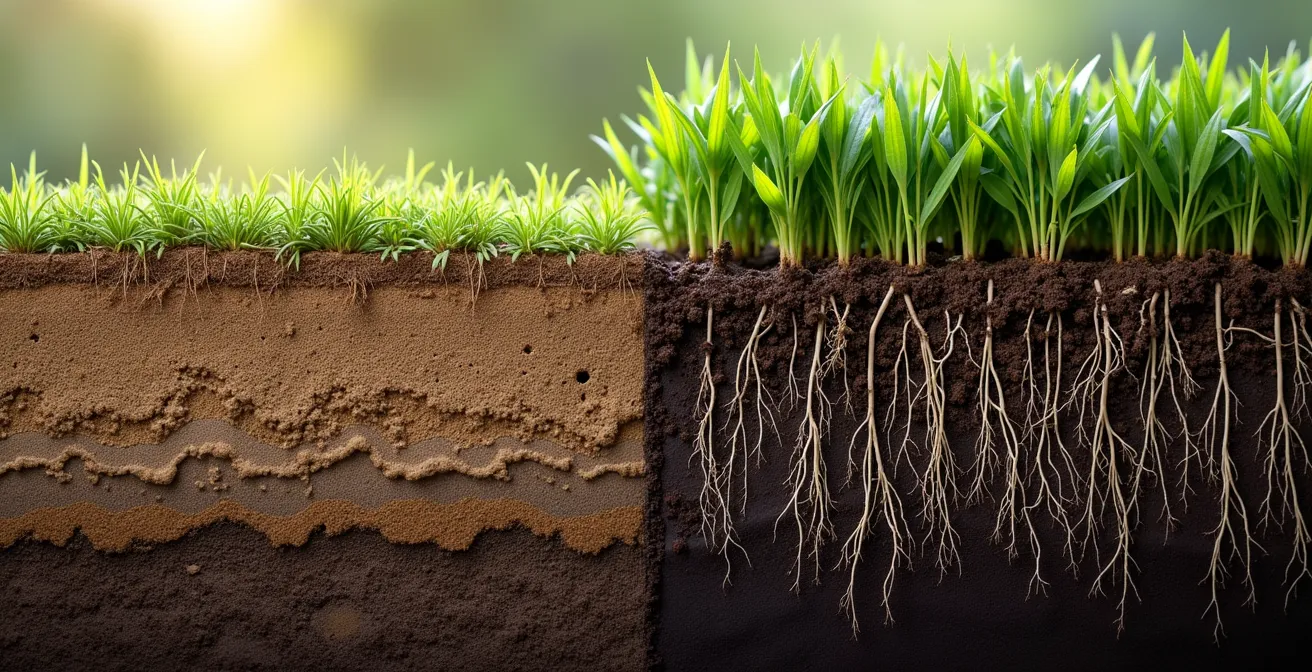
As the illustration shows, the structural difference is stark. While the lawn’s roots barely scratch the surface, the meadow’s roots are actively building a deep, dark, carbon-rich soil profile. Converting even a small portion of a lawn to a native meadow is one of the most impactful regenerative actions a landowner can take. It’s a shift from a high-maintenance, resource-intensive landscape to one that largely takes care of itself while actively restoring the earth beneath it.
Sunflowers or Mustard: Which Plant Cleans Heavy Metals From Soil?
For landowners dealing with a legacy of contamination—perhaps from past agricultural practices or industrial proximity—the soil can feel permanently broken. However, nature offers a remarkable solution called phytoremediation, the process of using living plants to clean up soil, air, and water. Certain plants, known as hyperaccumulators, have an incredible ability to draw up and store specific heavy metals and other toxins in their tissues, effectively pulling them out of the soil.
Both sunflowers and Indian mustard are famous for this ability, but they work on different contaminants and require careful management. Sunflowers are renowned for their capacity to absorb highly toxic elements like lead, arsenic, and even uranium from the soil, concentrating them in their leaves and stems. Indian mustard is also a powerful accumulator, particularly for cadmium, lead, and zinc. The crucial thing to understand is that these plants are not a “plant and forget” solution. Once they have done their job, the plant matter itself is considered hazardous waste and must be carefully removed and disposed of according to local regulations to prevent the toxins from simply re-entering the ecosystem. As the Permaculture Research Institute notes in “Advanced Soil Remediation Techniques”:
The combination of phytoremediation with mycoremediation using fungi like oyster mushrooms can break down complex toxins that plants alone cannot manage.
– Permaculture Research Institute, Advanced Soil Remediation Techniques
This highlights that cleaning soil is a complex biological process. The table below, derived from data in a comparative guide on regenerative practices, outlines the specializations of a few key phytoremediation plants.
| Plant Type | Mechanism | Metals Removed | Disposal Required |
|---|---|---|---|
| Sunflowers | Hyperaccumulation | Lead, Arsenic, Uranium | Yes – Hazardous waste facility |
| Indian Mustard | Biofumigant + Accumulation | Cadmium, Lead, Zinc | Yes – Special disposal |
| Willow Trees | Phytoextraction | Cadmium, Zinc, Copper | Yes – Controlled burning |
The “Three Sisters” Mistake: Why This Guild Fails in Cool Climates
The “Three Sisters”—a traditional Native American planting guild of corn, beans, and squash—is one of the most celebrated examples of permaculture-in-action. In theory, it’s a perfect symbiotic system: the corn provides a trellis for the beans, the beans fix nitrogen in the soil to feed the corn, and the sprawling squash shades the ground, suppressing weeds and conserving moisture. However, many enthusiastic gardeners in cooler regions have been left disappointed when this classic guild fails to thrive. The problem isn’t the concept of guilding, but a mismatch between the plants and the climate.
The primary culprit is the corn. Most varieties of corn are heat-loving plants that require a long, warm growing season. This is measured in “Growing Degree Days” (GDD), a metric that tracks heat accumulation. Climate data analysis reveals that corn needs between 2,100-3,000 Growing Degree Days (GDD) to mature properly. Many northern or high-altitude climates simply don’t provide this, often falling in the 1,500-2,000 GDD range. When the corn fails to grow tall and strong, the entire system collapses: the beans have nothing to climb, and without the corn’s shade, the soil can get too hot for the squash. This is a critical lesson in contextual ecology: a successful design in one biome can be a total failure in another. True permaculture isn’t about copying designs, but about understanding the underlying principles and adapting them to your unique environment.
Action Plan: Auditing Your Climate for Successful Guilds
- Climate Inputs: List all your key local climate factors: first and last frost dates, average GDD, typical rainfall patterns, and prevailing winds.
- Existing Species Inventory: Catalog the native plants and “weeds” that already thrive on your land. These are your best clues to what works in your microclimate.
- Needs vs. Reality: Cross-reference the specific needs of your desired guild plants (e.g., corn’s heat requirement) with your collected climate data. Be honest about what is and isn’t viable.
- Ecological Function Assessment: Evaluate if the guild’s purpose (e.g., groundcover, nitrogen-fixing) is being met, not just if it looks like a textbook example.
- Resilient Guild Design: Replace non-viable plants with climate-appropriate alternatives that serve the same function. For example, use tall sunflowers or Jerusalem artichokes instead of corn for a vertical element.
Cover Crops vs Mulch: Which Protects Bare Soil Better in Winter?
One of the foundational rules of regenerative agriculture is to “keep the soil covered.” Bare soil is a wound on the landscape, vulnerable to erosion from wind and rain, compaction from heavy downpours, and death to the microbial life that depends on stable conditions. The two primary tools for protecting this wound are mulch (a layer of dead organic matter like straw, wood chips, or leaves) and cover crops (living plants like rye, vetch, or clover grown to protect and enrich the soil).
So which is better for winter protection? The answer is: they serve different but complementary roles in feeding the soil’s metabolism. Mulch acts as a protective blanket. It physically shields the soil surface from the elements, insulates it from extreme temperature swings, and slowly breaks down to provide food for decomposer organisms like fungi and earthworms. It is a form of “passive” feeding for the soil.
Cover crops, on the other hand, are an “active” protection. Their living roots create a powerful network that holds the soil together, preventing erosion. More importantly, these living roots are constantly pumping out liquid carbon—sugars and proteins called root exudates—directly into the soil. These exudates are a primary food source for bacteria and fungi, keeping the soil microbiome alive and active even through the cold months. While mulch feeds the decomposers on the surface, living cover crops feed the microbial life in the root zone. A combination is often ideal: a living cover crop growing through a light layer of mulch provides the ultimate winter protection, combining a physical shield with an active, living root system.
Why Sending Leaves to the Landfill Is a Waste of Free Fertilizer?
Every autumn, a valuable resource rains down from the trees, and for many, the instinct is to rake it, bag it, and send it to the curb. This is a profound misunderstanding of the nutrient cycle. Those leaves are the tree’s way of returning borrowed minerals—calcium, magnesium, potassium—back to the earth. When sent to a landfill, this organic matter becomes a serious environmental problem. Deprived of oxygen in a packed landfill, the leaves undergo anaerobic decomposition, a process that produces methane, a potent greenhouse gas. In fact, environmental research confirms that leaves and other organic matter in landfills produce methane, a gas with a warming potential over 20 times that of carbon dioxide.
By keeping leaves on your property, you are not just preventing pollution; you are capturing a perfect, slow-release fertilizer and soil conditioner. The best way to process them is to create “leaf mold.” This is essentially a slow, cool composting process dominated by fungi. Unlike hot compost, which is bacterially driven, the fungal decomposition of leaves creates a superb soil amendment that is unparalleled for improving soil structure, water retention, and encouraging the beneficial mycorrhizal networks that are the foundation of a healthy soil food web. A pile of leaves is not waste; it is the primary ingredient for building the highest quality, fungal-dominated compost imaginable. It is the forest’s own method of regenerating soil, and we can easily replicate it.
Action Plan: Creating Fungal-Dominated Leaf Mold
- Step 1: Collect your fallen leaves in autumn. Shredding them with a lawn mower will speed up decomposition, but it isn’t necessary.
- Step 2: Pile the leaves in a simple wire bin or a shaded, out-of-the-way corner of your property.
- Step 3: Moisten the pile thoroughly. It should be damp like a wrung-out sponge, not soaking wet.
- Step 4: (Optional but recommended) To accelerate the process, inoculate the pile by adding a few handfuls of rich, dark soil from a healthy forest floor. This introduces the beneficial fungi.
- Step 5: Wait. After 6 to 12 months, you will have a dark, crumbly, and sweet-smelling soil amendment. Apply a 2-3 inch layer around perennial beds, fruit trees, and shrubs.
Why Adding Fresh Manure Can Burn Your Seedlings Instantly?
For any gardener focused on soil fertility, manure is liquid gold—but only when handled correctly. Applying fresh, uncomposted manure, especially from poultry or horses, directly to a garden bed can be disastrous for young plants. This “hot” manure is incredibly high in soluble nitrogen and salts. While plants need nitrogen, this overwhelming concentration acts like a chemical burn, scorching the delicate roots of seedlings and often killing them outright. This is the opposite of the slow, stable nutrient release we want for building healthy soil.
The solution is composting. The composting process is a managed decomposition that allows microbes to break down the volatile compounds in manure and transform them into a stable, balanced, and safe soil amendment. As expert Dr. Jake Mowrer of the Texas A&M Soil Science Department explains, there’s a critical health reason for this as well:
The thermophilic phase of proper composting reaching 131-160°F is essential not just for nutrient breakdown but for eliminating pathogens like E. coli and Salmonella.
– Dr. Jake Mowrer, Texas A&M Soil Science Department
Not all manures are created equal, however. Some, like those from rabbits or alpacas, are considered “cold” because they have a more balanced carbon-to-nitrogen ratio and can often be applied directly to the garden in moderation without risk of burning plants. Understanding this distinction is key to using this powerful resource effectively. The following table, based on information from a guide to permaculture principles, classifies common manure types.
| Manure Type | Nitrogen Level | Composting Required | Application Method |
|---|---|---|---|
| Chicken (Hot) | Very High (1.1% N) | Yes – 6+ months | Only after full composting |
| Horse (Hot) | High (0.7% N) | Yes – 3-6 months | Compost first or age |
| Rabbit (Cold) | Moderate (0.5% N) | Optional | Can apply directly in moderation |
| Alpaca (Cold) | Low (0.3% N) | No | Direct application safe |
Key Takeaways
- Your primary goal is to feed the soil’s living metabolism with diverse organic matter, not just to fertilize plants.
- Context is everything. A successful technique in one climate (like the Three Sisters) can be a failure in another if not adapted.
- “Waste” is a human concept. Fallen leaves, rotting wood, and properly managed manure are the most valuable resources for regenerating soil.
How to Adopt Organic Horticultural Practices for Higher Vegetable Yields?
A regenerative environment isn’t just about wild meadows and food forests; it can also be about producing high yields of nutrient-dense food from a vegetable garden. The key is to apply the same soil-first principles—minimal disturbance, constant soil cover, and high organic matter—to your annual beds. The goal is to move away from the cycle of tilling, which destroys soil structure and burns up organic matter, and toward methods that build soil health year after year.
This approach allows for more intensive planting because the soil is so fertile and resilient. When soil isn’t being constantly disturbed, the delicate fungal networks remain intact, earthworm populations explode, and the soil structure becomes beautifully aggregated and porous. This leads to healthier plants that are more resistant to pests and diseases, and it dramatically reduces weed pressure, as weed seeds are not constantly being brought to the surface by tilling. It creates a virtuous cycle where healthy soil grows healthy plants, which in turn contribute more organic matter back to the soil.
Case Study: Charles Dowding’s No-Dig Method
Market gardener Charles Dowding is a world-renowned proponent of the “no-dig” or “no-till” method. His long-term trials consistently show that his no-dig beds, which are topped with 2-4 inches of compost annually, produce yield increases of 20-30% compared to identical, traditionally cultivated beds. His method allows for denser planting and a near-elimination of weeding, as the compost mulch smothers annual weeds and the undisturbed soil doesn’t bring dormant seeds to the surface. This approach, as noted in the NCSU Extension Gardener Handbook, exemplifies how starting with a layer of organic matter and adding to it over time creates a system that works for continuous succession and higher productivity.
To maximize yields in this system, bio-intensive strategies can be employed. This involves using space as efficiently as possible through techniques like close hexagonal planting and vertical growing. By focusing on creating incredibly deep, rich soil in raised beds and then planting them intensively, you can achieve astonishing productivity from a very small footprint, all while continuously improving your most valuable asset: your soil.
Now that you understand the core, soil-focused strategies for healing your land, the next step is to integrate them into a cohesive, long-term vision. This is not about a single season’s success, but about setting in motion a multi-year process of regeneration. For this journey to succeed, it is crucial to revisit the foundational principle of treating your land as a living system. To put these ideas into practice, begin by selecting one or two of these methods and apply them to a small, manageable test area on your property.