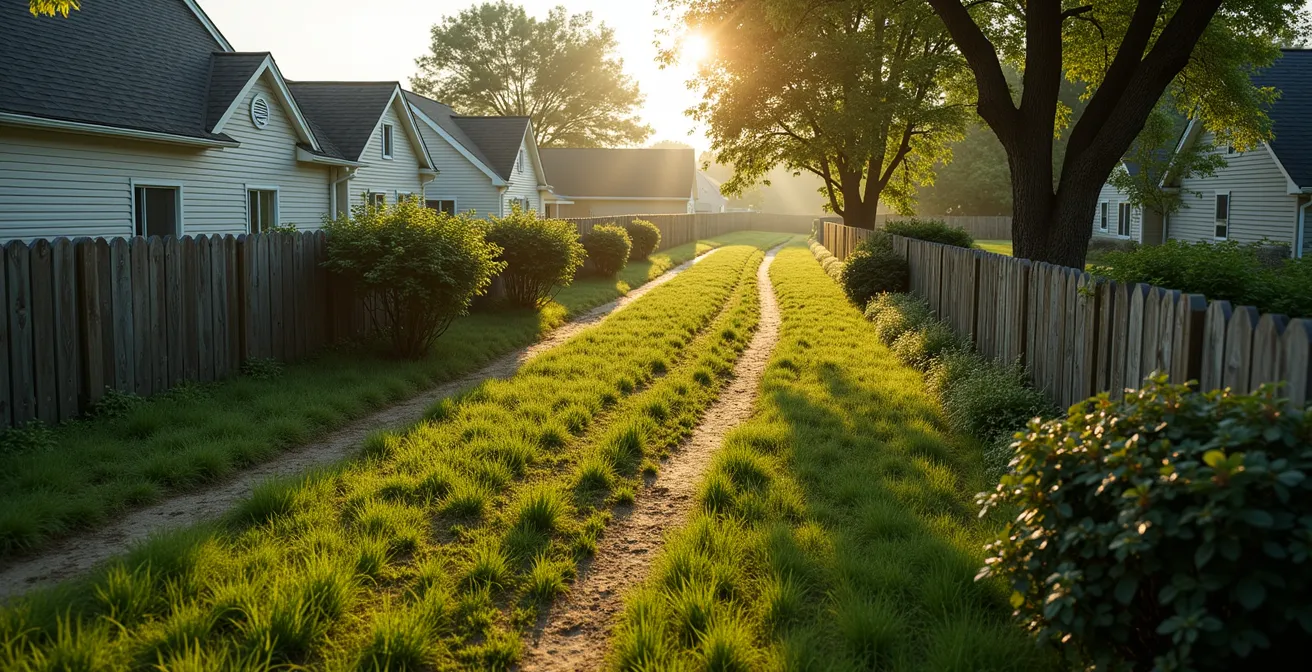
To truly help wildlife, think beyond random fence holes and native plants; success lies in designing a collaborative, multi-layered network that strategically connects your neighborhood.
- Effective corridors are systems, not single actions, addressing movement from the ground (hedgehogs) to the air (bats and squirrels).
- Small, science-based changes, like light color and mow height, have an outsized impact on whether your yard is a pathway or a barrier.
Recommendation: Start by mapping your neighborhood’s existing green spaces and identifying the single most impactful ‘first link’ you can create with a few willing neighbors.
Your neighborhood watches a hedgehog gingerly approach a fence, sniff along the impenetrable barrier, and turn back in defeat. You’ve all talked about helping, maybe even planted a few butterfly-friendly flowers. The common advice is simple: “cut holes in fences,” “plant native species,” or “let your lawn grow.” While well-intentioned, these isolated actions often fail to create meaningful change. They treat a systemic problem—habitat fragmentation—with a patchwork of temporary fixes.
The issue isn’t just a lack of food or shelter in any one yard; it’s the absence of safe passage between them. For a frog, a mowed lawn is a desert; for a bat, a security light is an invisible wall. But what if the key wasn’t just individual acts of kindness, but a coordinated strategy? What if your collection of private yards could be transformed into a functional, networked ecosystem? This is the core principle of enhancing habitat permeability—the ease with which wildlife can move through a landscape.
This guide moves beyond the basics. It’s a blueprint for your neighborhood group to stop thinking in terms of isolated backyards and start designing a collaborative, multi-species network. We will explore the precise science behind creating ground-level infrastructure for small mammals, arboreal superhighways for squirrels, and dark corridors for nocturnal flyers. You will learn not just what to do, but the ecological reasoning that makes these interventions powerful, transforming your suburb from a fragmented grid into a living, breathing landscape.
This article provides a detailed roadmap for transforming your neighborhood into a thriving wildlife network. The following summary outlines the key strategies we will cover, from creating safe passages to coordinating community efforts.
Summary: Creating a Network of Ecological Corridors
- Hedgehog Highways: How to Cut Fence Holes Without Losing Privacy?
- Why Squirrel Bridges Are Essential in Tree-Sparse Neighborhoods?
- Mowed Grass vs Wildflower Strip: Which Serves as a Better Migration Path?
- The Security Light Mistake That Blocks Bat Migration Routes
- How to Align Planting With Neighbors to Create a Continuous Hedge?
- The Boundary Mistake That Could Force You to Tear Down Your Fence
- How to Select Native Flowers That Feed Specific Local Bees?
- How to Preserve Local Biodiversity and Ecosystems in a Manicured Lawn?
Hedgehog Highways: How to Cut Fence Holes Without Losing Privacy?
The concept of a “hedgehog highway” is the cornerstone of creating ground-level habitat permeability. It’s a simple, powerful idea: small, 13x13cm holes at the base of garden fences allow hedgehogs, toads, and other ground-dwelling creatures to roam freely in search of food, mates, and shelter. However, the primary concern for homeowners is often privacy and aesthetics. The solution lies in strategic implementation, not just random hole-cutting. As a successful village project in the UK demonstrated, residents can create vast, interconnected corridors while maintaining complete privacy. Their method involved standardizing hole sizes and using strategic plantings or decorative covers to conceal the openings.
To address concerns about attracting unwanted visitors like rats, placement is key. Holes should be cut in areas away from compost bins or bird feeders. Keeping these areas clean and free of spilled food is standard good practice and will ensure you’re primarily helping your intended species. The goal is to create ground-level infrastructure that is both functional for wildlife and discreet for homeowners. Consider these practical steps:
- For Hedgehogs and toads: A 13x13cm hole at ground level is the gold standard.
- For smaller mammals like voles and shrews: A 10x10cm gap left under a fence panel often suffices.
- For privacy: Position holes in corners, behind established shrubs, or install small wooden tunnels that act as a visual baffle. A simple brush pile placed over the opening on either side provides both a privacy screen and valuable shelter.
By treating these small gaps with the same design consideration as any other garden feature, you can build a network that is effective for wildlife without compromising the human enjoyment of the space. It’s a classic example of how a small, coordinated change can have a massive ecological impact.
Why Squirrel Bridges Are Essential in Tree-Sparse Neighborhoods?
While ground-level corridors are vital for many species, we must also look up. In many suburbs, mature trees that once formed a continuous canopy have been replaced by roads and sparse ornamental plantings. For arboreal species like squirrels, this creates deadly gaps, forcing them to the ground where they are vulnerable to predators and vehicles. In fact, wildlife-vehicle collisions make up nearly 20% of reported crashes in some rural areas, a problem that echoes in suburban landscapes.
This is where “arboreal superhighways” become essential. A squirrel bridge—often a simple, sturdy rope or a specially designed ladder—can reconnect fragmented tree canopies, providing a safe crossing over a road or a wide, treeless expanse of lawn. These structures are more than just a novelty; they are critical infrastructure for an entire class of wildlife that experiences the world vertically. They prevent genetic isolation in local squirrel populations and directly reduce road mortality.
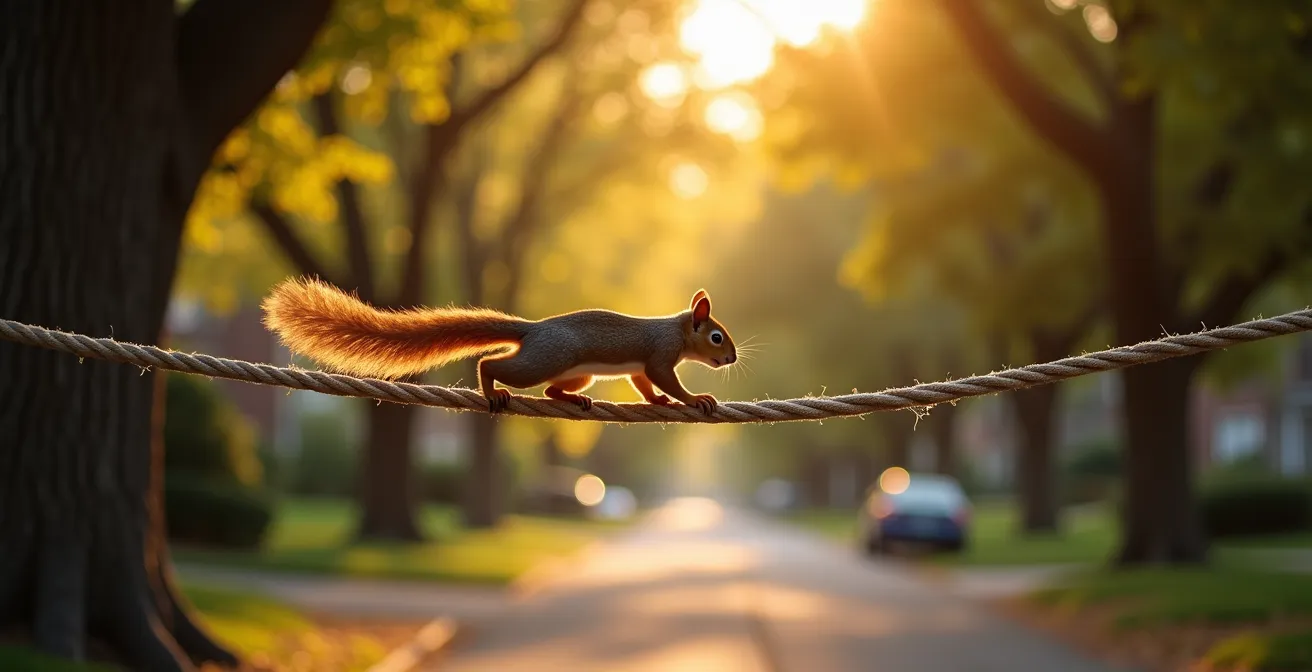
As you can see, the solution doesn’t have to be complex. A well-placed rope bridge becomes an integral part of the ecosystem. The key is to identify the most dangerous crossing points in your neighborhood—often where a line of mature trees is broken by a driveway or street—and work with homeowners on either side to install a bridge. This collaborative effort ensures the networked ecosystem extends from the ground to the treetops, creating a truly three-dimensional corridor for all residents, furry or otherwise.
Mowed Grass vs Wildflower Strip: Which Serves as a Better Migration Path?
The traditional suburban lawn is often described as a “green desert.” While aesthetically pleasing to some, a closely mowed, monoculture grass lawn offers virtually no food or shelter for wildlife. For a small mammal, insect, or amphibian, attempting to cross it is a perilous journey, exposing them to predators and heat stress. A wildflower strip, by contrast, is a bustling metropolis. It’s a dense, cool, and humid environment teeming with life, providing both a pantry and a protected highway. The difference is not trivial; it’s a matter of ecological orders of magnitude.
The data is stark. Recent Cambridge University research demonstrates that insect biomass was 25 times higher in wildflower areas compared to mown lawns. This explosion of insect life forms the base of the food web, supporting birds, amphibians, and small mammals. For those worried a “wild” strip will look messy, the key is intentionality. A well-defined, managed wildflower strip with mown edges looks deliberate and beautiful, signaling care rather than neglect. It becomes a designed feature, not an overgrown patch.
This comparative table clearly illustrates the superior function of a wildflower strip as a wildlife corridor. It’s not just a path; it’s a complete life-support system.
| Feature | Mowed Lawn | Wildflower Strip |
|---|---|---|
| Ground Temperature | High (heat stress) | Cool & humid |
| Insect Abundance | Baseline | 362% increase |
| Small Mammal Movement | Exposed/dangerous | Protected corridors |
| Pollinator Diversity | Limited | 195.5% increase |
| Maintenance Frequency | Weekly mowing | Twice yearly cutting |
By encouraging neighbors to convert even a one-meter-wide strip of their lawn—especially along a shared fence line—you create a continuous, resource-rich corridor. This single change can do more to boost local biodiversity than almost any other action.
The Security Light Mistake That Blocks Bat Migration Routes
While we focus on physical barriers like fences, we often overlook the invisible walls we create with light. For nocturnal species like bats and moths, a single bright, cool-white security light can be as impassable as a brick wall. This is a core concept of sensory ecology: understanding that different species perceive the world in fundamentally different ways. Bright, upward-facing lights cause light pollution that disorients migrating birds and fragments the night sky for bats, forcing them into longer, more dangerous routes to find food.
As Jeremy Romero of the National Wildlife Federation points out, the effect is profound. He states that “a single bright, upward-facing security light creates a virtual ‘wall’ that fragments the sky, forcing bats into longer, more dangerous foraging routes.” The good news is that making your lighting bat-friendly doesn’t mean plunging your neighborhood into darkness. It’s about being smart with light: using the right color, the right direction, and only when necessary. This is one of the most cost-effective and immediate ways to improve your neighborhood’s habitat permeability for nocturnal wildlife.
Your neighborhood group can advocate for these simple, bat-friendly lighting solutions:
- Switch Bulb Color: Use amber or red LED bulbs with a color temperature below 2700K. These wavelengths are less disruptive to most nocturnal animals.
- Use Motion Sensors: Instead of constant “dusk-to-dawn” lighting, install motion sensors with short timers (e.g., 30 seconds). This provides security when needed without creating a permanent barrier.
- Direct the Light Down: Install directional hoods or shields on all outdoor fixtures to prevent light from spilling upwards and sideways, keeping flight corridors dark.
- Lower the Lights: Position lights below 3 feet in height for pathways. This illuminates the ground for humans while preserving the dark sky above for bats.
By adopting these practices, you reclaim the night sky for wildlife, dismantling the “virtual walls” and restoring critical nocturnal corridors.
How to Align Planting With Neighbors to Create a Continuous Hedge?
A single, beautifully planted native garden is an oasis. A continuous, interconnected corridor of native hedges planted across multiple properties is a functioning ecosystem. The difference in scale and impact is immense. The goal of collaborative planting is to link these oases together, creating a “hedgerow highway” that provides food, shelter, and a protected travel lane for countless species. The challenge, as with any community project, is coordination. It requires a strategic approach that goes beyond simply telling people to “plant natives.”
The success of large-scale projects like the Florida Wildlife Corridor, which connects nearly 18 million acres, is built on this very principle of collaborative effort between neighbors. On a suburban scale, this means agreeing on a shared vision and a few key “anchor species” that will form the backbone of the hedgerow. The goal isn’t for everyone to have identical yards, but for the edges of the yards to connect seamlessly. Establishing a shared one-meter “biodiversity zone” on each side of a property line can create a two-meter-wide corridor without any homeowner feeling they’ve lost their entire yard.
Starting this conversation can be the hardest part. A practical, step-by-step strategy is essential to build momentum and trust within the neighborhood group.
Action Plan: Forging a Neighborhood Hedge Corridor
- Mapping the Gaps: Create a simple, shared map of the neighborhood, marking existing mature trees, hedges, and green spaces. This visualizes the ‘low-hanging fruit’—the easiest connections to make first.
- The Anchor Plant Gift: Start by identifying 2-3 hardy, beneficial native anchor plants (e.g., a specific viburnum or dogwood). Gifting these starter plants to interested neighbors is a powerful, low-pressure way to begin.
- Propose the ‘Biodiversity Zone’: Introduce the idea of a shared 1-meter zone on each side of the property lines, dedicated to creating a continuous, connected planting.
- Organize Plant Swaps: Host seasonal neighborhood plant swaps. This builds community, reduces costs, and encourages the sharing of successful local species.
- Coordinate via Shared Tools: Use a simple social media group or a shared document to coordinate species selection, ensuring a mix of plants that provide food and shelter throughout the year.
By approaching the project with a clear strategy, you move from a collection of individual gardens to the co-creation of a vital, living network.
The Boundary Mistake That Could Force You to Tear Down Your Fence
In the enthusiasm to create lush, green corridors, it’s crucial to respect the legal and practical realities of property boundaries. A poorly planned planting can lead to neighborly disputes, or worse, legal action. The most common and costly mistake is planting too close to a property line without considering the plant’s mature size. A small sapling planted a foot from a fence can grow into a large tree whose trunk pushes over the fence or whose roots crack a neighbor’s foundation. This isn’t just a nuisance; it can be considered property encroachment.
The same applies to aggressive or invasive species. As RSPB wildlife gardening expert Adrian Thomas warns, “Planting invasive species near a boundary line is a form of property encroachment – their root systems or runners can cross boundaries, causing legal and ecological nightmares.” Therefore, a core part of your neighborhood strategy must be education on responsible planting. The goal is to create biodiversity, not legal battles. A “right plant, right place” mantra is essential for the long-term success and sustainability of your wildlife corridor project.
Adhering to some simple guidelines can prevent 99% of potential issues and ensure the corridor remains a source of pride, not conflict. Before any major planting, community members should be aware of these best practices:
- Respect Setbacks: Maintain a minimum 1-meter setback from property lines for large shrubs and a 3-meter distance for trees with a mature spread over 5 meters.
- Plan for Access: Always leave a maintenance gap of at least 45cm between your plantings and your fence. This allows you to repair or replace the fence without having to destroy the hedge.
- Avoid Invasive Species: Completely avoid planting known invasive species (like bamboo or English ivy in some regions) within 2 meters of any boundary.
- Document and Share: Before installation, create a simple sketch of your planting plan, document the locations, and share it with your immediate neighbors. This transparency builds trust and prevents future misunderstandings.
By integrating these rules into your group’s planning, you ensure that the ecological network you’re building is resilient, respectful, and built to last.
How to Select Native Flowers That Feed Specific Local Bees?
The advice to “plant native flowers” is a great start, but to truly elevate your corridor’s ecological function, you need to be more specific. Why? Because many of our most vital pollinators are specialists. Unlike generalist honeybees that can forage on many flower types, specialist native bees often depend on the pollen of a single plant family or genus to feed their young. When these specific native plants disappear, the specialist bees that rely on them disappear too. Your neighborhood corridor can become a critical refuge for these vulnerable species by intentionally planting what they need.
This isn’t just a theory; the impact is measurable and significant. Recent agricultural landscape studies reveal that wildflower strips with over 50 native species increased specialist solitary bee diversity by a staggering 195%. Furthermore, their reproductive success shot up by 78% compared to areas with non-native plantings. This shows that diversity and local adaptation are key. A generic “wildflower mix” from a big-box store might not contain the specific plants your local bees need.
So, how do you choose the right ones? The first step is to move beyond the general “native” label and ask more targeted questions. A great strategy for your group is to:
- Identify Local Specialists: Use online resources from local university extension programs, native plant societies, or the Xerces Society to identify 2-3 specialist bee species in your specific region (e.g., Squash Bees, Blueberry Bees, or certain Mason Bees).
- Match the Plants: The same resources will list the specific native plants these bees co-evolved with. For Squash Bees, this means planting any variety of squash, pumpkin, or gourd. For others, it might be specific species of sunflowers, asters, or penstemons.
- Plant in Drifts: Bees are more likely to find and use a large, dense patch of their preferred flower than single, scattered plants. Encourage neighbors to plant in “drifts” of at least one square meter.
By focusing on these specific relationships, your neighborhood corridor transforms from a generic “bee-friendly” space into a high-fidelity conservation project actively supporting the most at-risk local pollinators.
Key takeaways
- Creating effective wildlife corridors is a system-level design project, not a series of isolated actions.
- Success requires a multi-layered approach, considering ground-level, arboreal, and nocturnal pathways.
- Strategic collaboration with neighbors, guided by clear plans and shared goals, is the single most critical factor for scaling impact.
How to Preserve Local Biodiversity and Ecosystems in a Manicured Lawn?
The vast expanse of the American lawn represents one of the biggest challenges—and opportunities—for suburban biodiversity. For many homeowners, the idea of converting their entire lawn into a wild meadow feels too extreme. However, preserving biodiversity doesn’t have to be an all-or-nothing proposition. There are powerful, intermediate steps that can transform a sterile green carpet into a living, breathing part of the local ecosystem while still maintaining a “lawn” appearance. This approach is gaining traction; National Wildlife Federation data shows the number of people planning to convert lawn to native landscape doubled in just two years.
One of the most effective strategies is the “Freedom Lawn” or “Clover Lawn” concept. As a case study in several urban areas showed, homeowners can dramatically boost their lawn’s ecological value by simply overseeding their existing turf with White Dutch Clover. The clover, a nitrogen-fixing plant, acts as a natural fertilizer, reducing the need for chemical inputs. Its flowers provide a crucial food source for a wide variety of pollinators, yet it can be mowed just like regular grass, maintaining a tidy appearance.
The results of this simple change are impressive: homeowners who integrated clover reduced their water usage by 30%, eliminated fertilizer needs entirely, and saw pollinator visits increase by 400%. Other simple strategies include:
- Mowing Higher: Simply raising your mower blade to 3-4 inches allows small ground flowers like violets and self-heal to bloom between mowings, providing resources for small pollinators.
- Reducing Mowing Frequency: Mowing every two weeks instead of every week can dramatically increase bee abundance and floral diversity.
- Leaving the Leaves: In autumn, mulching leaves into the lawn with a mower instead of bagging them returns nutrients to the soil and provides crucial overwintering habitat for butterfly larvae and other insects.
By promoting these less-intensive lawn care strategies, your neighborhood group can help residents find a comfortable middle ground, turning the largest single “habitat” in your suburb into a more productive part of the networked ecosystem.
Your neighborhood now has the blueprint to move from isolated yards to a connected, thriving ecosystem. The next step is to take this knowledge and turn it into collective action. Start by sharing this guide and organizing a meeting to map your neighborhood’s green assets and identify your first, most achievable connection project.