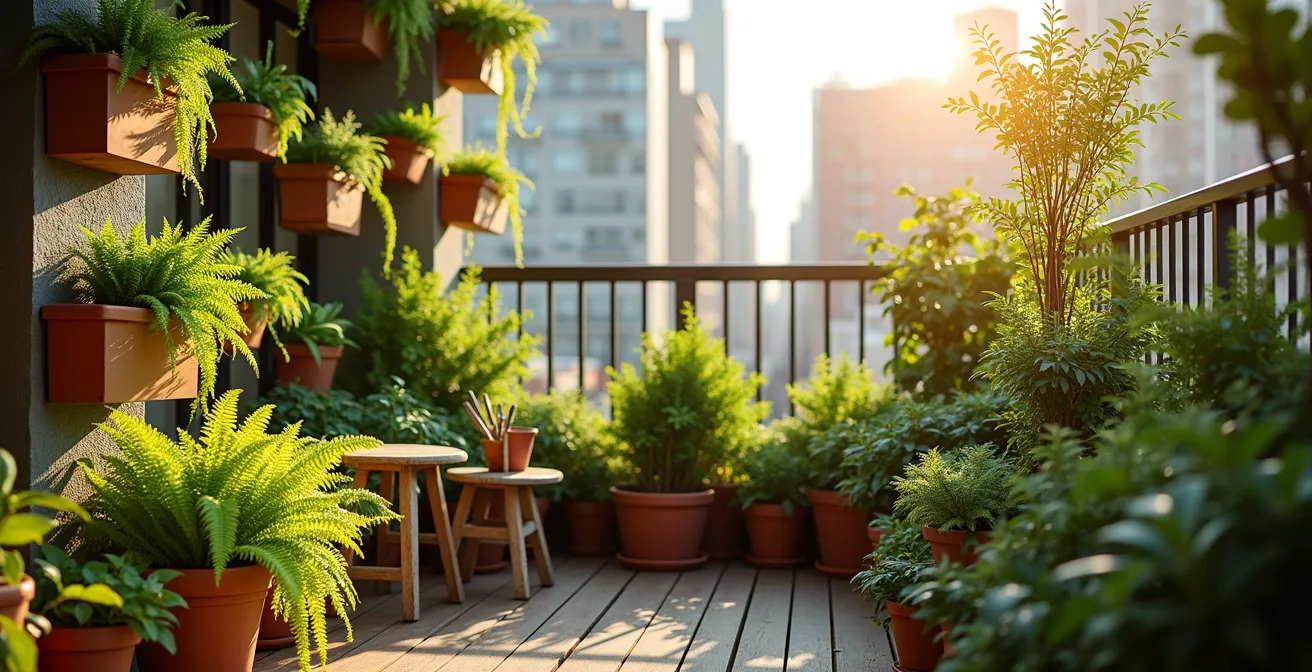
Contrary to popular belief, biophilic design isn’t just about adding a few decorative plants; it’s about systematically engineering a personal ecosystem to achieve measurable psychological and physiological benefits.
- Effective biophilia in urban settings prioritizes function over form, using plants as tools to manage air quality, sound, and sensory input.
- The key is maximizing “biomass density” and creating multi-sensory experiences, even in the smallest spaces like a balcony or desk.
Recommendation: Shift your mindset from “owning plants” to “deploying a natural system,” starting with a clear goal like improving air in your breathing zone or creating a sound buffer.
For the millions living in concrete jungles, the feeling of a “nature deficit” is a palpable, daily reality. A persistent disconnect from the natural world can leave us feeling stressed, unfocused, and drained. The common advice is simple: buy a houseplant. While well-intentioned, this barely scratches the surface. Traditional biophilic design often conjures images of sprawling corporate atriums or homes with vast gardens, leaving apartment dwellers and office workers feeling that a true connection to nature is a luxury they cannot afford.
The conversation usually revolves around three pillars: incorporating direct nature (plants, water), using natural analogues (wood grain, earthy colors), and enhancing the nature of the space (creating prospect and refuge). But for those without a garden, these concepts can feel abstract. We are told to add a fiddle-leaf fig to a corner, but what does that one plant truly accomplish against the backdrop of city noise and recycled air? This approach treats nature as decoration, a static object in a room.
But what if the solution wasn’t just about adding a plant, but about engineering a functional ecosystem? The real power of biophilia for the urbanite lies in a radical shift in perspective: from passive aesthetics to active, strategic environmental design. It’s about using living organisms as a high-performance technology to manipulate your immediate surroundings. This isn’t about simply having nature; it’s about making nature *work for you*.
This guide will deconstruct how to move beyond decorative greenery and build a functional biophilic system. We will explore how to maximize plant life on a tiny balcony, use vegetation to actively manage noise and air quality, and design a multi-sensory environment that directly targets anxiety and boosts mental wellness, proving that you don’t need a backyard to cultivate a profound connection with the natural world.
To help you navigate these advanced concepts, this article breaks down the core strategies for engineering your personal urban oasis. The following sections will guide you through practical applications, from your balcony and office to your own sensory well-being.
Summary: A Practical Guide to Urban Biophilic Engineering
- Pots or Vertical Systems: Which Maximizes Biomass on a Tiny Balcony?
- Why Community Gardens Reduce Neighborhood Crime Rates?
- Green Roof or Container Garden: Which Is Feasible for an Old Building?
- Bamboo or Conifers: Which Plants Block Traffic Noise Best?
- Desk Plants or Green Walls: Which Boosts Employee Productivity More?
- Real Plants vs High-Quality Faux: Which Truly Lowers Cortisol Levels?
- How to Arrange Plants to Create a Localized Clean Air Zone?
- How to Design a Sensory Garden to Reduce Anxiety and Boost Mental Wellness?
Pots or Vertical Systems: Which Maximizes Biomass on a Tiny Balcony?
For an apartment dweller, the balcony is prime real estate. The goal here isn’t just to have a few pretty flowers; it’s to maximize biomass density—the total volume of living plant matter in a limited area. More biomass translates to greater environmental benefits like air filtration, humidity regulation, and a stronger visual connection to nature. While traditional pots are a good start, they are inherently limited by floor space. To truly transform a small balcony, you must think vertically.
Vertical systems are designed to make the most of unused wall space, fundamentally changing the equation of urban gardening. These systems can take many forms, from stacked planters and wall-mounted pockets to sophisticated hydroponic towers. Their primary advantage is unparalleled space efficiency. Research shows that it’s possible to cultivate up to 50 plants in just 4 square feet of floor space using a vertical tower, a density impossible to achieve with conventional pots. This concentration of life creates a “living wall” effect that offers a powerful immersive experience.
This approach moves beyond simple container gardening to mimic the layered canopy of a forest, creating a true micro-habitat. The comparison below, based on an analysis of different urban greening techniques, highlights the strategic advantages of going vertical.
| Feature | Traditional Pots | Vertical Systems |
|---|---|---|
| Space Efficiency | Limited to floor area | Uses vertical wall space |
| Plant Density | 5-10 plants per sq meter | Up to 50 plants in 4 sq ft |
| Maintenance | Daily watering needed | Weekly with drip irrigation |
| Biodiversity Support | Single layer planting | Multi-layer canopy mimicry |
| Cost | $10-50 per container | $20-100 for DIY systems |
Ultimately, while pots offer simplicity, vertical systems are the superior choice for anyone serious about engineering a high-impact biophilic environment on a tiny balcony. They represent a strategic investment in biomass, turning a forgotten wall into a thriving ecosystem.
Why Community Gardens Reduce Neighborhood Crime Rates?
Biophilic design isn’t confined to the four walls of your apartment; it extends into the community. For those without private outdoor space, community gardens offer a powerful way to engage with nature. But their benefits go far beyond fresh vegetables. A growing body of evidence shows that these green spaces actively contribute to social cohesion and can lead to a measurable reduction in crime. This happens because a garden is not a passive park; it is a space that demands active participation and shared stewardship.
The key lies in the concept of “eyes on the street” and increased community engagement. A neglected vacant lot invites illicit activity, whereas a vibrant community garden brings residents outdoors, fostering positive social interactions and informal surveillance. This process transforms anonymous neighbors into collaborators with a shared stake in their environment. As biophilic design pioneer Stephen Kellert noted, the benefits stem from a change in behavior.
Biophilic Activities refers to the increased amount of time spent outside and visiting parks, longer outdoor periods at schools, improved foot traffic across the city, improved participation in community gardens and conservatory clubs.
– Stephen Kellert, Biophilic Design Framework
By creating a hub for these activities, community gardens build social capital. This strengthens the neighborhood’s collective efficacy—its ability to self-regulate and maintain public order. However, it’s crucial to approach urban greening with awareness of its potential downsides. The very desirability of these green spaces can lead to “green gentrification,” where rising property values and an 11% rent increase in greening areas can displace long-term, lower-income residents. Therefore, successful community greening projects must be implemented with equity in mind, ensuring the benefits are shared by all.
Green Roof or Container Garden: Which Is Feasible for an Old Building?
For residents of older buildings, the dream of a rooftop oasis often clashes with the reality of structural limitations and regulations. While a full-fledged green roof is the gold standard for urban greening, offering incredible insulation, stormwater management, and aesthetic benefits, it is often an impractical solution for existing, older structures. The immense weight of saturated soil, membranes, and vegetation can exceed the load-bearing capacity of a roof not originally designed for it. For this reason, a modular container garden emerges as the far more feasible and adaptive strategy.
Unlike a monolithic green roof, a container garden consists of individual pots, troughs, and raised beds. This modularity offers several key advantages for old buildings. Firstly, the weight is distributed and can be concentrated over structural supports like load-bearing walls. Secondly, it allows for a gradual, scalable approach. You can start small and expand over time. Thirdly, it’s non-permanent and can be adapted or removed without altering the building’s structure, a critical factor for renters or buildings with strict co-ownership bylaws.
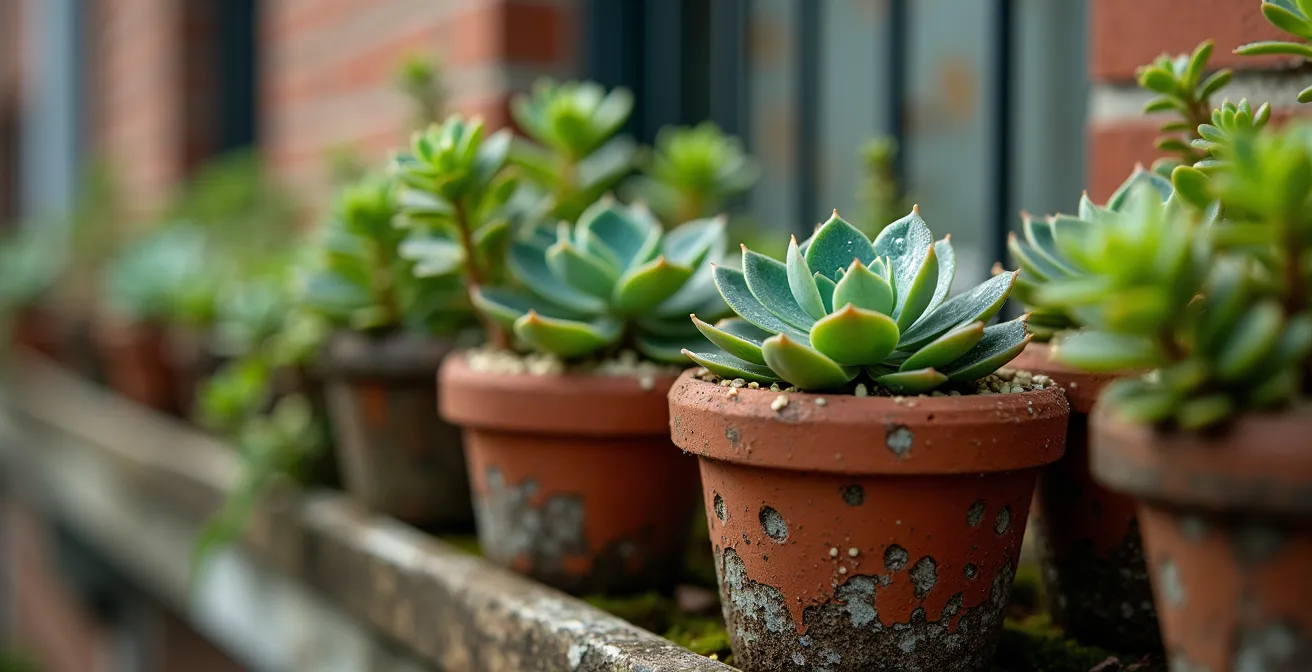
This approach allows you to create a lush, productive garden without undertaking a major and costly engineering project. The image below showcases how lightweight, varied containers can transform a weathered balcony into a vibrant micro-farm, blending organic growth with aged architecture.
Before embarking on any rooftop or balcony project in an older building, a thorough assessment is non-negotiable. The process involves more than just buying pots; it requires due diligence to ensure safety and compliance.
- Evaluate structural load capacity: Consult a structural engineer, especially for buildings over 30 years old, to determine the maximum safe weight your roof or balcony can support.
- Check co-ownership bylaws and heritage regulations: Review your building’s rules and local municipal codes for any restrictions on modifications to the building’s exterior.
- Assess dynamic loads: Consider not just the static weight of pots and soil, but also the dynamic forces of wind and the significantly increased weight of water-saturated soil after a heavy storm.
- Calculate insurance and permits: Contact your insurance provider about liability changes and obtain any necessary permits from your municipality before beginning installation.
Bamboo or Conifers: Which Plants Block Traffic Noise Best?
For urban dwellers, constant traffic noise is a major source of chronic stress. While we can’t eliminate the source, we can use biophilic design to create an acoustic buffer. This is about more than just blocking sound; it’s about acoustic masking, using the pleasant, natural sounds of rustling leaves to cover and distract from harsh, artificial noise. The effectiveness of a plant as a sound barrier depends on its physical structure: density, leaf shape, and height are all crucial factors.
Bamboo and conifers are both popular choices for creating living screens, but they work in different ways. Conifers, with their dense network of needles and rigid branches, are excellent at scattering high-frequency sounds. However, their slow growth can be a disadvantage. Bamboo, on the other hand, is a champion of acoustic design. Its tall, dense culms (stems) create a formidable physical barrier, while its abundant leaves rustle in the slightest breeze, generating a gentle “white noise” that effectively masks the rumble of traffic. This dual-action—blocking and masking—makes it a superior choice for many urban applications. This effect is not just pleasant; it’s restorative. Studies have found that nature sounds can lead to 9-37% faster physiological recovery from stress.
The principle of using dense, layered vegetation to manage the urban soundscape has been proven on a massive scale, providing a blueprint for our own smaller projects.
Case Study: Bosco Verticale, Milan
This pioneering residential skyscraper features over 20,000 plants across two towers, creating a natural shield against the city’s noise and pollution. The strategic placement of different plant species at various heights creates multiple sound-diffusion layers. This demonstrates how combining plant types and creating structural complexity maximizes acoustic benefits, turning a building facade into a functional sound absorber.
To create your own sound buffer on a balcony, the key is density and variety. Combine fast-growing clumping bamboo with broad-leafed shrubs and grasses to create a multi-layered barrier that diffuses, absorbs, and masks unwanted noise, engineering a pocket of acoustic tranquility.
Desk Plants or Green Walls: Which Boosts Employee Productivity More?
In the modern office, biophilic design has moved from a niche interest to a strategic tool for enhancing employee performance. The question is no longer *if* plants help, but *how* to deploy them for maximum impact. The two most common approaches are individual desk plants and large-scale living green walls. Both have merit, but they serve different psychological functions and yield different results. The choice depends on whether the goal is personal empowerment or environmental immersion.
Individual desk plants offer a sense of personal control and connection. Tending to a small plant on one’s desk provides micro-breaks, a tangible connection to a living thing, and a sense of ownership. This intimate scale is powerful. However, its impact is largely localized to the individual employee. A living green wall, by contrast, transforms the entire environment. It creates an immersive, “wow-factor” experience that affects everyone in the space. It makes a bold statement about the company’s commitment to well-being and has a greater impact on ambient air quality and acoustics. Research from the University of Exeter has shown that enriching an office with plants can increase well-being by 15% and productivity by 6%.
Further research reinforces this, suggesting that the scale of the intervention matters. While a single plant is good, a whole-office approach may be better.
In an office context, incorporating nature can improve well-being by 13% and productivity 8%.
– Aarhus University Research Team, 2019 Biophilic Design Study
The ideal solution often involves both. The green wall sets the ambient biophilic tone for the entire space, while desk plants provide the personal, tactile connection that fosters individual well-being, as seen in the workspace below.

So, which is better? For a company looking to make a significant, culture-shifting investment, the green wall has a broader impact. For empowering individual employees and starting on a smaller budget, desk plants are an effective and highly personal solution. A hybrid strategy often yields the best of both worlds.
Real Plants vs High-Quality Faux: Which Truly Lowers Cortisol Levels?
In the quest for low-maintenance greenery, high-quality artificial plants have become increasingly popular. They offer a perfect, unchanging visual cue of nature. But does this visual simulation trigger the same profound, stress-reducing benefits as a living plant? The science suggests a clear difference. While a faux plant can provide a pleasant aesthetic, it lacks the dynamic, multisensory inputs that are crucial for truly lowering physiological stress markers like cortisol.
A real plant is not a static object. It engages multiple senses through subtle, often subconscious cues: the gentle scent of damp earth, the slight air movement from transpiration, the visual evidence of growth and change, and the tactile sensation of a leaf. These are signals of life, and our brains are hardwired to respond to them. This connection is deeply ingrained, and its absence is felt. For instance, research from Aarhus University shows that children exposed to more nature have 55% fewer mental health problems, a testament to the power of authentic natural engagement. Artificial plants, no matter how realistic, are biologically inert. They offer none of these vital, dynamic cues.
The difference is particularly evident in environments where stress reduction is a primary goal, such as healthcare settings. While more research is needed, the current understanding points towards the unique benefits of living organisms.
The Role of Indoor Plants in Healthcare
Multiple studies suggest that the presence of real indoor plants is beneficial for reducing patient stress and even increasing pain tolerance. A 2023 literature review on biophilic design in healthcare noted that while the evidence for physiological benefits from real plants is growing, the literature is still limited. It highlights that the direct psychological effects, such as changes in positive emotions and feelings, require more dedicated study. This suggests that while we know real plants have a positive effect, we are still uncovering the full extent of the mechanisms at play.
So, while a high-quality faux plant is certainly better than a barren, sterile space, it should be seen as a “natural analogue”—a simple visual reference. For the genuine, cortisol-lowering, and well-being-enhancing benefits that lie at the heart of biophilia, there is no substitute for the complex, living system of a real plant.
How to Arrange Plants to Create a Localized Clean Air Zone?
We spend up to 90% of our lives indoors, breathing air that is often more polluted than the air outside. Given that the built environment is currently responsible for 39% of global energy-related carbon emissions, improving our indoor ecosystems is a critical health intervention. While it’s a myth that a few houseplants can purify an entire home, it is absolutely possible to use strategic plant arrangement to create a localized clean air zone, particularly in the areas where you spend the most time—your “breathing zone.”
This is a core principle of personal ecosystem engineering. The goal is not to clean the whole house, but to create a high-density cluster of air-purifying plants immediately around your desk, your bedside table, or your favorite armchair. By grouping several plants together, you achieve two things. First, you concentrate their collective air-filtering capacity right where you breathe. Second, the plants create a natural “humidity dome” through transpiration, which can help combat the dry air common in artificially heated or cooled buildings. This humid micro-climate is also beneficial for the plants themselves.
Creating this targeted zone requires a more thoughtful approach than simply scattering plants around a room. It involves understanding your home’s airflow and concentrating your green resources where they will have the most direct impact on your well-being. The following plan outlines how to engineer your personal breathing zone.
Your Action Plan: The 5-Step Breathing Zone Strategy
- Map Airflow: Identify your home’s natural airflow patterns. Observe how air moves from windows, doors, and HVAC vents to understand where airborne particles travel.
- Create Green Filters: Position high-density plant clusters at these primary air entry points. This acts as a first-line biological filter before the air circulates throughout your space.
- Concentrate Around You: The most crucial step is to place a significant concentration of plants (3-5 minimum) within a three-foot radius of your most sedentary areas, such as your work desk, bedside, or reading chair.
- Group for Humidity: Cluster plants close together. Their collective transpiration will create a pocket of higher humidity, which is beneficial for both your respiratory system and the plants themselves.
- Utilize Vertical Space: In your breathing zone, use tiered stands or wall planters to maximize plant density without consuming valuable floor or desk space, amplifying the local effect.
This targeted strategy turns a passive collection of plants into an active, functional system designed to deliver cleaner, healthier air directly to you.
Key Takeaways
- Biophilic design in urban spaces is not about decoration, but about engineering functional ecosystems to improve well-being.
- Maximizing “biomass density” through vertical systems is more effective in small spaces than using traditional pots.
- Real, living plants provide dynamic, multi-sensory benefits that artificial plants cannot replicate, making them essential for genuine stress reduction.
How to Design a Sensory Garden to Reduce Anxiety and Boost Mental Wellness?
In our visually-dominated world, we often forget that our connection to nature is a full-body experience. A truly effective biophilic space engages all the senses. This is the principle behind a sensory garden: a space consciously designed to stimulate sight, sound, smell, touch, and even taste. For the apartment dweller, this can be created in a collection of containers on a balcony or even a sunny windowsill. The goal is to build a restorative sanctuary that actively reduces anxiety and boosts mental wellness.
Designing for the senses means selecting plants for more than just their looks. For sound, choose grasses or bamboo that rustle in the wind. For smell, incorporate aromatic herbs like lavender, rosemary, or mint, which release their scents when touched. For touch, include a variety of textures: the soft, fuzzy leaves of lamb’s ear, the waxy surface of a succulent, or the spiky foliage of a conifer. For sight, use a mix of colors, forms, and flowers that change with the seasons. And for taste, a few pots of cherry tomatoes, strawberries, or edible flowers add an interactive, rewarding element. The goal is to get outside and engage with this space. Research from the University of Exeter found that spending an optimal 120-200 minutes per week in nature is associated with good health and wellbeing.
This multi-sensory approach creates an immersive experience that grounds you in the present moment, a powerful antidote to anxiety. It transforms a simple collection of plants into an interactive, therapeutic tool. This deepens the connection beyond the visual, fostering a true relationship with your small patch of nature. As the experts at Terrapin Bright Green eloquently state, the ultimate goal is a profound sense of belonging.
Biophilic design must nurture a love of place.
– Terrapin Bright Green, 14 Patterns of Biophilic Design
Creating this “love of place” is the pinnacle of personal biophilic design. It turns your urban dwelling from a mere shelter into a restorative habitat that nurtures both body and mind, proving that a deep connection with nature is possible, even in the heart of the city.
Start today by choosing one sensory element you want to introduce to your space and select a single plant that embodies it. This small, deliberate act is the first step in engineering an environment that actively supports your mental and physical well-being.