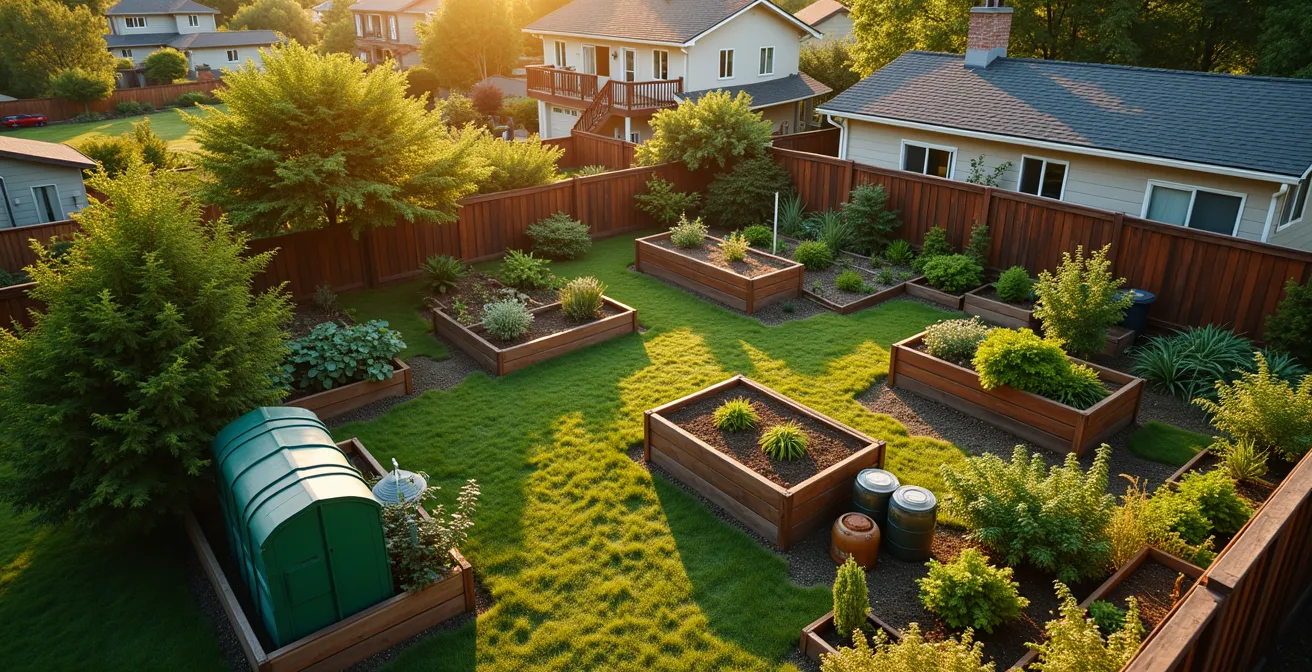
The key to a truly sustainable garden is not adding more “eco-friendly” tasks, but designing a closed-loop system where waste is eliminated because every output becomes a valuable input.
- Fallen leaves and grass clippings are not trash; they are the primary ingredients for nutrient-rich soil amendments that feed your garden for free.
- Rainwater is not a problem to be drained away; it’s a critical resource that, when properly harvested and managed, can drastically reduce your reliance on municipal water.
- The lifecycle of every item, from mulch to tools, must be considered to reduce your garden’s overall carbon footprint and stop contributing to landfills.
Recommendation: Start by identifying one major “waste” stream from your yard—like leaves or rainwater runoff—and find a way to redirect it back into the garden as a resource.
The typical suburban yard operates on a linear, wasteful model. We rake up leaves and bag them for the landfill, only to buy back fertilizer and mulch in plastic bags. We channel precious rainwater into storm drains, then turn on the sprinklers to hydrate our plants with treated municipal water. This constant cycle of disposal and consumption is not only expensive and inefficient; it depletes the very ecosystem we are trying to cultivate. It’s a constant battle against nature, requiring chemical interventions and endless inputs to maintain a fragile, artificial beauty.
Many well-intentioned gardeners try to correct this by adopting isolated “green” habits: starting a compost pile, installing a single rain barrel, or choosing organic pesticides. While these are steps in the right direction, they often fail to address the root problem. They are disparate actions, not a cohesive strategy. The real shift happens when you stop thinking about your garden as a collection of plants to be managed and start seeing it as a complete ecosystem. The goal is not just to sustain it, but to make it regenerative.
What if the solution wasn’t about doing more, but about connecting the dots? The core principle of a circular garden economy is simple: every output becomes an input. Fallen leaves are not waste; they are future soil. Rainwater isn’t a nuisance; it’s a free irrigation supply. An old tool isn’t junk; it’s an asset to be preserved. This approach transforms your garden from a resource-draining dependency into a self-sufficient, resilient, and truly beautiful closed-loop system.
This guide will walk you through the practical application of this system-oriented mindset. We will deconstruct the common resource flows in a suburban garden and show you how to redirect them, creating a regenerative cycle that builds soil, conserves water, and eliminates waste, all while fostering a healthier, more vibrant landscape.
Summary: Closing the Loop in Your Suburban Garden
- Why Sending Leaves to the Landfill Is a Waste of Free Fertilizer?
- How to Install a Rain Barrel System That Doesn’t Breed Mosquitoes?
- Pine Straw or Rubber Mulch: Which Is Truly Sustainable?
- The Nursery Pot Mistake That Fills Landfills Every Spring
- How to Maintain Garden Tools so They Last a Lifetime?
- Why Adding Fresh Manure Can Burn Your Seedlings Instantly?
- Smart Controller or Timer: Which Irrigation Tech Saves More Water?
- How to Create a Regenerative Environment Using Permaculture Principles?
Why Sending Leaves to the Landfill Is a Waste of Free Fertilizer?
Every autumn, a valuable resource rains down on our lawns, and our first instinct is to bag it up and send it to a landfill. This is the first and most significant break in the garden’s natural resource cycle. Leaves are not waste; they are the soil’s inheritance. When they decompose in a landfill, they produce methane, a potent greenhouse gas. But when composted in your yard, they become “black gold,” a nutrient-rich soil amendment that improves structure, aeration, and water retention.
The nutritional value isn’t trivial. According to research, the nutrient content of yard trimmings is significant, with studies indicating composted leaves contain valuable nutrients for plant growth. For instance, some analyses show a composted leaf nitrogen content of 0.5-1%, along with phosphorus and potassium. By discarding leaves, you are throwing away free, perfectly balanced fertilizer and then spending money on synthetic substitutes.
Creating leaf mold is the simplest way to close this loop. It’s a slow-composting process that relies on fungi rather than bacteria. The steps are straightforward: rake your leaves (avoiding any treated with chemicals), shred them with a lawnmower to accelerate decomposition, and pile them into a simple wire cage or bin. Keep the pile as moist as a wrung-out sponge. In one to two years, you’ll have a dark, crumbly, and nutrient-rich material that is one of the best soil conditioners available. This process not only feeds your garden but also sequesters carbon in the soil, actively benefiting the wider environment.
By shifting your perspective from “yard cleanup” to “resource harvesting,” you transform a chore into a foundational act of regenerative gardening.
How to Install a Rain Barrel System That Doesn’t Breed Mosquitoes?
Harvesting rainwater is a cornerstone of a self-sufficient garden, reducing your reliance on treated municipal water and providing your plants with naturally soft, chlorine-free water they prefer. However, the fear of creating a breeding ground for mosquitoes stops many homeowners. A properly designed system eliminates this risk entirely by focusing on two principles: physical barriers and overflow management. A rain barrel should never be a stagnant, open pond.
First, every opening must be sealed. The main inlet where water enters from the downspout must be covered with a fine mesh screen, securely fastened. This screen prevents adult mosquitoes from laying eggs and also filters out leaves and debris. The spigot and any overflow outlets should also be properly sealed. For biological control within the barrel, products containing Bti (Bacillus thuringiensis israelensis) are a safe and effective option. These are naturally occurring bacteria that kill mosquito larvae but are harmless to humans, pets, plants, and other wildlife.
The most critical element, however, is designing for overflow. A single rain barrel can fill surprisingly fast. A proactive overflow strategy is not just a safety measure; it’s an opportunity to integrate the system into your landscape. Rather than a simple pipe that dumps water near your foundation, the overflow should direct water away from the house and into a productive area. The image below shows an ideal setup.
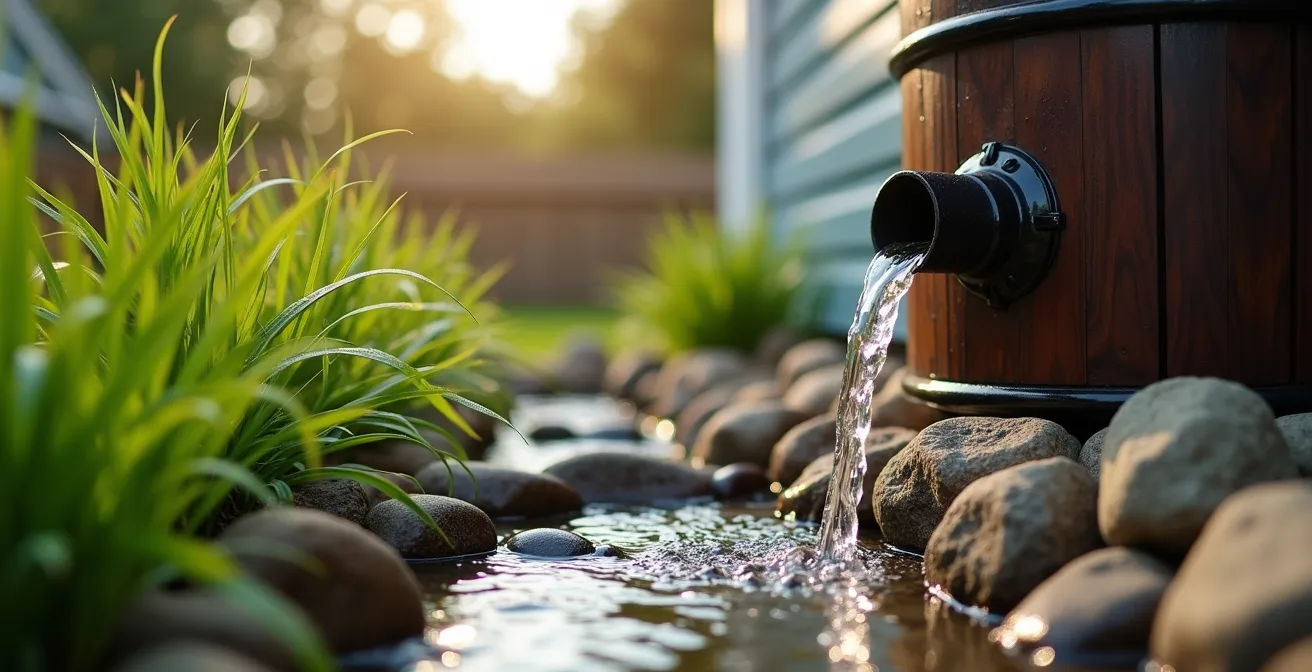
As you can see, the overflow is channeled into a bioswale or rain garden—a shallow depression filled with water-loving native plants and rocks. This allows the excess water to slow down, spread out, and slowly percolate into the ground, hydrating a larger area of your garden and recharging the local water table. This turns a potential problem into a functional and beautiful garden feature, creating a resilient, multi-layered water management system.
This approach moves beyond a simple barrel and creates an integrated water-harvesting network that is both safe and regenerative.
Pine Straw or Rubber Mulch: Which Is Truly Sustainable?
Choosing a mulch is a critical decision that impacts soil health, water retention, and your garden’s overall carbon footprint. The debate often centers on aesthetics and longevity, but a regenerative mindset demands we look deeper at the entire lifecycle. Pine straw, a renewable byproduct of the timber industry, and rubber mulch, made from recycled tires, present a stark contrast in their ecological return on investment.
Rubber mulch is marketed on its longevity, promising a decade or more of maintenance-free cover. However, this durability comes at a high environmental cost. The manufacturing process is energy-intensive, and while it diverts tires from landfills, studies have raised concerns about the potential for zinc and other chemicals to leach into the soil over time. Furthermore, rubber mulch does nothing to improve soil health; it is an inert, inorganic barrier. It smothers the soil’s natural biome and, at the end of its life, becomes a disposal problem once again.
Organic mulches like pine straw, shredded leaves, or wood chips operate on a completely different principle. They are part of the resource cycle. As they decompose, they add vital organic matter to the soil, feeding microbial life, improving aeration, and increasing water-holding capacity. While they need to be replenished every year or two, this is not a flaw; it is their function. They are slowly and steadily feeding the earth. The most sustainable option of all, however, is a “living mulch”—a low-growing groundcover plant that protects the soil, suppresses weeds, and in some cases, even fixes nitrogen.
To make an informed decision, it’s helpful to compare these options side-by-side, considering their full lifecycle impact.
| Mulch Type | Carbon Footprint | Soil Health Impact | Longevity |
|---|---|---|---|
| Pine Straw | Low (local sourcing) | Adds organic matter | 1-2 years |
| Rubber Mulch | High (processing/transport) | Potential zinc leaching | 10+ years |
| Living Mulch | Negative (carbon sequestration) | Nitrogen fixation possible | Perennial |
As this comparative analysis of mulch materials suggests, choices that prioritize soil building over simple durability offer far greater long-term benefits to the garden ecosystem. True sustainability is not about finding a permanent, static solution, but about participating in a dynamic, life-giving cycle.
Ultimately, the best mulch is one that breaks down and becomes part of the soil it was meant to protect.
The Nursery Pot Mistake That Fills Landfills Every Spring
Every spring, gardens bloom and so do our landfills, filled with mountains of black plastic nursery pots. These pots are a perfect example of a linear, single-use design flaw in an industry dedicated to nature. Most are made from plastics that are difficult or impossible to recycle in municipal programs, creating a massive stream of waste. A homeowner can easily accumulate dozens of these pots in a single season. The solution isn’t just about finding a place to recycle them; it’s about designing them out of your gardening practice altogether.
Shifting your mindset from “disposal” to “circularity” opens up a range of powerful alternatives. This involves refusing new plastic where possible, reusing what you have, and rethinking how you source plants. Instead of seeing the pot as an unavoidable part of buying a plant, you can actively seek out methods that bypass it. This is a fundamental application of circular economy principles in your own backyard.
Here are several effective strategies to break the cycle of nursery pot waste:
- Create soil blocks: Using a simple tool called a soil blocker, you can form compressed blocks of soil to start seeds. This creates vigorous, “air-pruned” seedlings that can be planted directly in the ground without any pot at all.
- Buy bare-root plants: During their dormant season (typically late fall to early spring), many trees, shrubs, and perennials are sold “bare-root.” They arrive without any soil or pot, reducing waste and often costing less.
- Organize pot-return programs: Talk to your local, independent nurseries. Many are happy to take back their pots for sanitizing and reuse, creating a closed-loop system at the community level.
- Transform old pots: Don’t just stack them; give them a new function. A plastic pot with a hole drilled near the bottom can be buried next to a plant and used as a reservoir for deep, efficient watering, similar to a traditional clay olla.
By actively choosing these alternatives, you can significantly reduce your garden’s plastic footprint and take a powerful stand against a culture of disposability.
How to Maintain Garden Tools so They Last a Lifetime?
In a disposable culture, it’s easy to view tools as replaceable. A rusty shovel or a dull pair of pruners gets tossed and replaced without a second thought. But this mindset is another break in the circular economy of the garden. A well-made tool is an investment, and with proper care, it’s an asset that can serve you for a lifetime, if not generations. Tool maintenance is not just about frugality; it’s an ethical practice that respects the resources and labor that went into creating the tool and prevents more items from ending up in the landfill.
The two greatest enemies of a garden tool are rust and neglect. The process of protecting them is simple and deeply satisfying. It involves three key actions: cleaning, sharpening, and oiling. After each use, take a moment to remove all soil from the metal parts. For sharpening, a simple mill file for shovels and hoes, and a sharpening stone for pruners, are all you need to restore a keen edge. A sharp tool is safer and more efficient, reducing strain on both the plant and your body.
The final, crucial step is rust prevention. This is where a simple but brilliant tool maintenance station comes in: a bucket filled with sand mixed with a bit of mineral oil. Plunging the clean, dry tool head into the sand scours it further, while the oil leaves a thin, protective coating on the metal. The handles, especially wooden ones, also need care. Periodically sanding them smooth and wiping them down with boiled linseed oil prevents cracking and splinters.
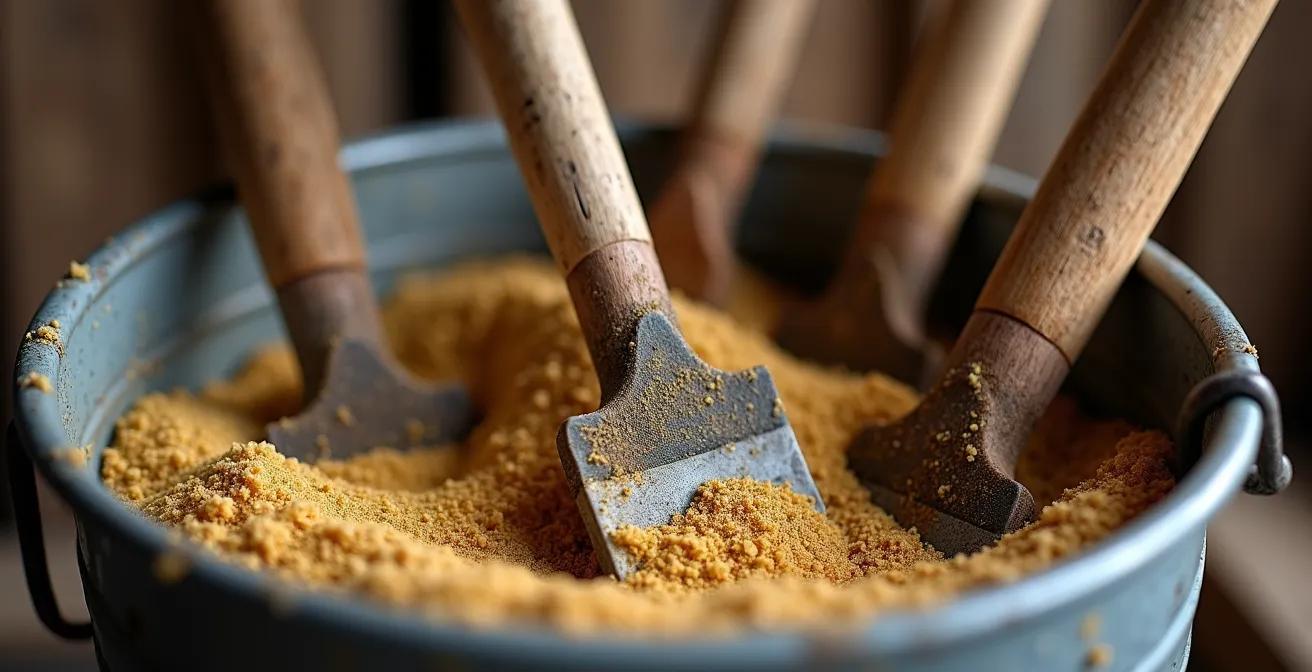
The longevity gained from this simple ritual is remarkable. With regular care, guidelines suggest that high-carbon steel tools can last 20+ years, becoming extensions of your own hands rather than disposable commodities. This practice of care fosters a deeper connection to your work and embodies the regenerative principle of preserving and enhancing the resources you already have.
By treating your tools as lifelong partners, you reject wastefulness and cultivate an ethos of stewardship that extends to every corner of the garden.
Why Adding Fresh Manure Can Burn Your Seedlings Instantly?
In the quest for natural fertilizers, fresh manure seems like a perfect, direct-from-the-source solution. However, applying it directly to your garden can have disastrous consequences, especially for tender seedlings. The reason is simple: fresh manure is too “hot.” This doesn’t refer to temperature, but to its extremely high concentration of soluble nutrients, particularly ammonia and other forms of nitrogen. This intense concentration acts like a chemical overdose, drawing moisture out of plant roots and effectively “burning” them, causing them to wilt and die.
The nitrogen content varies significantly by animal. For example, fresh poultry manure is one of the hottest, with a much higher nitrogen percentage than cow or horse manure. Data shows that poultry manure can contain 3-5% nitrogen, whereas cow manure is closer to 1-1.5%. Without a composting or aging period, this nitrogen is too readily available and overwhelms a plant’s ability to process it. The composting process is essential because it allows microorganisms to break down and stabilize these volatile nutrients, converting them into a slow-release form that plants can safely absorb over time.
Furthermore, fresh manure can contain harmful pathogens (like E. coli) and viable weed seeds. A proper “hot composting” process, where the pile reaches temperatures of 130-160°F, is necessary to kill off both these threats. If you are sourcing manure from an outside supplier, it’s crucial to act as an informed consumer to ensure you’re getting a safe, stable product. You are not just buying a bulk material; you are introducing a powerful biological component into your garden’s ecosystem.
Your Checklist for Sourcing Safe Manure
- Animal Feed: What were the animals fed? Specifically ask if the hay or pasture was treated with persistent herbicides (like aminopyralid), which can pass through the animal and kill your garden plants.
- Medications: Were antibiotics or de-wormers used? While often broken down during composting, it’s an important factor for some organic gardening philosophies.
- Bedding Material: What bedding was used? Avoid manure mixed with sawdust from treated wood (like walnut, which is toxic to plants).
- Aging Process: How long has the manure been aged or composted? A minimum of six months is a good starting point for cool composting, while hot-composted manure may be ready sooner.
- Compost Temperature: Has the compost reached thermophilic temperatures (above 130°F)? This is the best guarantee that pathogens and weed seeds have been neutralized.
By respecting the need for this cooling-off period, you turn a potentially harmful substance into one of the most beneficial and regenerative amendments for building rich, living soil.
Smart Controller or Timer: Which Irrigation Tech Saves More Water?
Water is a finite resource, and efficient irrigation is a key part of sustainable garden management. The move away from “set it and forget it” hose-end sprinklers has led to two main technological paths: basic hose timers and advanced “smart” irrigation controllers. While both offer more control than manual watering, their approach to water conservation is fundamentally different. A basic timer automates a schedule; a smart controller automates a response to the environment.
A basic hose timer is a simple and affordable tool. You set it to water for a specific duration on specific days. This is an improvement over inconsistent manual watering, but its core flaw is that it is static. It doesn’t know if it rained yesterday, if it’s unusually cool and humid today, or if a heatwave is forecast for tomorrow. It will execute its pre-programmed schedule regardless of the actual needs of your garden, leading to significant water waste through overwatering or stressed plants from underwatering.
A smart ET controller, on the other hand, uses data to make decisions. “ET” stands for evapotranspiration, which is the rate at which water is lost from the soil and plant leaves. These controllers connect to Wi-Fi and pull local weather data—temperature, humidity, wind, and rainfall—to automatically adjust the watering schedule. If it just rained, the system will pause. If a heatwave is coming, it might water more deeply to prepare the plants. This dynamic response to real-world conditions is what leads to substantial water savings. However, there’s a third, ancient technology that often outperforms both in specific applications: clay ollas. These unglazed clay pots are buried in the soil and filled with water, which slowly seeps out directly to the plant roots as the soil dries, delivering water with near-perfect efficiency.
The right choice depends on your garden’s scale and your budget, but the potential for water savings varies dramatically.
| Technology | Water Savings | Cost | Maintenance |
|---|---|---|---|
| Basic Timer | 0-10% | $20-50 | Seasonal adjustments |
| Smart ET Controller | 20-40% | $150-300 | WiFi/sensor checks |
| Clay Ollas | 50-70% | $10-30 each | Refill weekly |
Ultimately, the “smartest” technology is the one that most accurately delivers water only when and where it is needed, minimizing waste and promoting deep, resilient root growth.
Key takeaways
- A sustainable garden operates as a closed-loop system, not a list of chores. The goal is to turn every output (leaves, water, etc.) into a valuable input.
- Waste is a design flaw. Actively seek ways to eliminate sources of waste, from single-use plastic pots to discarding nutrient-rich leaves.
- True sustainability is regenerative. Your actions should not just maintain the garden but actively build soil health, increase biodiversity, and improve resource efficiency over time.
How to Create a Regenerative Environment Using Permaculture Principles?
We’ve explored how to close individual loops in the garden: turning leaves into soil, harvesting rainwater, choosing sustainable materials, and preserving tools. Permaculture is the philosophy that weaves all these threads together into a single, cohesive, and highly productive design. It’s a method for creating human habitats that are not just sustainable but regenerative, by consciously mimicking the patterns and relationships found in natural ecosystems. It is the ultimate expression of a circular garden economy.
A core concept in permaculture is the “food forest,” which designs a garden in seven distinct layers, just like a natural forest. This isn’t just for large rural homesteads; the principles can be applied to a typical suburban lot. Patrick Dolan’s “One Yard Revolution” project is a powerful case study, demonstrating how a 7-layer food forest can be established in a small urban space. The system includes a canopy of fruit trees, an understory of berry bushes, an herbaceous layer of perennials like comfrey (whose deep roots mine nutrients for other plants), a groundcover of strawberries, a root layer of crops, a vertical layer of climbing vines, and crucially, a fungal network in the soil that connects everything. This “stacking” of functions in space and time allows for immense productivity in a small area while building soil and creating habitat.
This system is inherently closed-loop. The leaves from the canopy trees become the mulch for the understory. The deep-rooted perennials bring up nutrients for the shallow-rooted annuals. The diversity of plants attracts a diversity of beneficial insects, reducing the need for pest control. The entire system works synergistically to produce food, build fertility, and manage resources with minimal external inputs. As Patrick Dolan, the creator of One Yard Revolution, puts it:
You can grow a lot of food on a little land using sustainable organic practices without spending a lot of money or working very hard.
– Patrick Dolan, One Yard Revolution Interview
This is the promise of a truly regenerative design. It’s a shift from a mindset of constant work and intervention to one of intelligent observation and partnership with nature.
By adopting this holistic view, you move beyond simple sustainability and become a co-creator of a thriving, self-sufficient, and beautiful backyard ecosystem.