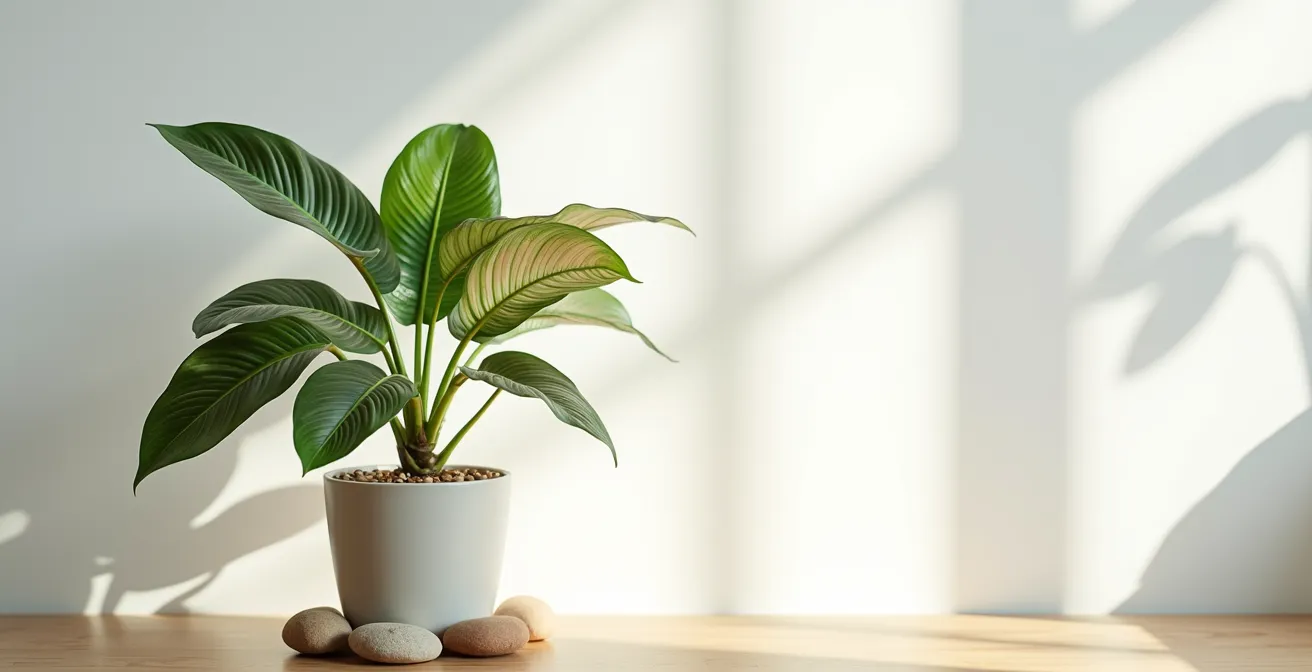
The survival of your Calathea Makoyana in a dry home depends not on frequent misting, but on systematically neutralizing the “invisible assassins” in its micro-environment.
- Tap water introduces a high mineral load that builds up in the soil, causing leaf curl and browning.
- AC creates subtle micro-drafts and temperature shocks that dehydrate leaves faster than roots can absorb water.
Recommendation: Shift from a reactive “care” mindset to a proactive “environmental control” strategy, focusing on water quality, draft detection, and consistent soil moisture.
The Calathea Makoyana, or “Peacock Plant,” is the crown jewel of patterned foliage, but for many, it’s a source of recurring heartbreak. You provide what you think is love—a bright spot, regular waterings—only to be met with the slow, agonizing crisp of its leaf edges. The vibrant patterns curl inward, turning a sickly brown, a clear sign of distress in the dry, conditioned air of a modern home. It’s a frustrating cycle that makes even dedicated plant lovers question their abilities.
Common advice floods the internet: “mist your plants daily,” “use a pebble tray,” or “buy an expensive humidifier.” While well-intentioned, these are often superficial fixes to a much deeper problem. Misting provides fleeting relief, and pebble trays have a notoriously localized and minimal effect. These actions treat the symptom—dry leaves—without addressing the root causes: the hostile micro-environment your air conditioner systematically creates. A truly thriving Calathea isn’t about random acts of kindness; it’s about understanding and controlling the physics of its immediate surroundings.
But what if the key wasn’t adding more humidity, but preventing its rapid loss? This guide takes a different approach. We will move beyond platitudes and into a diagnostic framework. Instead of just telling you *what* to do, we’ll explore *why* your Calathea is struggling by identifying the three invisible assassins: a high mineral load from your tap water, stealthy micro-drafts from vents and windows, and the punishing cycle of moisture volatility in the soil.
By learning to see your home through your plant’s eyes, you can transform its environment from a survival-mode desert into a stable, supportive ecosystem. We will cover the science behind water quality, effective humidity solutions that won’t ruin your floors, and a watering rhythm that respects the plant’s natural needs, not a rigid calendar. Get ready to finally stop saving your Calathea and start helping it flourish.
This article provides a complete system for diagnosing and solving the common issues that plague Calathea Makoyana in dry environments. Explore the sections below to master each element of its care.
Article Summary: A Survival Guide for Your Peacock Plant
- Why Calathea Leaves Curl Up Tight When You Use Tap Water?
- How to Build an Effective Pebble Tray That Actually Raises Humidity?
- Distilled or Rainwater: Which Is More Cost-Effective for Calatheas?
- The Drafty Window Mistake That Turns Calathea Leaves Brown
- When to Water a Calathea: The Danger of “Drying Out” Completely
- Why Tap Water Causes Brown Tips on Your Dracaena Leaves?
- How to Increase Humidity for a Ficus Without Ruining Your Wood Floors?
- Which Low-Maintenance Houseplant Survives 3 Weeks Without Water?
Why Calathea Leaves Curl Up Tight When You Use Tap Water?
When you see your Calathea’s leaves curling like ancient scrolls, the first instinct is to suspect a lack of water. While thirst is a factor, the more insidious culprit is often the water *quality*. Tap water is not pure H2O; it’s a cocktail of dissolved minerals and chemicals added for public health, which can be toxic to sensitive tropical plants. This accumulation is what a botanist would call an increasing mineral load in the soil.
Over time, these substances build up in the potting mix, creating a hostile environment for the plant’s delicate roots. As one analysis of water quality points out, sensitive plants are particularly vulnerable to a buildup of chemicals like chlorine and fluoride, along with hard minerals like calcium. Instead of absorbing pure water, the roots are forced to take in this concentrated mineral solution, which damages them and hinders their ability to hydrate the plant. The leaf curling and browning are the visible screams of a plant being slowly poisoned from the ground up.
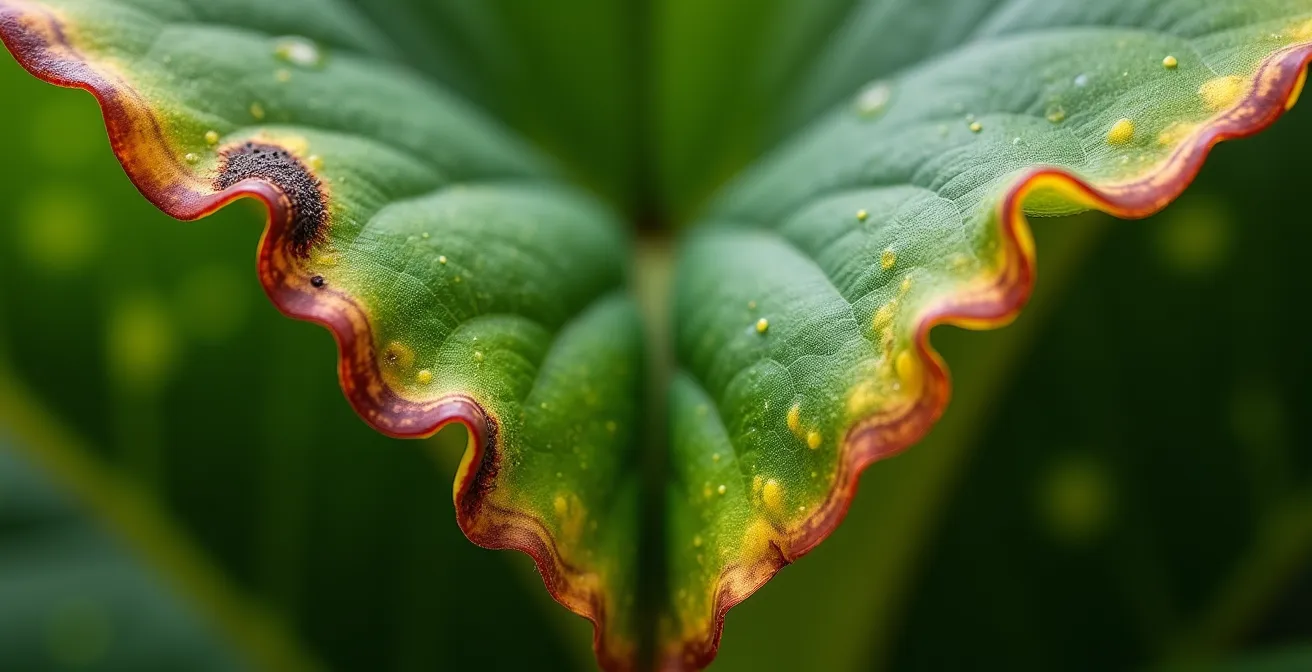
This damage is cumulative. Each watering with tap water adds another layer of minerals to the soil, gradually tipping the balance. The plant may seem fine for months, but eventually, the threshold is crossed, and the symptoms appear rapidly. Recognizing this is the first step: your Calathea isn’t just “thirsty”; it’s reacting to a soil environment that has become toxic. The solution lies not in watering more, but in changing the water itself.
How to Build an Effective Pebble Tray That Actually Raises Humidity?
The pebble tray is one of the most frequently recommended solutions for low humidity, presented as a simple, passive humidifier. The concept is sound: water evaporates from a wide surface area, increasing the moisture in the air immediately around the plant. However, its real-world effectiveness is often vastly overstated. The goal isn’t just to have a tray of wet rocks; it’s to maximize the rate of evaporation to create a meaningful humidity delta between the air and the leaf surface.
The truth is, a standard pebble tray offers a very modest boost. In fact, scientific testing on the matter is quite sobering, with one study finding just a 3% humidity increase at 1.5 inches above the tray. This is a far cry from the 60%+ humidity a Calathea craves. To make a pebble tray more than just a decorative gnat-breeder, you must focus on maximizing the two key factors: surface area and airflow. A wider tray is always better than a deep one, and the material of the pebbles themselves plays a critical role.
Regular, smooth river rocks have a relatively low surface area. For a significant improvement, consider using porous materials like LECA (Lightweight Expanded Clay Aggregate) or pumice. These materials act like tiny sponges, absorbing water and then releasing it slowly, which drastically increases the total evaporative surface. Placing a small, silent USB fan nearby to gently blow air *across* the tray’s surface will also accelerate evaporation, making the system far more effective. Just ensure the airflow isn’t aimed directly at the plant’s foliage, as that would defeat the purpose by creating a drying draft.
Distilled or Rainwater: Which Is More Cost-Effective for Calatheas?
Once you accept that tap water is a slow poison for your Calathea, the next logical question is what to use instead. The two purest options are distilled water and rainwater. Both are free of the harmful minerals and chemicals found in tap water, but they differ significantly in their nutrient profile and cost-effectiveness. The choice between them depends on your access to resources, the size of your plant collection, and your long-term budget.
Distilled water is the ultimate blank slate. The distillation process removes everything—harmful chemicals, but also beneficial trace minerals. While it’s perfectly safe, using it exclusively means your plant gets zero nutrients from its water source. You will need to be diligent with a balanced fertilizer regimen to compensate for this lack. Buying distilled water can also become expensive and inconvenient, especially if you have numerous thirsty tropicals. It’s a reliable but high-maintenance and potentially costly solution.
Rainwater, on the other hand, is nature’s perfect drink for plants. It’s naturally soft, slightly acidic, and contains nitrates and organic matter that plants can use. For your Calathea, it’s the gold standard. The obvious drawback is collection and storage, which can be challenging for apartment dwellers. A simple collection barrel or even just buckets left out during a storm can provide a free, high-quality supply. However, you must consider potential contamination from roofing materials or urban pollution. For many, a more practical middle ground is using an at-home water filter (like a ZeroWater pitcher) that removes contaminants while leaving some minerals intact. Studies suggest that using filtered water that retains beneficial minerals is often a superior strategy for encouraging growth compared to pure distilled water.
The Drafty Window Mistake That Turns Calathea Leaves Brown
One of the most underestimated “invisible assassins” for a Calathea is the micro-draft. As a tropical understory plant, the Makoyana is evolved for a still, warm, and humid environment. It is exquisitely sensitive to sudden changes in temperature and air movement. A location that seems perfect—like a bright spot near a window—can be a death trap if that window is drafty or located near an AC vent.
These drafts create two major problems. First, moving air, no matter how gentle, drastically accelerates transpiration—the process of water evaporating from the leaf pores. The plant loses moisture to the dry air faster than its roots can pull water from the soil, leading to dehydration, crispy edges, and brown spots. Second, Calatheas are intolerant of cold. As research confirms, keeping them in an environment with temperatures below 60°F can cause leaves to die back. A draft from a window in winter or a direct blast from an AC unit in summer can easily cause this temperature shock.
The challenge is that these micro-drafts are often imperceptible to us. You won’t feel a strong breeze, but your Calathea will. Locating these “danger zones” is crucial for your plant’s survival. You must become a detective of air currents in your home, identifying and neutralizing these threats to create a stable micro-environment for your plant.
Action Plan: Detecting Invisible Micro-Drafts
- Light an Incense Stick: Safely light an incense stick or a match and hold it near your Calathea’s location.
- Observe the Smoke: Watch the trail of smoke. If it drifts horizontally or swirls chaotically, you have a draft. A perfectly still environment will see the smoke rise vertically.
- Map the Danger Zones: Test key areas, especially within three feet of windows, doors, and air conditioning or heating vents. These are the most common sources of harmful air currents.
- Mark the Hotspots: Mentally note any area where the smoke moves rapidly. These are no-go zones for sensitive plants like Calatheas.
- Relocate or Shield: Move your Calathea to a more sheltered location. If that’s not possible, use taller, hardier plants or furniture to create a physical barrier that shields it from the draft.
When to Water a Calathea: The Danger of “Drying Out” Completely
The mantra for many houseplants is “water thoroughly, then allow the soil to dry out.” Applying this logic to a Calathea Makoyana is a recipe for disaster. These plants come from forest floors where the soil is consistently moist, but never waterlogged. They have fine, delicate root systems that are not built to handle periods of drought. Allowing the soil to dry out completely causes these feeder roots to die back, impairing the plant’s ability to absorb water even when you finally do water it. This leads to the classic symptoms of underwatering—drooping, curling, crispy leaves—even if your watering schedule seems frequent.
The goal is to maintain a state of consistent, even moisture. The soil should feel like a well-wrung-out sponge, not a dry desert or a sodden swamp. This is especially challenging in an air-conditioned environment, which causes significant moisture volatility. The dry air wicks moisture from the soil surface, making the top inch feel dry while the root ball might still be wet. Relying solely on the “finger test” can be misleading.
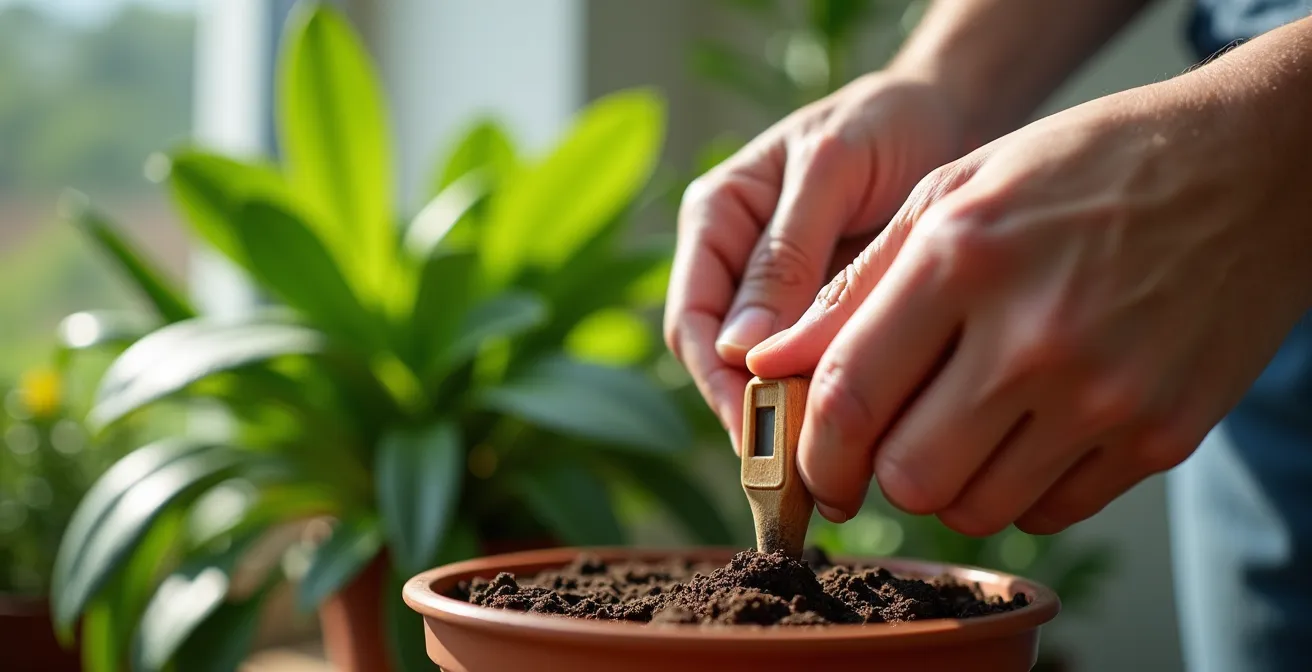
A more reliable method is to use a moisture meter, inserting it deep into the root ball to get an accurate reading. Alternatively, learn the weight of your pot. Lift it right after a thorough watering and then again every day. You will quickly develop a feel for its weight when it’s time for another drink. Your Calathea will also give you clues; it’s wise to pay attention to the plant’s expressive foliage, which curls inwards slightly when it’s beginning to get thirsty. This is a far better indicator than a calendar. Water when the top 25% of the soil is dry, but before the entire pot has dried out.
Why Tap Water Causes Brown Tips on Your Dracaena Leaves?
The issue of tap water toxicity is not unique to Calatheas. Many common houseplants, including the popular and seemingly hardy Dracaena, exhibit similar symptoms of distress like brown leaf tips and stunted growth when watered consistently with tap water. This shared sensitivity underscores a fundamental principle of tropical plant care: what’s safe for humans to drink is not always safe for plants evolved in pristine, low-mineral ecosystems. For plants like Dracaenas and Spider Plants, the primary culprit is often fluoride.
While fluoride is added to municipal water for dental health, it can be phytotoxic (toxic to plants) in high concentrations. Sensitive species are unable to process the element, which then accumulates in the leaf tips and margins—the furthest points from the roots. This buildup kills the plant tissue in those areas, resulting in the characteristic brown, dead tips. Chlorine is another common additive that can cause similar issues, though it tends to dissipate if water is left to sit out for 24 hours; fluoride, however, does not.
Understanding this sensitivity spectrum is crucial for anyone managing a mixed collection of houseplants. What a resilient Snake Plant can tolerate with ease will quickly harm a Peace Lily or a Dracaena. Recognizing that “houseplant” is not a monolith but a diverse group with varied needs is the mark of an advanced plant parent. The following table illustrates how different common houseplants react to the mineral load in tap water.
| Plant Type | Chlorine Sensitivity | Fluoride Sensitivity | Hard Water Tolerance | Safe Water Options |
|---|---|---|---|---|
| Calathea | Extreme | Extreme | Very Low | Distilled, Rainwater |
| Dracaena | High | Extreme | Low | Filtered, Rainwater |
| Spider Plant | Moderate | High | Moderate | Filtered, Settled Tap |
| Peace Lily | High | High | Low | Filtered, Distilled |
| Snake Plant | Low | Low | High | Any water type |
How to Increase Humidity for a Ficus Without Ruining Your Wood Floors?
The quest for higher humidity is a common challenge for owners of many tropical plants, not just Calatheas. A Ficus, for instance, will also drop leaves in a dry environment. While a powerful humidifier is the most effective tool, it comes with its own set of risks, especially the threat of water damage to wood floors, furniture, and walls. The key to safely increasing humidity is a combination of strategic placement and protective barriers.
Whether you’re using a humidifier or a large, optimized pebble tray, it should never be placed directly on a wood surface. Always use a waterproof plant mat or a deep, wide saucer underneath. For humidifiers, the rule of thumb is to maintain at least three feet of distance from any wood furniture or floors. Opt for a cool mist humidifier over an ultrasonic one, as ultrasonic models can disperse fine mineral dust (from tap water) onto your furniture, leaving a white film. Using filtered or distilled water in your humidifier eliminates this problem entirely.
Another effective strategy is to create “humidity zones.” Instead of trying to raise the humidity of an entire room, group your humidity-loving plants together. Their collective transpiration will create a more humid micro-environment around them. This clustering makes it more efficient to run a humidifier for their benefit without saturating the entire space. For especially delicate or small plants, a glass cloche or a mini indoor greenhouse can create a personal high-humidity biosphere, offering maximum benefit with zero risk to your home’s surfaces.
Key Takeaways
- Calathea survival hinges on managing the micro-environment, not just following generic care tips.
- Tap water’s mineral load (chlorine, fluoride) is a primary cause of leaf curl and browning, requiring a switch to purified water.
- Micro-drafts from AC and windows are “invisible assassins” that dehydrate leaves; they must be detected and eliminated.
Which Low-Maintenance Houseplant Survives 3 Weeks Without Water?
After exploring the meticulous, high-maintenance world of the Calathea Makoyana, it’s fair to ask: does it have to be this hard? The answer is no. The plant kingdom is vast, and for every demanding tropical queen, there is a resilient desert survivor. If the constant battle over humidity, water purity, and micro-drafts sounds more like a chore than a joy, it’s perfectly valid to choose a plant that better suits your environment and lifestyle. This isn’t failure; it’s strategic selection.
Plants like the ZZ Plant (Zamioculcas zamiifolia), the Snake Plant (Dracaena trifasciata), and various cacti are the polar opposites of a Calathea. These are xerophytes, plants adapted to arid conditions. They have evolved to store water in their leaves, stems, or roots, allowing them to endure weeks, or even months, of neglect. They thrive on the “benign neglect” that would kill a Calathea. They are perfectly happy with low humidity, infrequent watering, and a wide range of light conditions. There is no such thing as a “best” plant, only the best plant *for you*.
Embracing this reality can be liberating. You can create a “zoned” collection in your home. Reserve the high-effort, high-humidity zone for one or two prized tropicals like a Calathea, and fill the rest of your space with tough, low-maintenance beauties. This allows you to enjoy the lushness of houseplants without being enslaved by their most demanding members. The ultimate goal of keeping plants is to bring joy and life into your home, not stress and frustration. Choosing the right plant for the right place is the most important decision you can make.
By applying this diagnostic mindset, you can transform from a frustrated plant owner into a confident environmental manager. Start today by testing your water, hunting for drafts, and getting a true feel for your soil’s moisture, and give your Calathea Makoyana the stable, supportive home it has been craving.