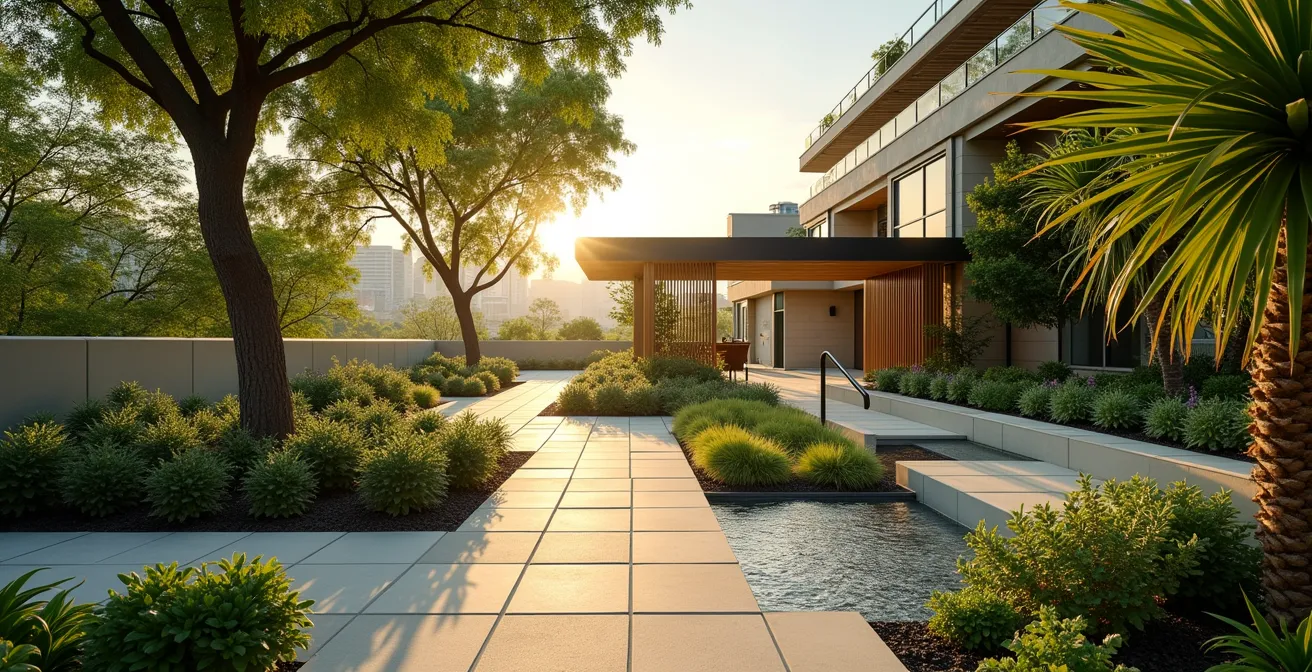
To truly cool your urban yard, you must treat it as a thermal system, not just a space for decoration.
- Your yard’s surfaces (asphalt, concrete) act as “heat sinks,” absorbing sun all day and radiating it back at night, keeping temperatures dangerously high.
- Strategic interventions like deploying deciduous trees as solar shields and replacing hardscape with permeable “evaporative engines” are far more effective than random planting.
Recommendation: Before buying a single plant, conduct a backyard heat audit to map your specific microclimates. This is the first step to deploying cooling strategies that actually work.
The feeling is unmistakable: you step from an air-conditioned home into your own backyard, and a blast of radiant heat hits you. The concrete patio feels like a hotplate, the dark fence seems to hum with stored warmth, and even the air feels thick and stagnant. This is the urban heat island (UHI) effect in miniature, a personal micro-crisis where your own property becomes a heat-retaining oven. Many residents try to fight back by planting a few flowers or installing a patio umbrella, treating the symptoms without understanding the cause.
The common advice—plant more, use light colors—is not wrong, but it is tragically incomplete. It fails to address the fundamental physics at play. Your yard operates as a dynamic thermal system. Sunlight is the input; stored and radiated heat is the output. Hard, dark, impermeable surfaces like asphalt, concrete, and even traditional roofing are not passive elements; they are active heat sinks, absorbing massive amounts of solar energy and slowly releasing it long after sunset. This is why urban areas fail to cool down at night, posing significant health risks.
This guide offers a paradigm shift. We will move beyond simple gardening tips and adopt the mindset of a microclimate cooling strategist. The core principle is this: to reclaim your backyard from the heat, you must actively manage its surfaces, airflow, and moisture. It’s not about decoration; it’s about strategic intervention. We will analyze how to dismantle your personal heat island, piece by piece, by deploying vegetation as an engineering tool and transforming heat sinks into cool oases.
This article provides a strategic framework for transforming your property. Follow along as we dissect the most effective interventions, from deploying trees as seasonal solar shields to auditing your yard’s unique thermal profile, empowering you to create a cooler, safer, and more resilient personal environment.
Summary: A Strategist’s Guide to Mitigating Backyard Heat
- Deciduous Trees on the South Side: How Much Do They Lower AC Costs?
- Asphalt vs Permeable Pavers: Which Material Absorb Less Heat?
- Extensive vs Intensive Green Roofs: Which Cools the Building More?
- Mist Systems vs Vegetation: Which Cools Patios More Efficiently?
- Why Night-Time Cooling Is Crucial for Reducing Heat Island Impact?
- Why Mature Trees Are Worth Thousands More Than New Saplings?
- Green Roof or Container Garden: Which Is Feasible for an Old Building?
- How to Identify Microclimates in Your Home to Save Sensitive Plants?
Deciduous Trees on the South Side: How Much Do They Lower AC Costs?
A strategically placed tree is not mere landscaping; it is a piece of high-performance biological machinery. When considering energy costs, deciduous trees are your most powerful allies. Positioned correctly, they function as dynamic solar shields, blocking the intense summer sun yet allowing the welcome warmth of the lower winter sun to pass through their bare branches. This seasonal adaptation is a critical advantage over static structures. The impact on your energy consumption is significant and measurable.
According to the Arbor Day Foundation, strategically planting large deciduous trees can result in substantial savings. Their research shows that proper placement around buildings can reduce summer air conditioning costs by up to 35%. This isn’t just about a patch of shade; it’s about preventing solar energy from ever hitting your building’s envelope—the walls and windows—in the first place. The U.S. Department of Energy corroborates this, estimating that just three well-placed trees could save a homeowner between $100 and $250 annually.
The strategy lies in the placement. For maximum summer cooling, plant deciduous trees with mature heights of at least 25 feet to the west and northwest of your home. This intercepts the brutal, low-angled afternoon sun that blasts western-facing walls and windows. Smaller trees can be used on the east side to block morning sun. It’s a common misconception to plant tall trees directly south of the house; this should be avoided as it can block the beneficial winter sun needed for passive heating.
Ultimately, thinking of a tree as an appliance—a zero-energy, self-repairing, carbon-sequestering air conditioner—is the first step toward a true cooling strategy. Its upfront cost and patience required for growth are repaid many times over in direct energy savings and increased comfort. Every leaf contributes to cooling through evapotranspiration, turning your yard from a static heat zone into an active, breathing cooling system.
Asphalt vs Permeable Pavers: Which Material Absorb Less Heat?
The ground beneath your feet is likely the largest heat sink on your property. A standard dark asphalt driveway or a concrete patio acts like a massive thermal battery, absorbing solar radiation all day and releasing it slowly throughout the evening and night. This is a primary driver of the backyard heat island effect. To dismantle this heat engine, you must fundamentally change the surface itself. The choice between impermeable asphalt and modern permeable pavers represents a choice between accumulating heat and actively dissipating it.
The difference in performance is not subtle. It’s a matter of physics. Dark, solid surfaces have low albedo (reflectivity) and high thermal mass. Lighter-colored, permeable systems work on two fronts: they reflect more sunlight to begin with, and they allow water to infiltrate, which then cools the surface through evaporation—a process called evapotranspiration. This turns the surface from a heat source into a passive cooling mechanism.
This illustration shows the hidden mechanics of a permeable paver system. Water doesn’t run off; it filters through the joints into a gravel base, where it is held and can slowly evaporate, actively cooling the surface from within.
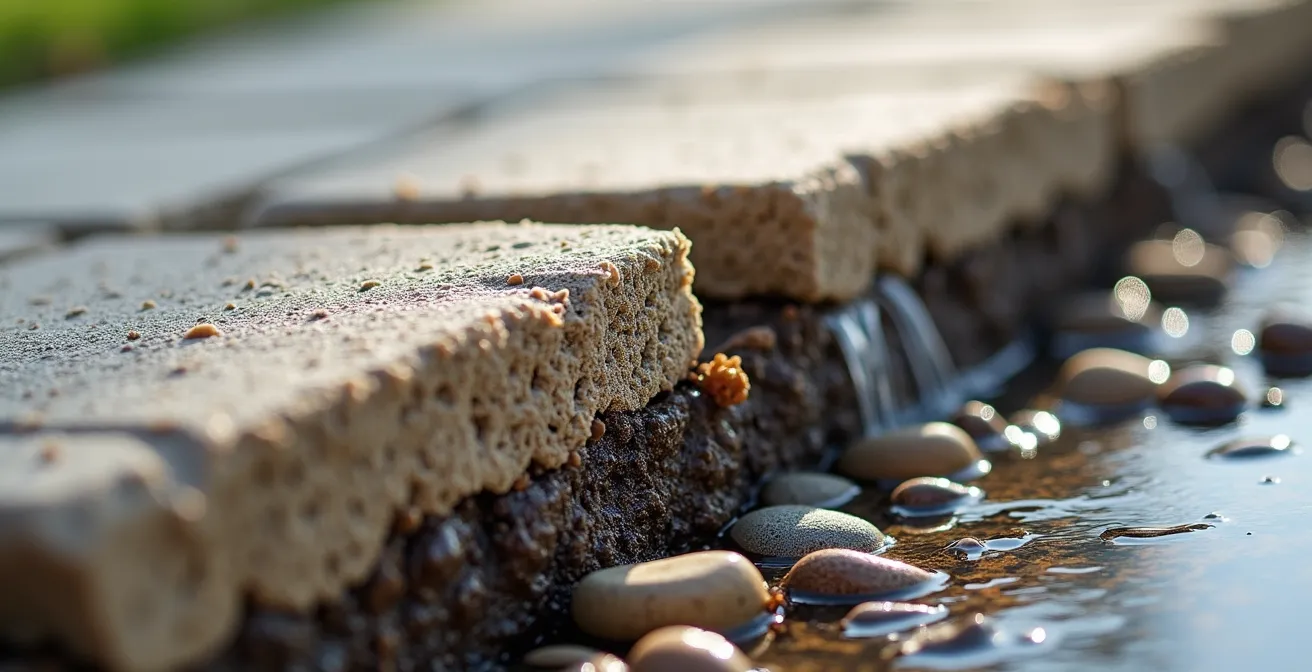
The temperature differences are dramatic, as this comparison shows. While dark asphalt can reach dangerously high temperatures, permeable systems integrated with vegetation remain remarkably cooler, making the space more usable and reducing the ambient air temperature around your home.
| Material Type | Peak Surface Temperature | Temperature Reduction vs Asphalt |
|---|---|---|
| Dark Asphalt | 152°F | Baseline |
| Concrete | 120°F | 32°F cooler |
| Light Pavers | 105°F | 47°F cooler |
| Permeable Pavers with vegetation | 90°F | 62°F cooler |
Replacing a heat-trapping surface with a permeable one is one of the most impactful interventions a homeowner can make. It directly tackles the problem of stored heat, reduces stormwater runoff, and creates a more comfortable and resilient outdoor living area. It’s a strategic shift from fighting heat to engineering a surface that breathes.
Extensive vs Intensive Green Roofs: Which Cools the Building More?
Your roof is a vast, unutilized surface area directly exposed to solar radiation. In an urban setting, a traditional dark roof is one of the most significant contributors to the heat island effect, both for your building and the surrounding environment. Transforming this surface into a living, breathing green roof is a powerful strategic move. However, not all green roofs are created equal. The choice between an “extensive” and an “intensive” system determines the level of cooling, cost, and structural requirements.
An extensive green roof is the lightweight, low-maintenance option. It involves a thin layer of soil (2-6 inches) and is typically planted with hardy, drought-tolerant vegetation like sedums. Its primary function is to provide an insulating layer, protecting the roof membrane and reducing solar heat absorption. An intensive green roof is, essentially, a rooftop garden. With a much deeper soil layer (12+ inches), it can support a wider variety of plants, shrubs, and even small trees. This greater biomass and soil depth provide significantly more insulation and, crucially, more powerful cooling through evapotranspiration.
The cooling effect is undeniable. Research from the EPA has shown that on a hot day, a green roof can be significantly cooler than a conventional roof. In some cases, it can lower rooftop temperatures by up to 27°F compared to traditional materials, which directly translates to cooler indoor spaces and lower air conditioning loads. The scale of this impact is immense; a study in Seoul, South Korea, found that covering 90% of the city’s buildings with green roofs could decrease the city-wide air temperature by up to 0.54°C and slash cooling-related energy demand by nearly 8%.
For an individual building, the greater the soil depth and plant mass (as in an intensive system), the greater the cooling potential. The thicker soil acts as a better insulator, and the larger plants transpire more water, actively pulling heat from the air. The decision, therefore, is a trade-off. An intensive roof offers superior cooling but requires significant structural support and maintenance. An extensive roof is more feasible for retrofitting but provides more modest cooling benefits. Both, however, represent a vast improvement over a heat-absorbing conventional roof.
Mist Systems vs Vegetation: Which Cools Patios More Efficiently?
The patio is often the epicenter of backyard heat, a slab of stone or concrete surrounded by heat-radiating walls. The immediate goal is to make this space bearable. The two primary tactics are technological—misting systems—and biological—vegetation. Misters provide instant cooling by flash evaporation, where tiny water droplets absorb heat from the air as they evaporate. Vegetation cools through the slower, sustained process of evapotranspiration. While misters offer a quick fix, a strategic integration of vegetation offers a more efficient, resilient, and holistic solution.
The power of vegetation as a cooling engine should not be underestimated. A single large, well-watered tree is a cooling powerhouse. It can provide a cooling effect equivalent to running ten room-sized air conditioners for 20 hours a day. This cooling comes from two mechanisms: the direct shade from its canopy and the massive amount of water it transpires through its leaves. While a misting system uses energy and water to achieve its effect, a tree is a self-powered evaporative cooler.
The most effective strategy is not to choose between technology and nature, but to integrate them. This concept of “bio-integration” creates a synergistic cooling effect that is far greater than the sum of its parts. For example, running a misting line through a vine-covered pergola is vastly more efficient than misting into open, hot air. The leaves provide a massive surface area for the mist to settle on and evaporate from, maximizing the cooling power of every drop of water while also benefiting the plant.
This approach creates layers of cooling. An overhead tree canopy provides the first layer of shade. A vine-covered pergola or trellis creates a second, lower layer of shade and an evaporative surface. Potted plants can be arranged to create green “walls” that block radiant heat from surfaces and channel cool breezes, all while adding to the overall evaporative cooling of the space. This multi-layered, living system is far more effective and sustainable than a purely mechanical one.
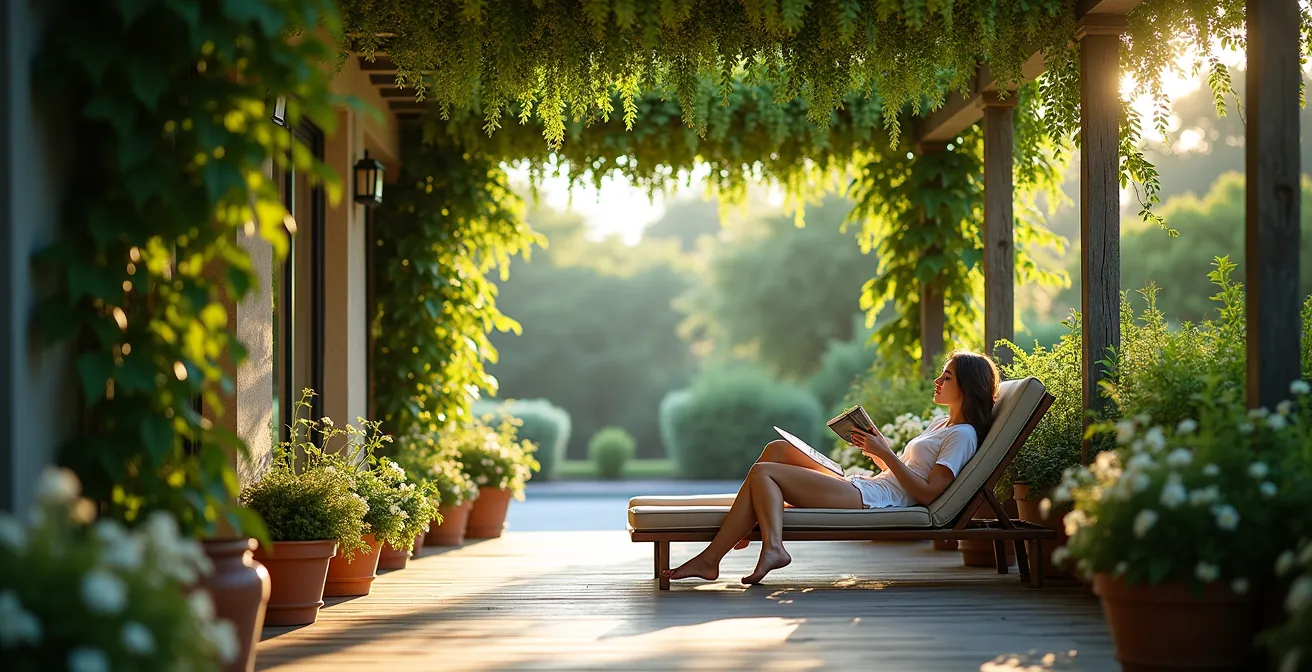
By combining the immediate relief of misters with the sustained, passive cooling of a well-designed plant ecosystem, you transform a hot patio into a comfortable oasis. This is the essence of microclimate strategy: using the right tool for the right job and making them work together.
Why Night-Time Cooling Is Crucial for Reducing Heat Island Impact?
One of the most dangerous and defining characteristics of the urban heat island effect is its persistence after sunset. While a rural field cools rapidly once the sun is gone, a city’s concrete canyons and asphalt plains continue to radiate the immense heat they absorbed during the day. This prevents cities from cooling down at night, leading to sustained thermal stress. Your own backyard is a microcosm of this phenomenon. The key to understanding this lies in the thermal properties of the materials that dominate your landscape: specifically, their emissivity and thermal mass.
Thermal mass is a material’s ability to store heat. Concrete and asphalt have very high thermal mass, acting like sponges for solar energy. Emissivity is a measure of how efficiently a surface releases that stored heat as thermal radiation. Green surfaces like grass and leaves have high emissivity; they cool down quickly at night by efficiently radiating their heat away. Conversely, many man-made materials, especially metals, have low emissivity and hold onto their heat for longer. Asphalt and concrete have a dangerous combination of high thermal mass and moderate-to-low emissivity, meaning they store a lot of heat and release it slowly, baking your yard for hours after dark.
Studies confirm this stark difference between urban and rural environments. According to the EPA, this material difference is why urban areas can be up to 5°F warmer at night than their undeveloped surroundings. The battle against the heat island is therefore not just a daytime struggle; it is an overnight war against stored energy. Reducing the amount of high-thermal-mass, low-emissivity materials is paramount.
Every square foot of lawn or garden bed you preserve or reclaim from pavement is a victory. It is a patch of high-emissivity surface that will cool down quickly, contributing to a lower ambient temperature overnight. This is why strategies like permeable pavers, green roofs, and maximizing green space are so critical. They are not just about daytime comfort; they are a direct assault on the thermal battery that keeps your home and neighborhood dangerously warm through the night, allowing your local ecosystem to “exhale” the day’s heat.
Why Mature Trees Are Worth Thousands More Than New Saplings?
In the strategic war against urban heat, not all soldiers are created equal. While planting any tree is a positive step, there is a monumental difference in the impact of a young, newly planted sapling versus a large, mature tree. A mature tree is not just a larger version of a sapling; it is an entirely different class of asset, a fully operational piece of green infrastructure whose value extends far beyond simple aesthetics. This value can be quantified in energy savings, property value, and ecosystem services.
The cooling power of a tree is directly related to its size—specifically, the surface area of its leaf canopy. A large, mature tree has thousands of times more leaf surface area than a sapling. Each leaf is a tiny evaporative cooler, transpiring water and actively pulling heat from the atmosphere. A mature tree’s vast canopy also casts a broad, dense shadow that can cool surfaces beneath it by 20–45°F compared to unshaded areas. A sapling provides a negligible puddle of shade and a tiny fraction of the evaporative cooling. It takes decades for a sapling to develop the infrastructure to provide these significant benefits.
This functional value translates directly into economic value. The USDA Forest Service has quantified this, noting that healthy, mature trees add an average of 10% to a property’s value. This is a real, market-driven valuation that recognizes the tangible benefits of shade, beauty, and an established landscape. Beyond individual properties, the collective value is staggering. An economic assessment in Louisville, Kentucky, found that the city’s tree canopy provides over $389 million in annual benefits, from stormwater management and air quality improvement to direct energy savings.
Therefore, from a strategic standpoint, preserving an existing mature tree is almost always more valuable than planting a dozen new saplings. If you are fortunate enough to have a mature tree on your property, it should be treated as your single most valuable cooling asset. Proper care, pruning, and protection are not expenses; they are investments in maintaining a piece of high-performance infrastructure. When planting new trees, one must think on a timeline of decades, understanding that the small tree planted today is a down payment on the powerful cooling engine it will become for a future generation.
Green Roof or Container Garden: Which Is Feasible for an Old Building?
The idea of transforming a barren, hot roof into a lush green space is compelling. However, for residents of older buildings, the dream of an intensive rooftop garden can quickly collide with the reality of structural engineering. The primary limiting factor for any green roof retrofit is weight. A fully saturated intensive green roof can impose a load of 80-150 pounds per square foot (or more), a stress that most older buildings were simply not designed to handle. This doesn’t mean the roof is off-limits; it means the strategy must adapt.
The key is to match the system to the structure’s capacity. For most retrofits on older buildings, a lightweight extensive green roof is the most viable built-in option. With a saturated weight of just 15-50 lbs/sq.ft, it’s a fraction of the load of an intensive system. Modern modular tray systems are even more accessible, offering a plug-and-play approach that is easy to install and distribute weight effectively. These systems provide the core benefits of a green roof—insulation, stormwater management, and membrane protection—without requiring a major structural overhaul.
Even a single large container can create a significant point load. A 24-inch terracotta pot filled with wet soil can easily exceed 200 pounds, concentrating all that weight on a tiny footprint. While a container garden is a fantastic option, it’s crucial to be strategic about distributing this weight, perhaps by placing pots over structural joists or load-bearing walls if possible.
Before any green material is brought onto a roof, a thorough structural assessment is non-negotiable. This doesn’t always require hiring an expensive engineer for a preliminary look. A homeowner can conduct an initial check for obvious red flags like visible sagging, existing leaks, or signs of water damage. Checking the building’s age and original permits can provide clues about its original load specifications. For any building over 30 years old, or if any concerns arise, consulting a structural engineer becomes an essential step for safety.
| System Type | Saturated Weight | Soil Depth | Retrofit Feasibility |
|---|---|---|---|
| Extensive green roof | 15-50 lbs/sq.ft | 2-6 inches | High |
| Semi-intensive | 25-80 lbs/sq.ft | 6-12 inches | Moderate |
| Intensive green roof | 80-150+ lbs/sq.ft | 12+ inches | Low (new construction) |
| Modular tray system | 15-40 lbs/sq.ft | 3-6 inches | Very High |
| Single 24″ terracotta pot | 200+ lbs (point load) | N/A | Moderate (with distribution) |
Feasibility is the cornerstone of strategy. A grand vision for an intensive rooftop park is useless if the building can’t support it. A well-executed, lightweight extensive system or a thoughtfully arranged container garden is infinitely more valuable, providing real cooling benefits within the safe limits of the existing structure.
Key Takeaways
- Surface Management is Paramount: Your primary goal is to replace or cover heat-absorbing surfaces (asphalt, dark concrete) with reflective, permeable, or living materials.
- Maximize the Evaporative Engine: Leverage the power of evapotranspiration. Every plant, from a mature tree to a sedum on a green roof, is an active cooling machine.
- Win the Night: The battle is won or lost after sunset. Prioritize strategies that reduce the amount of heat stored in thermal mass materials to allow your environment to cool effectively overnight.
How to Identify Microclimates in Your Home to Save Sensitive Plants?
Your backyard is not a uniform temperature zone. It is a complex tapestry of distinct microclimates—small pockets of cooler, hotter, wetter, or windier conditions created by the interplay of sun, shade, structure, and surface. It’s estimated that within a single property, mid-afternoon temperatures can vary by 15°F to 20°F between the coolest shaded spot and the hottest sun-baked wall. To act as a true cooling strategist, you must first become a cartographer of your own thermal landscape. Identifying these microclimates is the single most important step before deploying any cooling solution.
A “heat audit” sounds complex, but it can be done with simple tools and systematic observation. The goal is to map the hot spots, cool zones, and airflow patterns. The western-facing wall that bakes in the afternoon sun, the narrow passage that funnels hot wind, the cool, damp area under a dense evergreen—these are all distinct microclimates. Knowing their location and characteristics allows you to deploy interventions with surgical precision. You can place sensitive plants in naturally cooler zones, target hot spots with a new shade tree, and use reflective surfaces to bounce light away from living areas.
This process of auditing transforms your approach from guesswork to data-driven strategy. Instead of planting a tree where it “looks nice,” you plant it where your heat map shows it will intercept the most afternoon sun. Instead of placing a bench randomly, you place it in a documented cool zone that captures the evening breeze. This understanding is the foundation of an efficient and effective cooling plan. It ensures that your resources—time, money, and water—are deployed for maximum impact.
By following a simple methodology, you can create a detailed heat map of your property. This map becomes your strategic blueprint, guiding every decision and turning your entire yard into a cohesive, optimized cooling system where every element is in the right place for the right reason.
Your 7-Step Backyard Heat Audit Plan
- Map Surface Temperatures: Use an infrared thermometer to measure surface temperatures of different materials (asphalt, grass, wall, deck) at 9 AM, noon, and 3 PM on a sunny day.
- Document Hottest Surfaces: Identify and mark your primary “heat sinks” on a sketch of your yard. These are often western walls, AC condenser units, dark driveways, and metal structures.
- Identify Coolest Zones: Locate and mark the consistently coolest areas. These are typically found under dense tree canopies, near water, or in the deep shade of north-facing walls.
- Map Airflow Patterns: On a lightly breezy day, use incense sticks or a smoke pen at various points to visualize airflow, revealing hot wind corridors and channels for cool breezes.
- Measure Vertical Heat: Check temperatures at different heights on sun-exposed walls (e.g., ground level, 3 feet, 6 feet) to understand how heat radiates upwards.
- Create a Heat Map Diagram: Synthesize your findings onto your yard sketch, using colors or labels to denote hot, warm, and cool zones. This is your strategic blueprint.
- Designate Safe Havens: Note any microclimates that consistently stay 5°F or more cooler than their surroundings. These are ideal locations for sensitive plants or seating areas.
Begin your backyard heat audit today. The fight against the urban heat island effect is won one property at a time, and your yard is the front line. By moving from passive decoration to active thermal management, you not only reclaim your own space but contribute to a cooler, more resilient community.