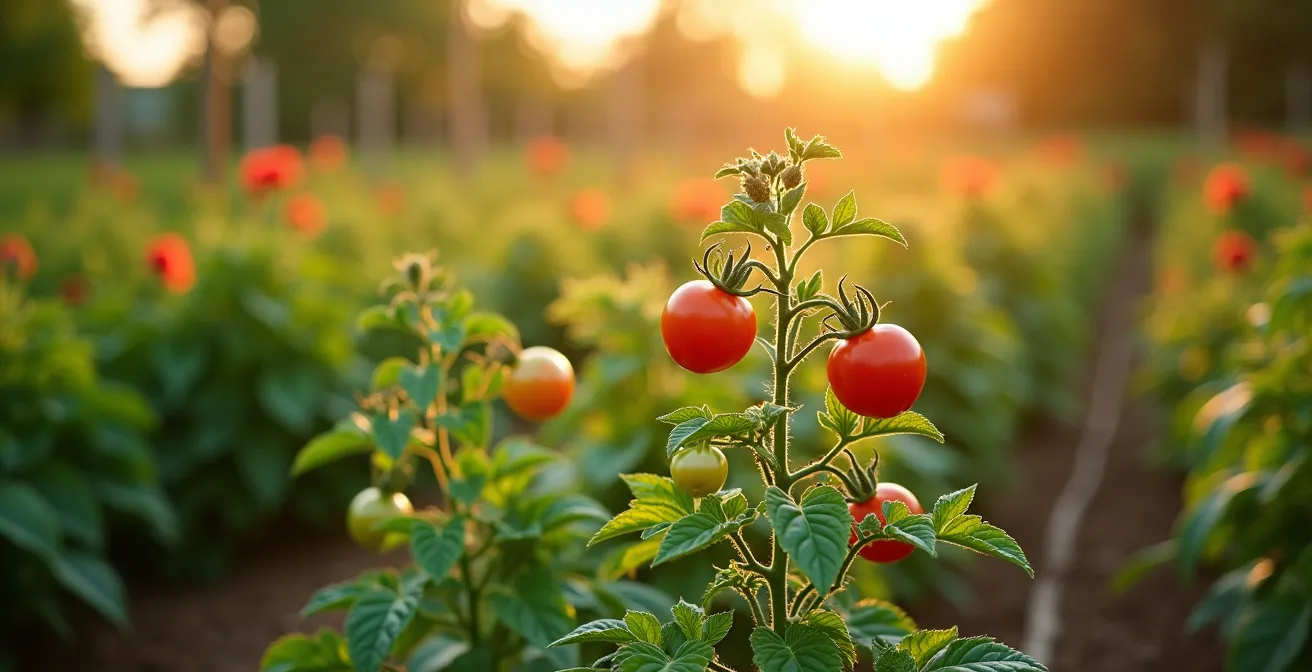
The secret to a thriving garden isn’t just knowing what N-P-K means; it’s understanding that these nutrients work in a dynamic, often competitive, system.
- Excess nitrogen can actively halt fruit production in favor of weak, leafy growth.
- Nutrient availability is dictated by soil pH and microbial life, meaning a fertilizer can be useless in the wrong environment.
- Timing the switch between nutrient profiles is more critical than the specific brand you use.
Recommendation: Stop feeding by the label and start feeding based on your plant’s life stage and observable soil conditions to prevent burnout and unlock its true potential.
That bag of fertilizer, with its three bold numbers, feels like a secret code. You know N-P-K stands for Nitrogen, Phosphorus, and Potassium—the primary macronutrients for plant life. The common advice is simple: nitrogen for leaves, phosphorus for roots, and potassium for flowers. Yet, this simplification is the root of so much gardening frustration. You follow the rules, but the results are lackluster: lush leaves with no tomatoes, weak stems that flop over, or yellowing leaves despite regular feeding. You live in fear of the most common mistake: a heavy hand that leads to the dreaded “fertilizer burn,” leaving you with crispy, brown-tipped leaves overnight.
The problem isn’t the fertilizer; it’s the approach. Viewing plant nutrition as a static formula to be applied is a recipe for failure. The real breakthrough comes when you shift your perspective. A garden is not a factory; it’s a complex biological system where nutrients interact, compete, and are only made available under specific conditions. Factors like soil pH, microbial life, and the plant’s own growth stage are just as important as the numbers on the bag. This isn’t about more fertilizer, but smarter application.
This guide will move beyond the basic “what” of N-P-K and into the critical “how” and “when.” We will deconstruct the dynamic interplay between these essential elements. You’ll learn not just to read the numbers, but to interpret what your plants and soil are telling you. By understanding the mechanisms of nutrient uptake, antagonism, and timing, you can stop guessing and start cultivating a garden that doesn’t just survive, but explodes with vigorous, healthy growth. This is the path to becoming a gardener who works with nature’s systems, not against them.
To navigate this complex but rewarding topic, we’ve structured this guide to build your expertise step-by-step, from foundational principles to advanced organic strategies.
Summary: Your Roadmap to Mastering Plant Nutrition
- Why Too Much Nitrogen Sacrifices Fruit for Green Leaves?
- How to Use Bone Meal to Boost Root Development Naturally?
- Liquid Feed or Granular Spikes: Which Provides Steady Nutrition?
- The Dosing Mistake That Turns Leaf Tips Brown Overnight
- When to Switch to High-Potassium Feed for Bigger Blooms?
- Straw vs Wood Chips: Which Mulch Feeds Fungi vs Bacteria?
- Why Do Veins Stay Green While Leaves Turn Yellow?
- How to Adopt Organic Horticultural Practices for Higher Vegetable Yields?
Why Too Much Nitrogen Sacrifices Fruit for Green Leaves?
Nitrogen (N) is the engine of vegetative growth, responsible for creating the lush, green foliage that powers photosynthesis. This has led to a common belief that “more is better.” However, an overabundance of nitrogen is one of the most frequent causes of a disappointing harvest. When a plant receives excessive nitrogen, it directs all its energy into producing soft, sappy leaves and weak stems at the direct expense of its reproductive functions—namely, flowering and fruiting. The plant becomes a beautiful green tower that fails to produce the very thing you’re growing it for.
This isn’t just an aesthetic issue; it creates a cascade of problems. The weak, overly lush foliage is a prime target for pests like aphids, who are drawn to the high nitrogen content. The plant’s structural integrity is compromised, making it susceptible to wind damage and lodging. The core issue is a hormonal imbalance. The plant remains in a perpetual state of vegetative growth, never receiving the signal to switch its focus to producing buds, flowers, and fruit. In fact, dialing back nitrogen at the right time can have a profound positive effect. For example, research on tomatoes found that reducing nitrogen to 30% during vegetative growth increased fresh tomato yield by 32.9%.
The key is to provide just enough nitrogen to build a healthy plant structure in the early stages and then reduce the supply as the plant approaches its flowering and fruiting phase. This strategic reduction is the trigger that tells the plant it’s time to shift energy from leaf production to making the flowers and fruits that lead to a successful harvest. It’s a classic case of where less is truly more.
How to Use Bone Meal to Boost Root Development Naturally?
Phosphorus (P) is celebrated for its role in strong root development, energy transfer, and flower production. Bone meal, with its typical 3-15-0 N-P-K ratio, is a classic organic amendment gardeners turn to for a phosphorus boost. It’s seen as a slow-release “bank” of P for the soil. However, simply adding bone meal to your garden does not guarantee your plants can use it. The effectiveness of bone meal is entirely dependent on one critical factor: soil pH.
Phosphorus from bone meal is only available to plants in acidic conditions. According to soil science experts, bone meal phosphorus is only available in soils with a pH below 7.0. If your soil is neutral or alkaline (above 7.0), the phosphorus remains “locked up” and inaccessible to plant roots, no matter how much you apply. You’re adding an ingredient the plant simply cannot metabolize. This is a perfect example of how understanding the soil system is more important than the amendment itself.
For a more reliable phosphorus strategy, especially in alkaline soils, consider fostering a healthy soil food web with mycorrhizal fungi. These beneficial fungi form a symbiotic relationship with plant roots, creating a vast network of hyphae that extends far beyond the roots themselves. They are experts at sourcing and transporting phosphorus directly to the plant, effectively bypassing soil pH limitations. Unlike bone meal, which is a passive resource, mycorrhizae are an active delivery system, continuously working to feed your plants in exchange for carbohydrates. For long-term plant health and robust root systems, inoculating your soil with mycorrhizal fungi often proves to be a more resilient and effective strategy than relying solely on pH-dependent amendments.
Liquid Feed or Granular Spikes: Which Provides Steady Nutrition?
The debate between liquid fertilizers and their solid counterparts—granular formulas or spikes—is fundamentally about control versus convenience. Neither is universally “better”; they are different tools for different jobs, best understood with the analogy of “spoon-feeding” versus a “buffet.” Liquid feeds are the ultimate tool for precise, immediate nutrition. When mixed with water, the nutrients are instantly available to plant roots. This makes them ideal for fast-growing annuals in containers, which have limited soil volume and high nutrient demands, or for providing a quick corrective boost to a plant showing signs of deficiency. However, this speed comes with risks. It’s easy to over-apply, leading to fertilizer burn, and the nutrients leach out of the soil quickly, requiring frequent applications (often weekly or bi-weekly).
Granular fertilizers and spikes, on the other hand, offer a “set it and forget it” approach. They are designed to release nutrients slowly over a period of weeks or months as they are broken down by water and soil microbes. This provides a steady, sustained “buffet” of food for established plants in the ground, like perennials, shrubs, and trees. The risk of burning roots is lower, though “hot spots” can occur if granules are concentrated in one area. The trade-off is a lack of immediate control; you cannot provide a quick boost during a critical growth phase.
The most effective strategy often involves a hybrid approach. Use a slow-release granular fertilizer early in the season to build a solid nutritional base. Then, use targeted liquid feeds as a “boost” at critical moments, such as just before flowering or during heavy fruit production. This gives you the best of both worlds: the long-term stability of a buffet and the precision of spoon-feeding when it matters most.
This table breaks down the core differences to help you choose the right tool for the job:
| Factor | Liquid Feed | Granular/Spikes |
|---|---|---|
| Delivery Method | Spoon-feeding (precise) | Buffet-style (sustained) |
| Best For | Container annuals | Established ground plants |
| Nutrient Release | Immediate | Slow, over months |
| Salt Index Risk | High – can burn roots | Hot spots possible |
| Application Frequency | Weekly/bi-weekly | Once per season |
| Control Level | High precision | Set and forget |
The Dosing Mistake That Turns Leaf Tips Brown Overnight
The most common fear for any gardener is fertilizer burn. You apply what you think is a helpful dose of nutrients, and the next day, the tips of your plant’s leaves are brown, dry, and crispy. This damage is caused by an excessive concentration of fertilizer salts in the soil, which creates a reverse-osmosis effect. Instead of water flowing from the soil into the plant’s roots, the high salt level literally pulls water *out* of the roots, desiccating them and leading to the characteristic burn on the foliage. The single biggest mistake that causes this is fertilizing dry soil.
As one mycology expert memorably put it in the Gardening Know How NPK Guide: “Never feed dry soil – it burns roots.” When soil is dry, any liquid fertilizer you add remains highly concentrated around the roots. However, if the soil is thoroughly watered *before* you fertilize, the water acts as a buffer, diluting the fertilizer and allowing it to spread evenly throughout the root zone, dramatically reducing the risk of burn. Think of it as the difference between pouring salt on a dry sponge versus a wet one; the wet sponge disperses the salt, while the dry one holds it in a concentrated spot.
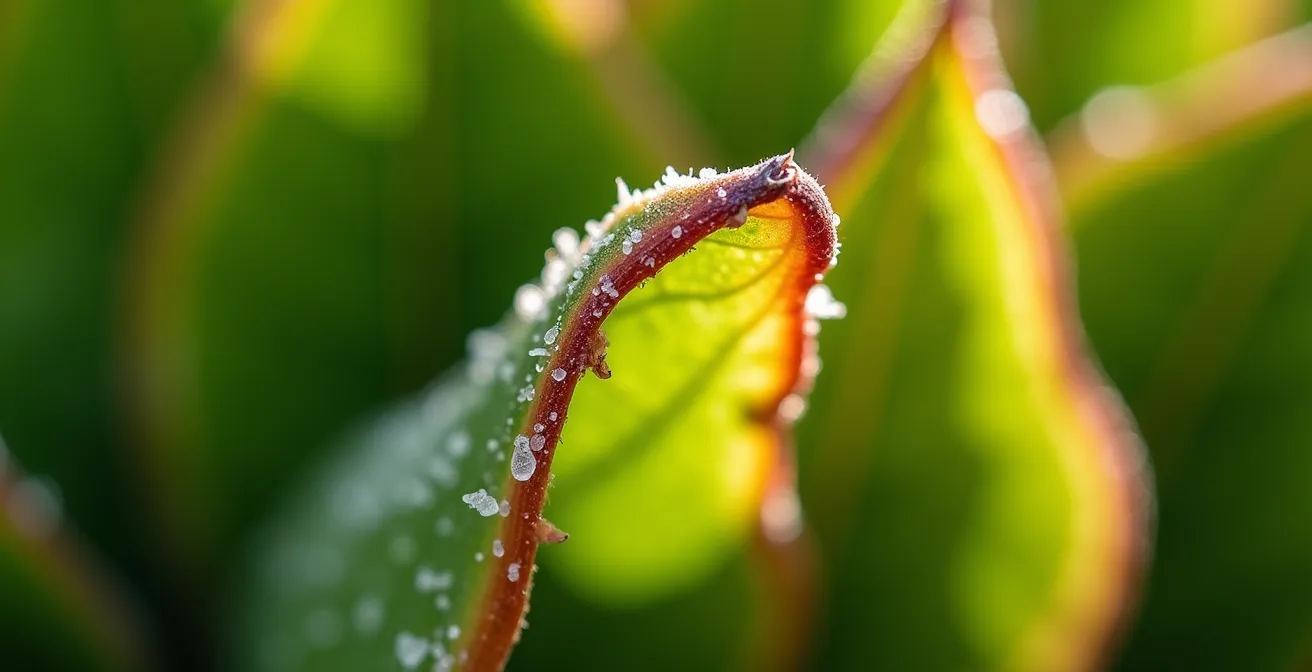
If you do make a mistake and see the signs of fertilizer burn, don’t panic. The damage to the leaves is permanent, but you can save the plant by taking immediate action to flush the excess salts out of the soil. The key is to act quickly to prevent further damage to the root system. Prune the damaged leaves for aesthetic reasons and to reduce stress on the plant, then give it time to recover before even thinking about fertilizing again.
Your Action Plan: Emergency Protocol for Fertilizer Burn Recovery
- Immediately stop all feeding and remove any visible granular fertilizer from the soil surface.
- For container plants, take the pot to a sink or outdoor area and slowly flush it with a volume of plain water equal to 2-3 times the pot’s volume. Let it drain completely.
- For in-ground garden beds, water the affected area deeply and slowly for an extended period to help dilute the fertilizer salts and push them deeper into the soil profile, away from the primary root zone.
- Prune off the severely damaged brown leaf tips or entire leaves. This won’t reverse the damage but improves the plant’s appearance and reduces areas for potential disease.
- Wait for new, healthy growth to appear before resuming any feeding. This is a clear sign the plant is recovering. When you do resume, start with a fertilizer solution diluted to half the recommended strength.
When to Switch to High-Potassium Feed for Bigger Blooms?
Potassium (K), the final number in the N-P-K trio, is the master regulator. It plays a crucial role in over 60 different enzyme systems within a plant, governing everything from water movement and photosynthesis to sugar transport. For the gardener, its most celebrated role is in promoting strong flowering and fruiting. While a balanced fertilizer is fine for general growth, a strategic switch to a high-potassium feed at the right moment can dramatically increase the size, quality, and quantity of your blooms and fruit.
The key is timing. Applying a high-K fertilizer too early is wasteful, and applying it too late will have a diminished effect. You must learn to read your plant’s visual cues. For fruiting plants like tomatoes or peppers, the ideal time to switch is when the first tiny fruits begin to form, roughly the size of a marble. This is when the plant’s energy demand shifts from building structure to developing fruit. For flowering plants like roses, a great time is right after deadheading the first major flush of blooms, to fuel the next wave. For annuals, begin the switch when you see the first distinct flower buds appearing, not just leafy growth.
However, more potassium isn’t a silver bullet. It’s crucial to understand the concept of nutrient antagonism. An excess of one nutrient can block the uptake of others, even if they are present in the soil. Potassium is known to compete with magnesium (Mg) and calcium (Ca). Applying excessive potassium can induce a magnesium or calcium deficiency, leading to symptoms like yellowing between leaf veins. In fact, deep scientific research shows excessive potassium blocks magnesium and calcium uptake when the Ca/P ratio is critical. The goal is not to flood the plant with potassium, but to shift the N-P-K ratio in its favor, often by choosing a “bloom booster” formula (like 1-3-2) and reducing nitrogen simultaneously.
Straw vs Wood Chips: Which Mulch Feeds Fungi vs Bacteria?
Mulching is a cornerstone of smart gardening, but not all mulches are created equal. Beyond conserving moisture and suppressing weeds, your choice of mulch actively shapes the soil’s “microbial economy.” The type of microbes you encourage—bacteria or fungi—depends on the carbon-to-nitrogen (C:N) ratio of your mulch, which in turn affects how nutrients are cycled in your soil. Understanding this relationship allows you to tailor your mulch to the specific needs of your plants.
Materials with a low C:N ratio, like straw, grass clippings, or compost, are easily broken down. They are a feast for fast-acting bacteria. This bacterial-dominated decomposition rapidly releases nutrients into the soil, making it perfect for hungry annual vegetable gardens that need a quick and steady supply of food throughout a single growing season. On the other hand, materials with a high C:N ratio, like wood chips or bark, are tough and lignin-rich. These are the preferred food source for slower-acting fungi. A fungal-dominated soil web is ideal for perennial plants, shrubs, and trees, as fungi are experts at breaking down complex woody material over months or even years, creating a stable, long-term nutrient cycle that mimics a forest floor.
The primary concern with high-carbon mulches like fresh wood chips is the phenomenon of “nitrogen robbing.” As microbes work to decompose the carbon-rich material, they require nitrogen to build their bodies. If there isn’t enough in the mulch itself, they will pull it from the surrounding soil, temporarily making it unavailable to plant roots and causing yellowing leaves. To counteract this, a simple solution is to mix a nitrogen source like blood meal or alfalfa meal with the wood chips before applying them. This feeds the microbes so they don’t have to “steal” from your plants.
This table from a study on soil biology highlights the different roles these mulches play:
| Mulch Type | Dominant Microbe | Nutrient Cycle Speed | Best Application | C:N Ratio |
|---|---|---|---|---|
| Straw/Grass | Bacteria | Fast (weeks) | Annual vegetables | 20-30:1 |
| Wood Chips | Fungi | Slow (months-years) | Perennials/Trees | 100-500:1 |
| Compost | Balanced | Moderate | All plants | 15-20:1 |
| Bark | Fungi | Very slow | Ornamental beds | 200-300:1 |
Why Do Veins Stay Green While Leaves Turn Yellow?
Seeing a plant’s leaves turn yellow while the veins remain starkly green is a classic and alarming symptom. This pattern, known as interveinal chlorosis, is a clear signal of a nutrient deficiency. But which one? The answer lies in understanding nutrient mobility. Nutrients are categorized as either “mobile” or “immobile” within a plant. Mobile nutrients (like Nitrogen, Phosphorus, Potassium, and Magnesium) can be moved by the plant from older tissues to newer growth. Immobile nutrients (like Iron, Calcium, and Manganese) cannot; once they are placed in a leaf, they are locked in.
This distinction is your primary diagnostic tool. If the yellowing appears on the older, lower leaves, it signals a mobile nutrient deficiency. The plant is sacrificing its old leaves to salvage precious mobile nutrients and send them to the new, vital growth at the top. Magnesium deficiency is a common culprit for this pattern. Conversely, if the yellowing with green veins appears on the newest, youngest leaves at the top of the plant, it points to an immobile nutrient deficiency. The plant cannot move these nutrients from its older leaves, so the new growth suffers first. Iron deficiency is the most frequent cause of this symptom.
However, the problem may not be a lack of nutrients in the soil, but rather a nutrient lockout caused by improper pH. Iron, for instance, becomes increasingly unavailable to plants as soil pH rises above 7.0. Similarly, some fertilizers containing phosphorus become completely unavailable to plants when soil pH is too high or low. Before adding any supplements, your first step should always be a soil pH test. For a quick fix, chelated iron can be applied as a foliar spray for immediate uptake, but the long-term solution involves correcting the soil pH, often by adding elemental sulfur to lower it into the optimal range for nutrient absorption.
Key Takeaways
- Balancing nutrients is a game of ratios and timing, not just quantity. Excess of one nutrient can be as harmful as a deficiency.
- Soil health, particularly pH and microbial life, dictates whether the nutrients you apply are actually available to your plants.
- Observing your plants—where they turn yellow, when they set bud—is your most important tool for knowing when and how to feed them.
How to Adopt Organic Horticultural Practices for Higher Vegetable Yields?
Moving towards an organic approach doesn’t mean sacrificing yield; it means building a self-sustaining system that provides a broader spectrum of nutrition. Instead of relying on synthetic, isolated N-P-K, organic horticulture focuses on feeding the soil food web, which in turn feeds the plants. This creates a resilient garden with enhanced nutrient uptake and better overall health. The key is to adopt a dynamic strategy that provides different nutrient profiles at different stages of plant growth, using natural and often homemade amendments.
This “phased feeding” can be achieved easily. In early spring, for vegetative growth, use a high-nitrogen “tea” made from comfrey or nettle leaves. As plants approach the flowering stage, switch to a balanced, all-purpose organic granular fertilizer. Once flowering and fruiting begin, provide a potassium boost with a fermented tea made from banana peels. A powerful technique from Korean Natural Farming (KNF) involves creating Fermented Plant Juice (FPJ) from vigorous, fast-growing weeds, which captures their growth hormones and nutrients to create a potent, phase-specific stimulant. The KNF approach exemplifies this holistic view, emphasizing the use of indigenous microorganisms and natural inputs to create a vibrant soil ecosystem.
Case Study: Korean Natural Farming Success
Growers implementing Korean Natural Farming techniques have seen significant yield improvements in vegetable production. By using FPJ from spring weeds as a nitrogen-focused growth stimulant and later switching to fermented fruit juices high in phosphorus and potassium, they successfully match the plant’s nutritional needs throughout its lifecycle. The core lesson from this practice is clear: success hinges on keen observation. As the KNF philosophy suggests, watching for signs of imbalance and adjusting your approach based on the plant’s signals is what ensures a bountiful harvest, season after season. It’s a dance between the gardener and the garden, not a rigid prescription.
Ultimately, the goal of organic horticulture is to close the nutrient loop. This involves continuously adding organic matter through mulching and composting, using microbial inoculants like mycorrhizal fungi to enhance phosphorus uptake, and performing occasional soil tests to monitor the health and diversity of your soil’s microbial population. It’s a more involved process than just applying a “balanced” fertilizer, but the results are a healthier, more productive, and more resilient garden.
By moving beyond simple N-P-K numbers and embracing your garden as a living system, you can provide your plants with the precise nutrition they need, right when they need it. Start today by observing your plants, testing your soil, and making one small, informed adjustment to your feeding strategy.