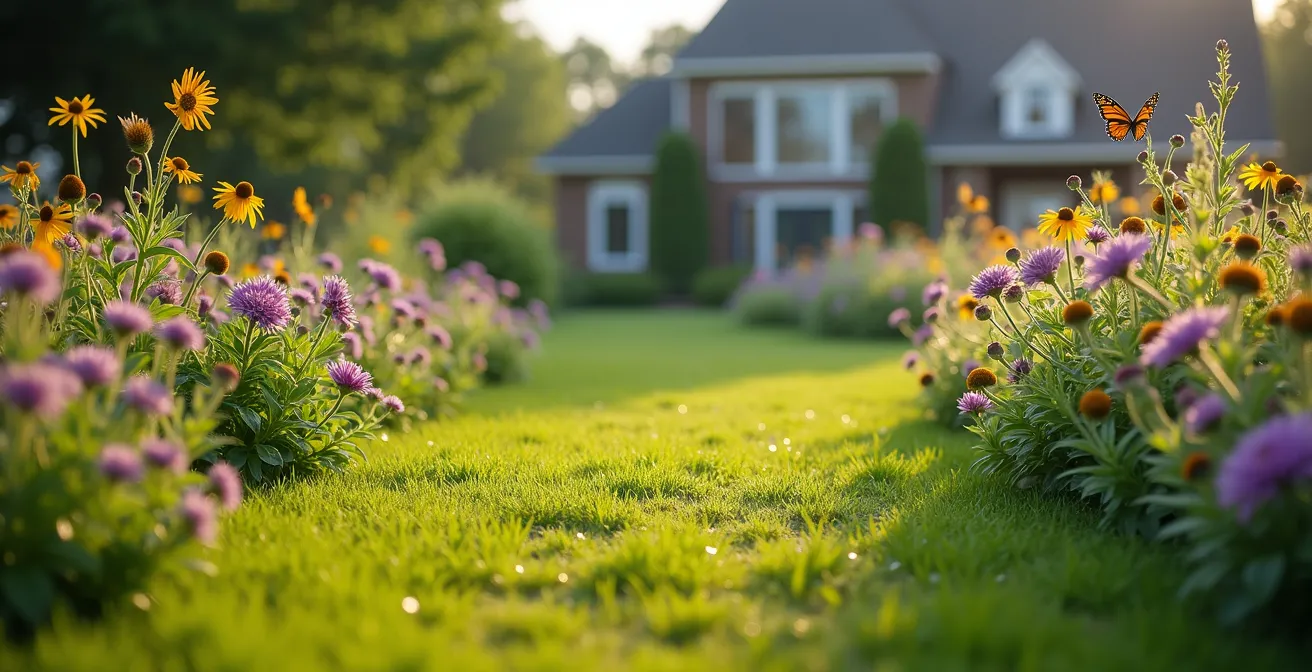
Many gardeners feel torn between maintaining a tidy, manicured lawn and the growing desire to support local wildlife. This guide resolves that conflict by showing it’s not an either/or choice. By implementing structured, intentional “pockets of life”—from artful log borders to smarter mowing patterns—you can create a rich ecosystem that looks deliberate and cared-for. It proves that a beautiful garden and a biodiverse one can be the same thing.
For the conscientious gardener, the pristine, uniform green of a suburban lawn can be a source of both pride and quiet conflict. You appreciate the order and neatness, yet you hear the call to support struggling pollinators and local wildlife. The common advice often feels like an ultimatum: let your yard run wild and embrace the “mess,” or continue with practices that offer little for the ecosystem. This creates a false dichotomy, suggesting that a garden cannot be both aesthetically pleasing and ecologically functional.
The prevailing wisdom pushes for large-scale rewilding or complete lawn replacement, which can feel overwhelming and aesthetically jarring for those who value a structured landscape. But what if the solution isn’t about abandoning control, but about redefining it? What if the most effective approach wasn’t about letting go, but about making deliberate, artful additions? The key lies in shifting our perspective from one of passive neglect to one of active, intentional habitat creation.
This guide offers a third way—a diplomatic path for the suburban conservationist. We will explore how to weave biodiversity into the very fabric of your manicured garden, not by sacrificing neatness, but by enhancing it with purposeful ecological features. You’ll learn to see your garden not as a single entity, but as a mosaic of opportunities where “cues of care” and vibrant ecosystems can coexist beautifully. It’s about making small, incremental changes that deliver a significant ecological impact while respecting your aesthetic standards.
To help you navigate this new approach, this article is structured to provide practical, step-by-step guidance. We will explore specific, manageable actions you can take to transform your yard into a structured sanctuary.
Summary: Weaving Biodiversity into a Manicured Lawn: An Eco-Gardener’s Guide
- Why a Log Pile Behind the Shed Is a Goldmine for Biodiversity?
- Does Letting Grass Grow for One Month Really Help Pollinators?
- Pond or Birdbath: Which Water Source Supports More Diverse Species?
- The Hybrid Seed Mistake That Offers No Genetic Diversity
- When to Cut Back Perennials to Protect Overwintering Insects?
- The Mulch Mistake That Blocks Ground-Nesting Bees
- Why Native Gardens Look Messy to Some and How to Give Them Structure?
- How to Implement Sustainable Management in a Suburban Garden?
Why a Log Pile Behind the Shed Is a Goldmine for Biodiversity?
One of the simplest and most effective ways to create an “ecological pocket” is to build a log pile. Often dismissed as yard waste, dead wood is a cornerstone of a healthy ecosystem. Tucked away behind a shed or in a discreet corner, a stack of logs, branches, and even old stumps becomes a bustling hub of life. This feature provides critical shelter for a vast array of organisms, from beneficial insects like beetles and centipedes to amphibians like salamanders and even small mammals.
This “habitat architecture” doesn’t have to look messy. Instead of a haphazard pile, you can create intentional designs. By using sections of logs to create beautiful borders around garden beds or stacking them vertically, you transform a simple resource into an aesthetic feature that signals care and purpose. This structure is particularly vital for pollinators. In fact, research from the USDA National Agroforestry Center reveals that nearly 70% of native bee species excavate nests underground, often choosing locations near the base of woody debris that provides protection and stable conditions.
The decaying wood also functions as a slow-release fertilizer, enriching the soil as it breaks down. Fungi, mosses, and lichens will colonize the logs, adding another layer of biodiversity and visual interest. A log pile is a low-effort, high-impact investment in your garden’s ecological health, proving that what is often considered waste can be a treasure trove of life.
Does Letting Grass Grow for One Month Really Help Pollinators?
The idea of “No Mow May” has gained popularity, but the all-or-nothing approach can feel extreme for a traditional gardener. The good news is that you don’t need to let your entire lawn become a wild meadow to make a significant difference. A more sustainable and aesthetically pleasing strategy is to adopt “less-mow” or “smart-mow” practices. This involves altering your mowing frequency and patterns to allow low-growing flowers to bloom and support pollinators.
Research has shown that simply changing mowing frequency from weekly to every two or three weeks can dramatically increase the abundance and diversity of bees. This allows common lawn plants like clover, self-heal, and dandelions to flower, providing crucial nectar and pollen. To maintain a “cared-for” look, you can implement creative mowing patterns. Creating serpentine paths or leaving unmown “islands” of taller grass within the lawn creates a sense of intentional design, a concept known as “structured wildness.”
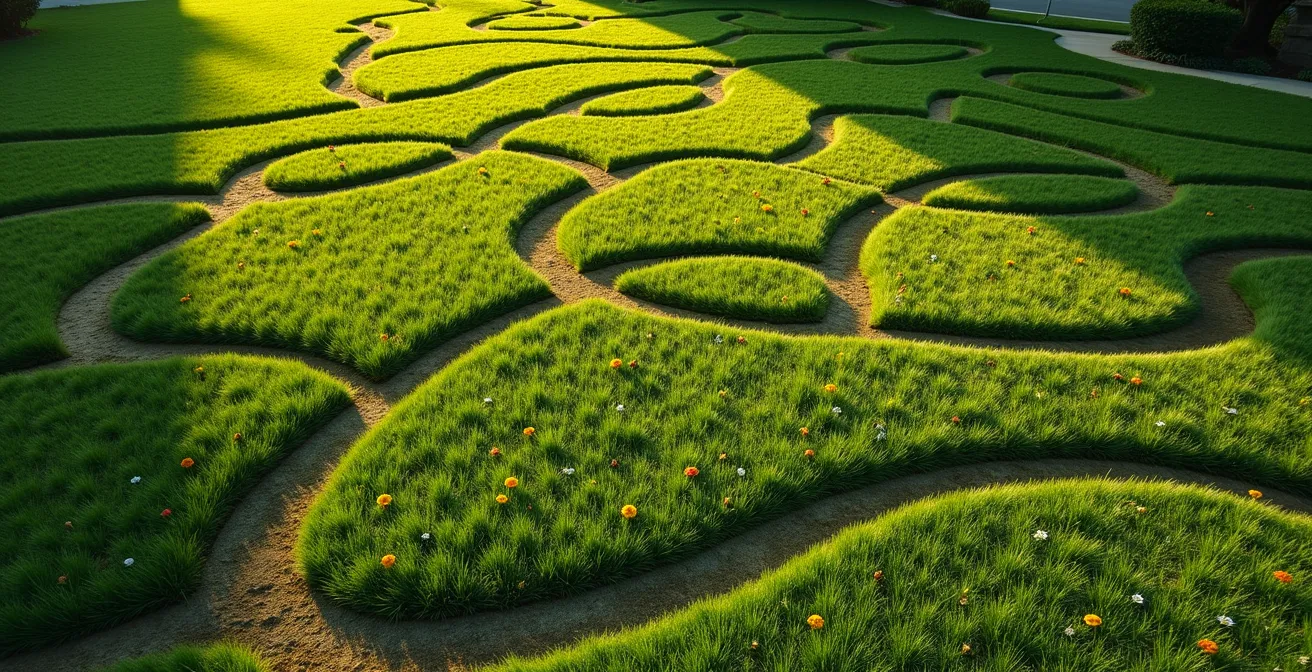
As the image above demonstrates, these patterns show that human intervention and ecological support can coexist. Setting your mower to its highest setting (around 4 inches or 10 cm) is another simple change that gives these small flowers a chance to thrive beneath the blades. This incremental approach allows you to support pollinators without sacrificing the utility and tidy appearance of your lawn.
- Mow every 2-3 weeks instead of weekly to increase floral resources.
- Create “meadow-mowing” patterns by leaving serpentine paths or islands of long grass.
- Set your mower deck to its highest setting to spare low-growing flowers.
- Leave at least 30% of the lawn area unmowed during peak flowering season to act as a refuge.
Pond or Birdbath: Which Water Source Supports More Diverse Species?
Adding a water source is one of the most impactful actions you can take for wildlife, but not all water features are created equal. The choice between a simple birdbath and a small pond represents a trade-off between maintenance, space, and the sheer diversity of life it can support. While any clean water is beneficial, a pond offers exponentially more ecological value.
A birdbath acts as a “service station.” It’s an essential resource for birds, bees, and butterflies to drink and bathe, but it primarily supports mobile species that visit and then leave. It requires frequent cleaning—often daily in hot weather—to prevent the spread of disease and to stop mosquitoes from breeding. In contrast, a small, well-designed pond functions as a complete, self-sustaining habitat. It supports the entire life cycle of numerous species, from dragonflies and damselflies laying their eggs to frogs and salamanders developing from tadpoles.
The following comparison, based on an analysis of lawn biodiversity strategies, highlights the key differences in ecological impact.
| Feature | Birdbath | Small Pond |
|---|---|---|
| Species Supported | Mobile species only (birds, bees) | Complete life cycles (dragonflies, amphibians, diving beetles) |
| Function | Service station for drinking/bathing | Complete habitat ecosystem |
| Maintenance | Daily water changes needed | Self-sustaining with proper setup |
| Disease Risk | High if not cleaned regularly | Lower with natural balance |
| Biodiversity Value | Limited – supports 10-15 species | High – supports 50+ species |
While a pond requires more initial effort to install, it can become a largely self-managing feature once a natural balance is established with aquatic plants. For the gardener looking for maximum impact, a small pond is an unparalleled addition, creating a vibrant ecosystem right in your backyard.
The Hybrid Seed Mistake That Offers No Genetic Diversity
The choices made at the nursery or in a seed catalog have profound, often invisible, consequences for your garden’s ecosystem. A common mistake is prioritizing showy, modern hybrids (often labeled as F1) or non-native “nativars” over true, open-pollinated native species. While these plants may be beautiful, they often function as ecological dead ends, offering little to no food for local insects and providing no genetic diversity for future resilience.
Native plants co-evolved with local wildlife for millennia, creating intricate relationships. Insects, especially the caterpillars of butterflies and moths, are often specialists that can only feed on specific native host plants. When we plant non-natives, we effectively starve them. The difference is staggering. For example, research from the National Wildlife Federation shows that a native oak tree can support over 550 species of caterpillars, which are a critical food source for birds. A non-native Ginkgo tree, by contrast, supports fewer than five.
These powerhouse native plants are known as keystone species. Just as a keystone in an arch supports the entire structure, keystone plants form the foundation of the local food web. Entomologist Doug Tallamy’s research has been instrumental in showing how gardens planted with these vital natives become “living landscapes.” These plants are not only beautiful but are essential for supporting birds, beneficial insects, and other animals. Choosing true native species over their sterile or genetically uniform cousins is a crucial step in creating a garden that is a participant in, not just an observer of, the local ecosystem.
When to Cut Back Perennials to Protect Overwintering Insects?
The tidy gardener’s instinct to “clean up” the garden in the fall can unintentionally harm the very creatures we want to help. The hollow stems and seed heads of perennials, along with leaf litter, provide crucial overwintering habitat for a huge variety of insects, including native bees, lacewings, and the chrysalises of butterflies.
By cutting everything down to the ground in October, we are essentially throwing away the next generation of pollinators and beneficial predators. The best practice is to delay your cleanup until spring. The science-based guideline is to wait until you’ve had one week of consistent daytime temperatures above 50°F (10°C). This ensures that the overwintering insects have had a chance to emerge. This practice of “leaving the leaves” and stems is a form of passive habitat architecture.
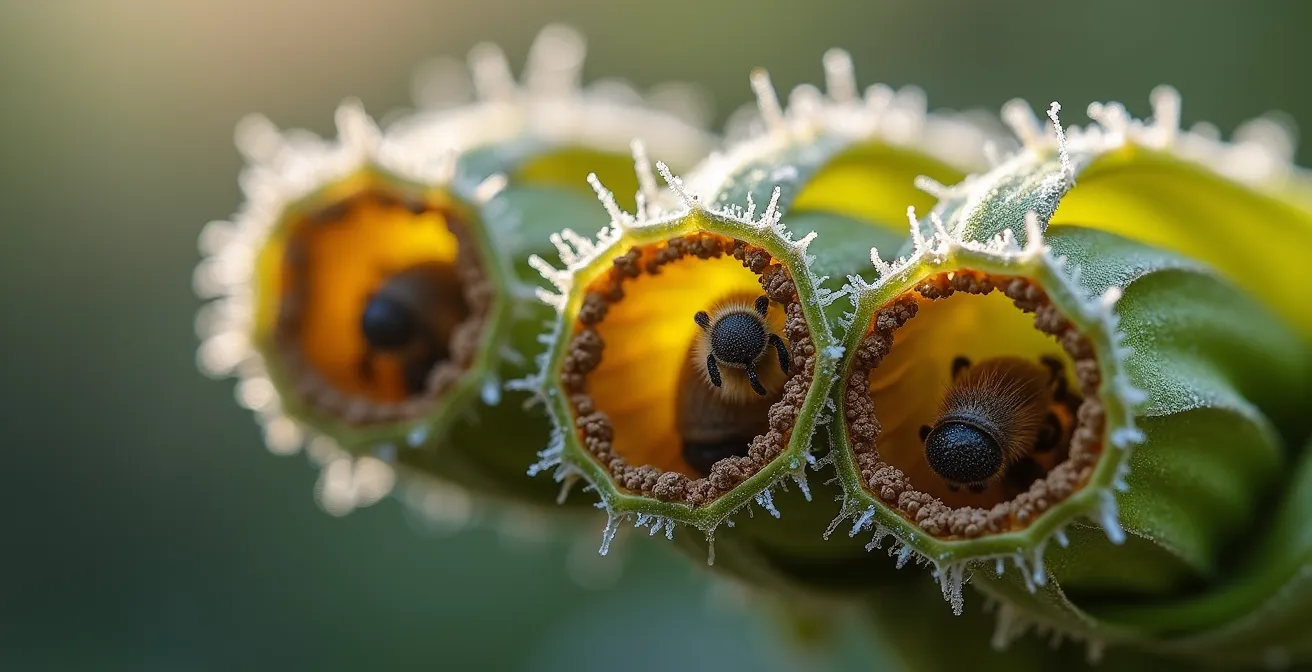
As this macro view shows, the pithy and hollow stems of plants like bee balm, raspberry, and elderberry are not dead debris but are insect real estate. When it is time to clean up, you can adopt a “chop and drop” method. Instead of removing the stems, cut them into 6-12 inch pieces and let them fall as natural mulch. You can also bundle hollow stems and leave them in a discreet corner of the garden to provide continued shelter. This patient approach transforms a fall chore into a powerful act of conservation.
The Mulch Mistake That Blocks Ground-Nesting Bees
Mulch is a gardener’s best friend for suppressing weeds and retaining moisture, but a thick, uniform layer of wood chips across every garden bed can create an impenetrable barrier for a vital group of pollinators. Many people are surprised to learn that the Xerces Society reports that a staggering 70% of native bee species are ground-nesters. These solitary bees need access to bare, undisturbed soil to excavate their nests.
When we apply a 3-inch layer of wood mulch everywhere, we are effectively putting up a “no vacancy” sign. A study from UC Santa Cruz specifically investigated the impact of various garden factors on bee populations and found a negative correlation between the area covered by mulch and the diversity of bee species present. This doesn’t mean you have to abandon mulch entirely. The solution lies in a more strategic, nuanced application.
Instead of wall-to-wall coverage, focus on leaving some areas of bare earth, especially in sunny, well-drained spots. A very practical compromise for maintaining a neat appearance is to mulch only the visible front two feet of your garden beds. The area behind, hidden by plants, can be left bare or covered with a lighter material like shredded leaves or compost, which ground bees can more easily navigate. You can also intentionally design patches of bare ground or sandy banks as small, purposeful features in your landscape.
- Leave patches of bare, undisturbed soil near flowering plants.
- Use compost or shredded leaves as a “living mulch” instead of heavy wood chips.
- Create intentional south-facing sandy banks as nesting features.
- Plant low-growing native groundcovers that still allow bees to access the soil between plants.
Key takeaways
- The perception of a “messy” native garden is overcome by using “cues of care” like mown borders and clear paths to signal intentional design.
- Strategic inaction, such as delaying spring cleanup and leaving plant stems standing, is one of the most powerful and effortless forms of habitat creation.
- The ground itself is a vital habitat for a majority of native bees; thick, wall-to-wall wood mulch can inadvertently sterilize this crucial nesting resource.
Why Native Gardens Look Messy to Some and How to Give Them Structure?
The primary barrier for many to embracing native plants is aesthetics. A wild, unmanaged meadow can feel chaotic and out of place in a suburban neighborhood. The key to overcoming this is to apply traditional design principles to native plantings, creating “structured wildness.” This sends clear visual signals, or “cues of care,” that the landscape is intentionally managed, not simply neglected.
Leading entomologist Doug Tallamy offers a brilliant, diplomatic approach to this. He advises using familiar elements of landscape design to frame native plantings. This shows you are a considerate neighbor who understands the local culture of care. As he explains:
You should use lawn where you walk because it’s the best plant to walk on without killing it. Line your sidewalk and your driveway with lawn, and have swaths of grass going through your property where you’re going to walk. Keep it low and manicured to show you understand what the culture is and that you’re intentional and taking care of your yard.
– Doug Tallamy, Interview with WHYY
This same principle can be applied with crisp, defined bed edges, fences, low walls, or repeating structural plants like native grasses. These elements provide a framework that makes the looser, more natural forms of native plants look purposeful and beautiful. As this overview of design templates for biodiversity shows, there are several effective models.
| Design Template | Key Features | Visual Impact |
|---|---|---|
| The Structured Meadow | Mown paths through tall grasses | Intentional wildness with clear human intervention |
| The Island of Wildness | Dense native planting surrounded by mown lawn | Controlled chaos with defined borders |
| The Layered Border | Plants grouped by height against a fence/wall | Traditional garden aesthetic with native plants |
| The Keystone Framework | Repeating structural plants (native grasses/shrubs) | Visual cohesion through repetition |
By using these design strategies, you are not diminishing the ecological value of the plants; you are simply making them culturally acceptable and aesthetically pleasing. You can have a garden that is both a haven for wildlife and a source of neighborhood pride.
How to Implement Sustainable Management in a Suburban Garden?
Embracing a sustainable, biodiversity-friendly approach can feel like a monumental task, but it’s best approached as a series of small, incremental changes. The goal is not to achieve ecological perfection overnight, but to start a process that gradually transforms your yard into a more living landscape. Adopting an 80/20 mindset, where you focus on the 20% of actions that yield 80% of the ecological benefits, is a practical way to begin.
This journey starts with understanding what you already have and identifying the biggest opportunities for impact. Reducing your lawn area, even by 50% instead of eliminating it, frees up space for high-value native plantings. Adding just one keystone tree, like a native oak, can support hundreds of species. These actions provide a far greater return on investment than many smaller tweaks. The importance of this work cannot be overstated, as global agricultural research confirms that 87% of flowering plants depend on pollinators for reproduction.
Creating a closed-loop system in your yard is another powerful step. This means composting all your leaves and yard waste on-site, using them to build living soil instead of relying on external fertilizers. This not only reduces waste but also fosters the critical soil microbiome. The first step in any sustainable plan is assessment. By understanding your garden’s current state, you can prioritize actions that will have the most significant and lasting impact.
Your 5-Step Garden Biodiversity Audit
- Map Your Zones: Sketch your yard and identify all distinct areas: full sun, deep shade, damp spots, dry spots, and existing lawn. This is your baseline habitat map.
- Inventory Key Assets: List your existing “ecological assets.” Do you have mature trees (native or not?), a water source, or patches of bare soil? Use an app like iNaturalist to identify key plants.
- Check for “Cues of Care”: Evaluate your garden’s structure. Where are your clean edges, paths, and borders? Identify where a “messy” habitat addition (like a log pile) could be framed by a neat border to look intentional.
- Identify Ecological Gaps: Based on this guide, where are your biggest gaps? No water source? No native host plants? Too much mulch? This helps you prioritize.
- Draft an Incremental Plan: Choose ONE high-impact action to start with. Will you reduce your lawn by 10%, create one small bare-ground patch for bees, or plant one keystone shrub? Start small to build momentum.
The journey to a more biodiverse garden is not about perfection, but progress. Start today by choosing one of these strategies to implement. Whether it’s leaving a small patch of lawn unmown or strategically placing a few logs, every intentional act helps build a bridge between a manicured aesthetic and a thriving ecosystem.