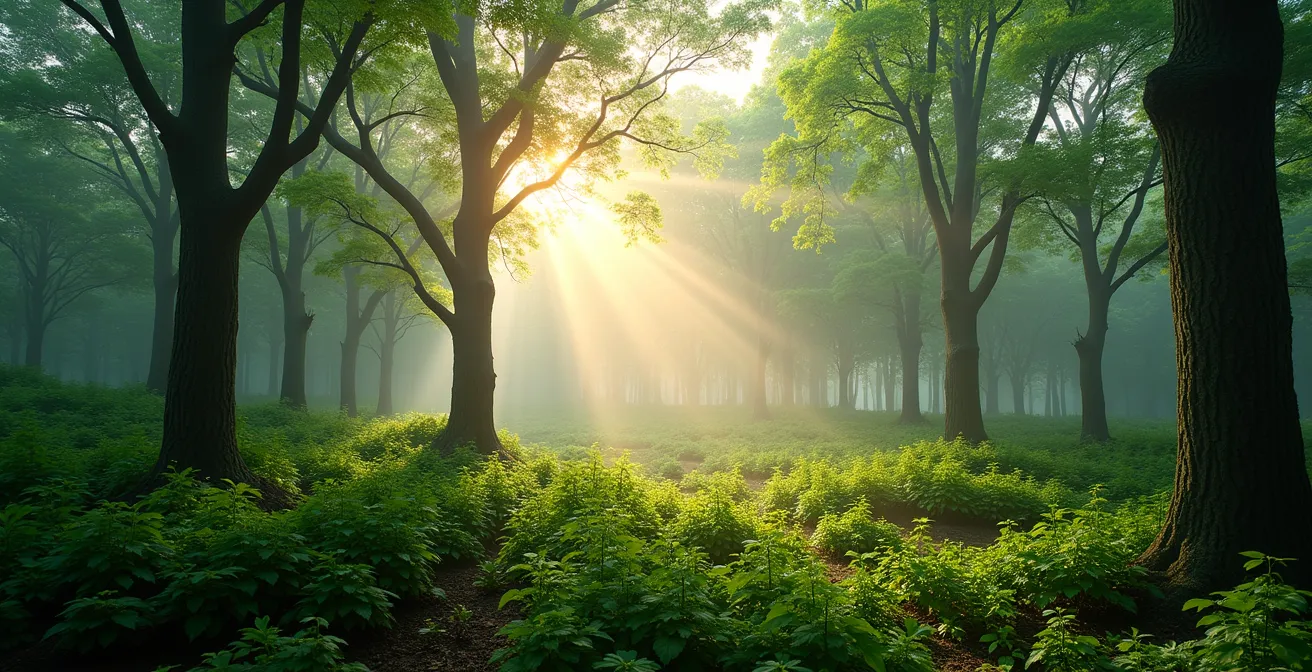
The Miyawaki method’s true potential isn’t just growing forests fast; it’s a powerful tool for large-scale ecological engineering.
- It leverages intense competition to create dense, resilient habitat nodes that grow up to 10 times faster than conventional plantings.
- Its success depends on strategically connecting these nodes through native hedges and soft-edged corridors, actively reversing the effects of fragmentation.
Recommendation: Shift your thinking from creating an ‘island’ forest to designing a ‘living network’ that connects your entire landscape.
For any community group or landowner watching isolated patches of green shrink, the desire to act is potent. The common response is simple: plant a tree, or perhaps several. While noble, this often results in scattered, vulnerable plantings that do little to mend the torn fabric of a local ecosystem. We see fragmented habitats—a woodlot here, a creek-side thicket there—and we treat the symptoms with isolated solutions. This approach, however, fails to address the fundamental problem of disconnection that cripples wildlife movement and genetic diversity.
The conversation around reforestation is often dominated by simple how-to lists that promise a patch of green. But what if the goal wasn’t just to create an island of nature, but to stitch these islands back together? What if there was a method that treated reforestation not as gardening, but as a form of ecological engineering? This is the paradigm shift offered by the Miyawaki method. It’s more than a technique for rapid tree planting; it’s a strategic framework for reversing habitat fragmentation on a micro and macro scale. It forces us to think beyond a single plot and consider how each dense, thriving mini-forest can become a vital habitat node in a larger, interconnected biological network.
This guide will deconstruct the Miyawaki method through the lens of connectivity. We will explore the science of dense planting, the design of functional boundaries, and the collaborative strategies required to weave a continuous tapestry of life through our fragmented landscapes. You will learn not just how to plant a forest, but how to build a corridor, one hyper-dense, native ecosystem at a time. The objective is ambitious: to stop patching holes and start reweaving the whole.
To guide you through this strategic approach, this article breaks down the core components of using the Miyawaki method for landscape-scale restoration. Below is a summary of the key concepts we will explore to build a cohesive, living network.
Summary: A Strategic Guide to Restoring Fragmented Habitats
- Why Planting Trees Very Close Together Accelerates Growth?
- How to Restore a Pond Edge to Filter Runoff and Hide Birds?
- Fences or Hedges: Which Boundary Allows Genetic Flow Between Populations?
- The “Hard Edge” Mistake That Dries Out Forest Fragments
- When to Introduce Understory Plants in a Reforestation Project?
- How to Align Planting With Neighbors to Create a Continuous Hedge?
- Native Oak or Exotic Maple: Which Survives Better in Changing Climates?
- How to Create Ecological Corridors Across Fenced Suburban Yards?
Why Planting Trees Very Close Together Accelerates Growth?
The foundational principle of the Miyawaki method defies conventional planting wisdom. Instead of giving each sapling ample space, it prescribes planting them incredibly close together, typically 3-4 saplings per square meter. This is not arbitrary; it’s a deliberate strategy to simulate the competitive dynamics of a natural, old-growth forest. In this dense environment, the primary struggle is for light. Saplings are forced into a rapid, vertical race towards the canopy, channeling their energy into upward growth rather than lateral branching. This intense competition is the engine behind the method’s most celebrated outcome.
Research confirms this accelerated development, with some studies showing that Miyawaki forests can establish a closed canopy and become self-sustaining in as little as three years. Further research by SUGi demonstrates a growth rate up to 10 times faster than traditional reforestation efforts. This rapid growth isn’t just about speed; it’s about creating a complex, multi-layered structure quickly. The mix of canopy trees, sub-trees, and shrubs planted together fills every vertical niche, creating a dense, structurally diverse habitat that would otherwise take decades to develop. This structure is crucial for biodiversity, offering shelter and resources for a wide array of species far sooner than a conventional plantation.
This process of “assisted succession” jump-starts the natural development of a forest ecosystem. By preparing the soil deeply and mulching heavily, we remove initial barriers to root growth and suppress weeds, allowing the native saplings to dominate and initiate this competitive race. The result is not just a collection of trees, but a functioning, resilient ecosystem—a powerful habitat node ready to be connected to the wider landscape.
Action Plan: Triggering Accelerated Growth
- Assess Site and Species: Identify a diverse mix of native canopy trees, sub-trees, and shrubs appropriate for your local ecology.
- Prepare Soil Deeply: Excavate and amend the soil to a depth of 1 meter with rich organic matter to facilitate rapid root penetration.
- Plant Densely: Arrange 3-4 saplings per square meter, mixing species randomly to mimic natural regeneration patterns and trigger competition for sunlight.
- Apply Heavy Mulch: Cover the entire area with a thick layer of mulch (around 15cm) to retain moisture, regulate soil temperature, and suppress competing weeds.
- Maintain Early On: Ensure consistent watering for the first 2-3 years, until the forest canopy closes and the ecosystem becomes self-sustaining.
How to Restore a Pond Edge to Filter Runoff and Hide Birds?
Pond and stream edges, or riparian zones, are critical ecological hotspots. They are also highly vulnerable to degradation from nutrient-rich runoff and erosion. Applying the Miyawaki method to these areas transforms them from fragile boundaries into robust, functional biofilters. By planting a dense, multi-layered buffer of native, water-loving species, you create a living sponge that intercepts, absorbs, and filters pollutants and sediments before they can contaminate the water body. The dense root systems stabilize the bank, preventing erosion, while the thick vegetation slows the flow of surface water, allowing for greater infiltration.
The structural complexity of a Miyawaki-style riparian planting offers immense benefits for wildlife. The dense shrub layer provides secure nesting sites and cover for birds, shielding them from predators and human disturbance. The overhanging branches of sub-trees and canopy species offer shade, which helps moderate water temperature for aquatic life. This layered structure creates a gradient of habitats, from the wettest edge with sedges and rushes to the drier upland with shrubs and trees, supporting a far greater diversity of species than a simple mown lawn or a monoculture planting.
A prime example of this is the Afforestt Clifton Park project in Karachi, which demonstrated a remarkable transformation of a wetland area. Using Miyawaki principles, the project established a dense, multi-layered plant community that not only improved water quality but also created a thriving habitat for various bird species. This showcases how the method serves a dual purpose: it solves an engineering problem (runoff) while creating high-value ecological real estate.
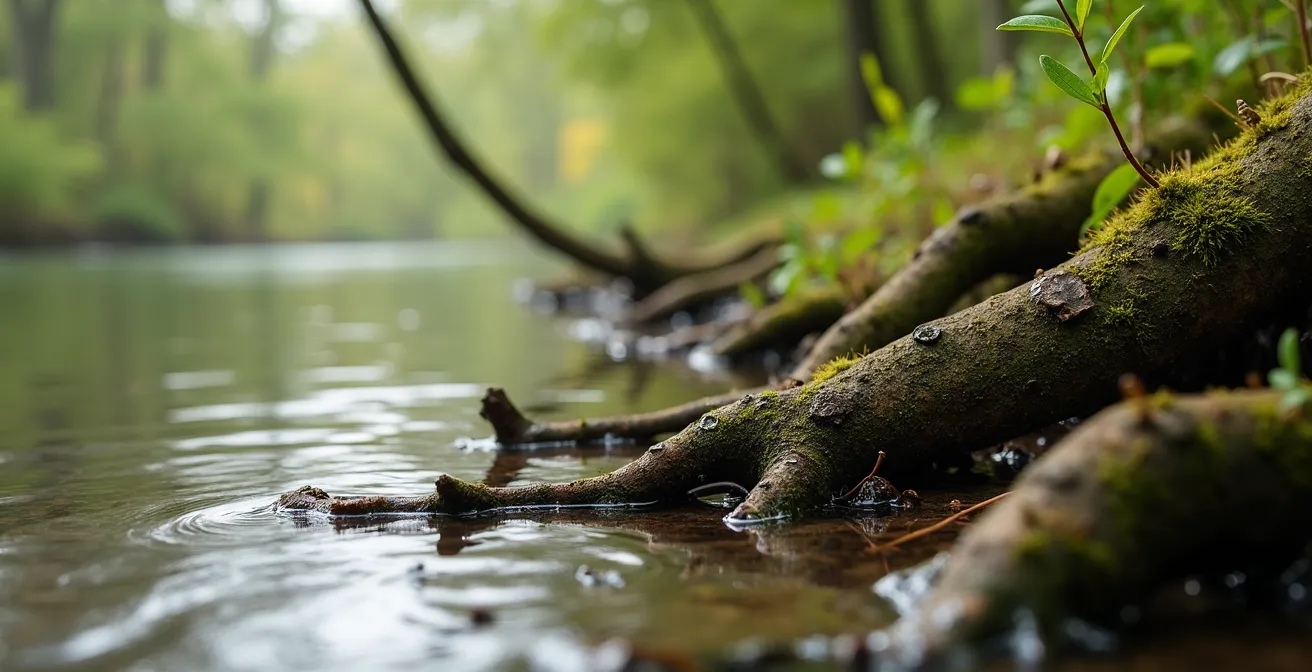
As the illustration above shows, the goal is to create an impenetrable wall of vegetation. This isn’t just an aesthetic choice; it’s a functional one. This density is the key to both effective filtration and providing the secure, hidden spaces that timid wildlife requires to thrive. A well-designed pond edge becomes more than a boundary; it becomes a vibrant, living ecotone that serves both land and water.
Fences or Hedges: Which Boundary Allows Genetic Flow Between Populations?
In fragmented landscapes like suburbs, property lines are often hard barriers. A wooden fence or a chain-link wall creates an absolute stop for most terrestrial wildlife, from insects and amphibians to small mammals. This isolates populations, preventing genetic flow and making them more vulnerable to local extinction. The choice of boundary is therefore not just a landscaping decision; it is a critical act of ecological design. A traditional fence isolates, while a living, native hedge connects.
A Miyawaki-style hedge, composed of a dense mix of native trees and shrubs, functions as a high-quality ecological corridor. It provides not only a pathway but also food and shelter along the way. Unlike a non-native monoculture hedge (like privet or boxwood) which offers limited ecological value, a diverse native hedge supports pollinators, birds, and beneficial insects. Furthermore, the intense density of planting has a profound effect below ground. The interconnected root systems create a thriving environment for mycorrhizal fungi, forming a “wood wide web” that facilitates nutrient exchange and soil health. In fact, studies show Miyawaki plantings can create vegetation up to 30 times denser, fostering an unparalleled level of underground connectivity that sterile fences completely sever.
The strategic replacement of impermeable fences with permeable, living boundaries is a cornerstone of restoring fragmented habitats. It transforms a landscape of isolated yards into a potential connectivity matrix, allowing life to move, interbreed, and thrive across a much larger area. Even a “living fence,” where native vines and shrubs are grown along a simple post-and-wire structure, provides significantly more connectivity than a solid barrier.
| Boundary Type | Permeability Level | Genetic Flow Impact | Species Supported |
|---|---|---|---|
| Traditional Fence | 0% | Complete barrier | None |
| Non-native Monoculture Hedge | 10% | Minimal connectivity | Limited generalist species |
| Miyawaki Native Hedge | 90% | High connectivity corridor | Pollinators, birds, small fauna, soil organisms |
| Living Fence (Post-wire + Native Plants) | 85% | Strong connectivity with structure | Full range including ground-dwelling species |
The “Hard Edge” Mistake That Dries Out Forest Fragments
One of the most common and damaging mistakes in creating or preserving small forest patches is the “hard edge” effect. This occurs when a forest abruptly ends at a mown lawn, a road, or a building. This sharp transition exposes the forest interior to drying winds, intense sun, and invasive species. The delicate, humid microclimate essential for many native ferns, fungi, and amphibians is compromised. This edge effect can penetrate deep into a small woodland, effectively shrinking the usable core habitat and stressing the trees along the perimeter.
The solution is to mimic nature by designing a “soft edge,” or an ecotone. An ecotone is a gradual transition zone between two different habitats. In this context, it involves creating a series of buffer zones around your core forest patch. The Miyawaki method is perfectly suited for engineering this transition. The central area should contain the densest planting of core canopy species. Surrounding this, you plant a wide band (5-10 meters) of hardy, sun-tolerant native shrubs. Finally, an outer fringe of native perennial wildflowers and grasses completes the gradient down to the adjacent open area. This layered structure acts as a living shield.
This soft edge buffers the core forest from the harsh exterior conditions. It dissipates wind, shades the ground, and helps maintain higher humidity levels within the woodland. This protection is critical for long-term health and resilience. As Western Washington University research confirms, the dense canopy of a Miyawaki forest offers improved protection from heat and desiccation. By extending this principle into a gradual ecotone, you amplify that protective effect, ensuring your habitat node isn’t slowly degrading from the outside in. Allowing leaf litter to accumulate across this entire gradient further builds soil health and moisture retention, creating a seamless and resilient ecosystem.
When to Introduce Understory Plants in a Reforestation Project?
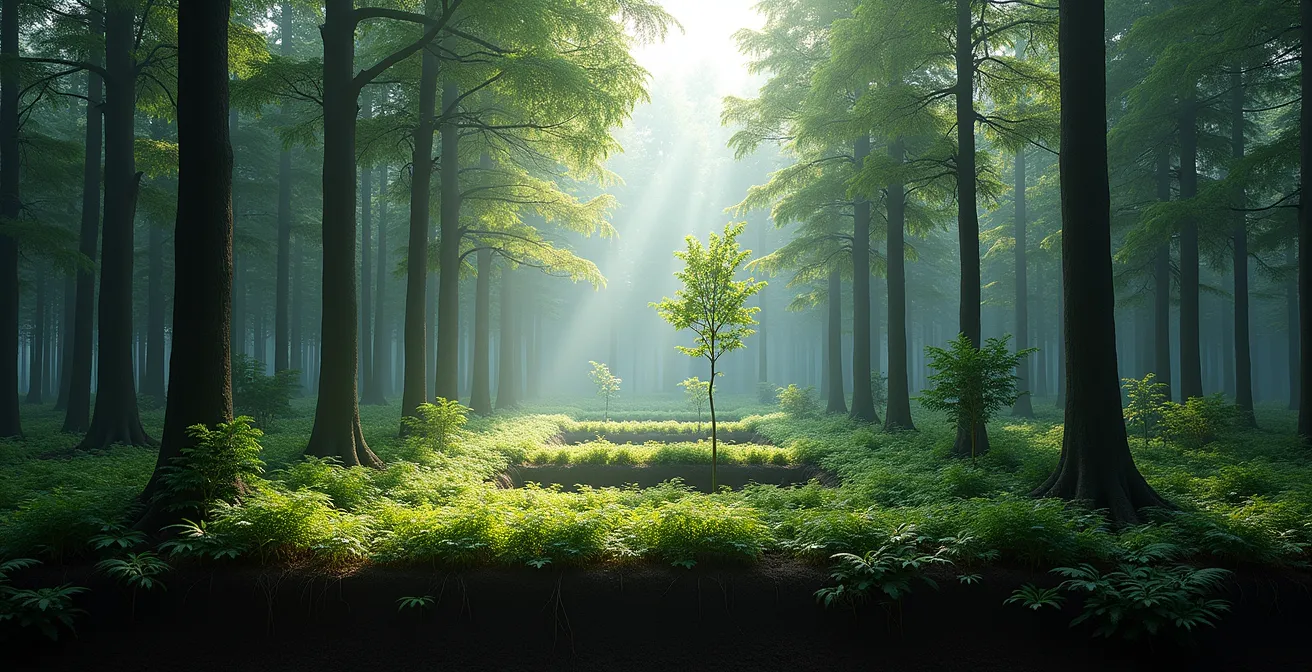
A key strategic decision in any reforestation project is timing: do you plant all layers of the forest at once, or do you introduce them in phases? The standard Miyawaki method advocates for the “all-at-once” approach. This involves planting the canopy, sub-tree, shrub, and groundcover layers simultaneously. This strategy is designed to immediately initiate the complex web of interactions and competition that drives rapid growth and ecological succession. For sites with reasonably good soil and moderate conditions, this is the most efficient path to creating a complex, multi-layered forest.
However, there are situations where a phased introduction might be more prudent. On highly degraded sites with poor soil, extreme sun or wind exposure, or where budgets are limited, starting with hardy “pioneer” species can be a wise first step. These fast-growing, resilient species can quickly create a protective microclimate and begin the process of soil building. Once this initial canopy is established (typically after 1-2 years), the more sensitive understory species can be introduced into a much more hospitable environment. This can increase the long-term survival rate of delicate ferns, wildflowers, and shrubs that might not have survived the initial harsh conditions.
The choice of strategy depends entirely on a careful assessment of your site. As demonstrated in the successful establishment of numerous Miyawaki forests in Kerala, India, the all-at-once method is highly effective under a wide range of conditions, proving its robustness. The key is that all layers are considered from the beginning, even if their planting is staged.
| Strategy | Best Site Conditions | Planting Timeline | Success Rate |
|---|---|---|---|
| All-at-Once (Miyawaki Default) | Good to average soil, moderate exposure | All layers planted simultaneously | 90%+ survival |
| Phased Introduction | Degraded soil, extreme exposure, limited budget | Pioneer species first, understory after 1-2 years | Higher long-term for sensitive species |
How to Align Planting With Neighbors to Create a Continuous Hedge?
The true power of the Miyawaki method for habitat restoration is realized when it scales beyond a single property line. A single native hedge is a valuable resource, but a continuous hedge stretching across multiple yards becomes a functional superhighway for wildlife. Achieving this requires moving from individual action to community collaboration. The first step is often communication and demonstration. Starting an “anchor node”—a successful Miyawaki planting on your own property—can be the most powerful tool for inspiring neighbors to join in.
Once interest is sparked, collaborative tools can streamline the process. Creating a shared online map (using a tool like Google My Maps) allows everyone to visualize the proposed corridor and see how their individual contribution fits into the larger vision. This fosters a sense of shared purpose. Community-led initiatives like hosting a “potluck” plant exchange, where neighbors grow and trade different native species, can reduce costs and increase plant diversity. Organizing a “hedge-raising” party transforms the labor of planting into a community-building event, strengthening social ties while building the ecological network.
It’s also important to be prepared for questions and concerns. Neighbors may worry about maintenance, pests, or aesthetics. Having positive, well-researched responses ready can help alleviate these fears. Frame the project in terms of its benefits: increased bird and butterfly populations, natural beauty, and a collective contribution to a healthier local environment. As the method’s founder, Dr. Akira Miyawaki, powerfully stated:
We basically made a mess of the world and a lot of people want to do something, but they don’t know: ‘What can I do?’ The forests can be built in under a year.
– Dr. Akira Miyawaki, Nordson Green Earth Foundation
This sentiment captures the empowering nature of this work. By providing a clear, actionable plan for collaboration, you can mobilize your community to achieve a landscape-scale reversal of fragmentation that would be impossible to accomplish alone.
Native Oak or Exotic Maple: Which Survives Better in Changing Climates?
The question of species selection is paramount in any reforestation project, but it takes on even greater significance in the context of a changing climate. While a fast-growing exotic like a Norway Maple might seem tempting for its rapid growth, it’s an ecological dead end. Native species are the bedrock of a resilient ecosystem. A native oak, for example, can support hundreds of species of caterpillars, which in turn are a critical food source for nesting birds. An exotic maple supports a tiny fraction of that biodiversity. When building a habitat node or a corridor, choosing native species is non-negotiable for creating a functional food web.
Beyond biodiversity, native species are fundamentally better adapted to local conditions, including climatic extremes. They have co-evolved with the local soil, rainfall patterns, and temperature fluctuations for millennia. This deep-rooted adaptation gives them a significant survival advantage over exotic species, especially as weather events become more unpredictable. The Miyawaki method, when implemented correctly, exclusively uses a diverse mix of native species. This diversity is itself a form of insurance; if one species struggles in a particularly hot or dry year, others are likely to thrive, ensuring the overall stability of the forest. Indeed, studies show native species in Miyawaki forests achieve upward of 90 percent survival, a testament to their inherent resilience.
Dr. Miyawaki’s foundational research was based on identifying “potential natural vegetation” by studying the last remnants of ancient, indigenous forests, often found around sacred shrines in Japan. His inventory of over 10,000 sites revealed the superior resilience and stability of these diverse native plant communities compared to the monoculture plantations that dominate the modern landscape. Choosing native oak over exotic maple is not just a preference; it’s a strategic decision to build an ecosystem that can feed local wildlife, withstand local climate stress, and endure for generations.
Key Takeaways
- The Miyawaki method is a tool for ecological engineering, not just tree planting; its goal is connectivity.
- Success hinges on creating a “soft edge” or ecotone around forest fragments to protect their microclimate from drying out.
- Replacing impermeable fences with diverse, native Miyawaki-style hedges is the single most effective action for enabling genetic flow across suburban landscapes.
How to Create Ecological Corridors Across Fenced Suburban Yards?
The ultimate application of this strategic thinking is to weave a functional ecological corridor through the challenging matrix of a fenced suburban neighborhood. This is where all the previous concepts converge. It’s an act of large-scale ecological engineering that starts with small, coordinated actions. The goal is to create a multi-layered connectivity matrix that provides safe passage for a wide range of species, from canopy-dwelling birds to ground-crawling amphibians.
This requires a multi-pronged approach that addresses different levels of the ecosystem. Canopy Corridors are formed by aligning tree plantings along property boundaries, creating an aerial pathway for birds and arboreal creatures. Shrub Corridors, the dense Miyawaki-style hedgerows we’ve discussed, provide the critical mid-level pathway and habitat. Ground-Level Corridors can be as simple as creating “no-mow” zones filled with leaf litter along fence lines, offering cover for insects, salamanders, and small mammals. Even water can be connected; linking rain gardens across several yards can create a Hydrological Corridor for amphibians. Finally, coordinating the use of downward-facing, warm-hued lighting can create Dark Sky Corridors, protecting nocturnal species from light pollution.
This vision of interconnected “stepping stone” habitats is not theoretical. The Sikh NGO, EcoSikh, has successfully implemented this concept by planting a network of over 400 ‘Guru Nanak Sacred Forests’ using the Miyawaki method. As documented in studies of Dr. Miyawaki’s work and its applications, these small, dense forests act as vital islands of biodiversity across fragmented urban and suburban landscapes, proving the model’s effectiveness at scale. Each forest, while small on its own, contributes to a larger, functional network that strengthens the entire regional ecosystem.
The journey from a single, concerned landowner to a community of ecological engineers begins with the first step: seeing your landscape not as a series of isolated parcels, but as a canvas for reconnection. Start by mapping the existing green spaces in your neighborhood and envisioning the lines of connection that could weave them together. This is how the landscape-scale reversal of fragmentation begins.