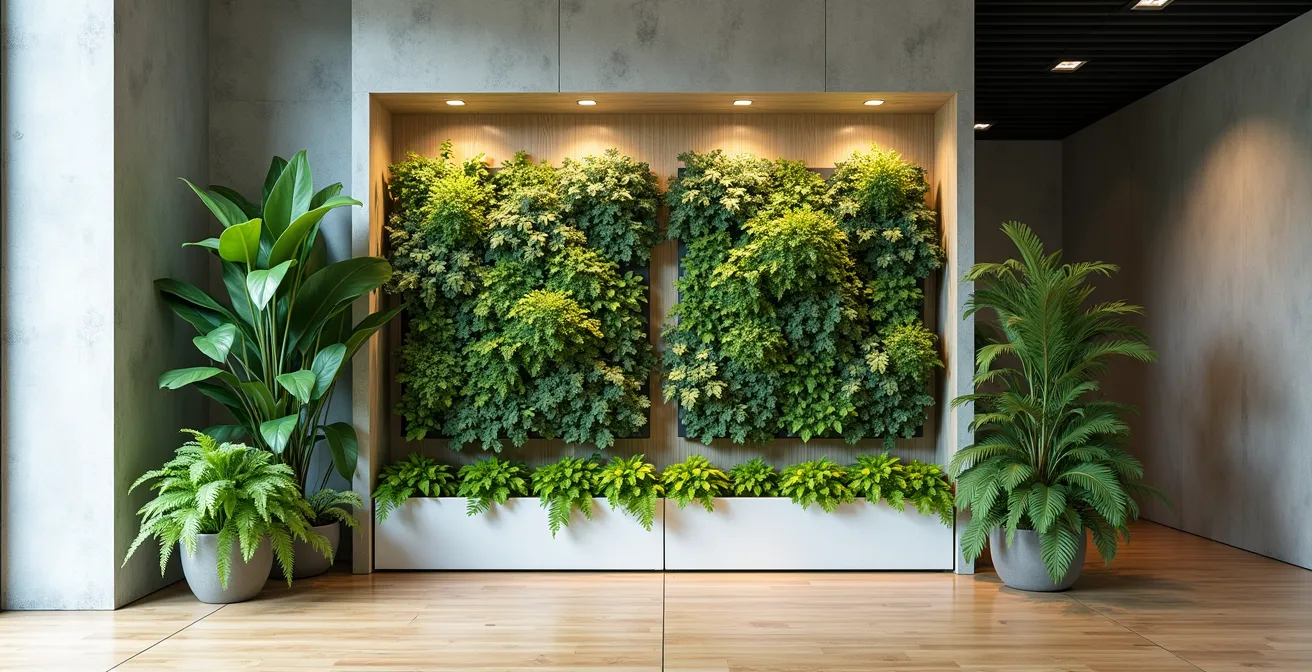
The “easier” living wall is not determined by using soil or hydroponics, but by how well the system is engineered to prevent catastrophic failure in water delivery, structural load, and moisture containment.
- Hydroponic systems require precise automation but offer superior control over water and nutrients, reducing risks of rot and pests when designed correctly.
- Soil-based systems can seem more forgiving but introduce variables like soil compaction, uneven water distribution, and higher, less predictable saturated weight.
Recommendation: Prioritize analyzing the engineering of the support systems (irrigation, waterproofing, anchoring) over the growing medium itself. A well-engineered hydroponic wall is far easier to maintain than a poorly designed soil wall.
The promise of a lush, vibrant living wall often clashes with a single, pervasive fear: the maintenance nightmare. You envision cascading water damage, dead plants, and a complex system that demands more time than you have. The debate typically simplifies to “hydroponics versus soil,” with hydroponics painted as technically complex and soil as forgivingly “natural.” This is a fundamental misunderstanding of the challenge.
The long-term success and ease of maintenance for any green wall do not hinge on the growing medium. They are a direct result of systems engineering. A living wall is not a potted plant scaled up; it is an integrated architectural system managing water, weight, biology, and gravity. Failure isn’t usually a slow decline—it’s a pump failure that kills an entire section overnight or a breached vapor barrier that silently rots your building’s structure.
This guide reframes the question. Instead of asking which medium is better, we will analyze the critical subsystems that dictate maintenance effort and failure risk. We will deconstruct the engineering trade-offs between a closed-loop hydroponic system and a soil-based installation, allowing you to assess any living wall not by its green foliage, but by the quality of its mechanical heart, its structural skeleton, and its protective skin.
This analysis breaks down the core engineering challenges you must consider. By understanding the critical failure points of each subsystem, you can make an informed decision based on technical realities, not marketing claims.
Summary: A Systematic Comparison of Living Wall Maintenance
- Why Automated Drip Lines Are Critical for Living Wall Survival?
- Ferns or Philodendrons: Which Plants Handle Gravity and Moisture Best?
- Can Your Drywall Hold a Wet Living Wall System?
- The Vapor Barrier Mistake That Rots Your Wall Behind the Plants
- How to Prune a 10-Foot Living Wall Without a Scissor Lift?
- How to Create a DIY Self-Watering Wick System for Under $5?
- HEPA Purifier vs Green Wall: Which Removes Allergens More Effectively?
- How to Keep a Calathea Makoyana Alive in Dry Air Conditioning?
Why Automated Drip Lines Are Critical for Living Wall Survival?
The single most common point of failure in any living wall is its irrigation system. While soil provides a temporary buffer, gravity and evaporation in a vertical environment are relentless. A missed watering cycle can desiccate plants in hours, not days. This is why automated irrigation is not a luxury; it’s a foundational requirement for long-term survival, especially in hydroponic setups where there is no soil to retain moisture.
Hydroponic systems, by design, demand precision. They operate as a closed loop where a pump circulates nutrient-rich water to the plant roots at set intervals. For example, a common configuration involves a timer running a low-noise pump for 15 minutes on, 15 minutes off. This consistent cycle is what ensures roots get adequate water without being perpetually submerged, which would lead to rot. The efficiency is remarkable; advanced hydroponic systems demonstrate that with proper calibration, they can operate with as little as 10% water runoff. This level of control is impossible with manual watering.
The system’s reliability depends on its components: high-quality pumps, properly configured timers, and flow regulators that ensure even distribution across every plant. In a soil wall, water tends to channel, oversaturating lower sections while upper sections remain dry. Automated drip lines in both systems mitigate this by delivering a measured dose of water directly to each plant’s root zone. Therefore, the maintenance question isn’t about the medium, but about the robustness of the automation that serves it. A failed pump or a clogged emitter is a critical emergency.
Ferns or Philodendrons: Which Plants Handle Gravity and Moisture Best?
Plant selection for a living wall is a lesson in bio-mechanics, not just horticulture. A plant that thrives in a pot may fail spectacularly on a vertical surface due to forces it never evolved to handle. The two primary stressors are gravity pulling on the root ball and the specific moisture conditions created by the system. This is where the plant’s root structure becomes a critical engineering factor. Plants like Philodendrons and Pothos have aggressive, adaptable root systems that actively grip the growing medium, whether it’s soil or hydroponic felt, providing strong anchoring.
In contrast, many ferns have fine, delicate root systems that are less effective at anchoring against gravity. They also demand consistent moisture but are highly susceptible to rot if oversaturated—a common issue in the lower, wetter sections of a poorly designed wall. The choice between hydroponics and soil directly impacts this. Well-designed hydroponic systems offer precise moisture control, but a system failure can be catastrophic. Soil offers a moisture buffer but is harder to control, creating micro-climates that may suit one plant but kill its neighbor. Furthermore, contained soil systems are prone to soil-borne pests, a problem largely eliminated in sterile hydroponic media.
The following paragraph introduces a comparative table based on an analysis of plant suitability for vertical gardens.
| Plant Type | Hydroponic Performance | Soil-Based Performance | Key Considerations |
|---|---|---|---|
| Ferns | Moderate – requires careful moisture control | Excellent – thrives in consistent moisture | Low-light tolerant, prone to rot if overwatered |
| Philodendrons | Excellent – aggressive root system adapts well | Good – tolerates various conditions | Forgiving of moisture variations |
| Pothos | Excellent – highly adaptable | Excellent – very resilient | Thrives in low-light conditions |
| Spider Plants | Good – moderate water needs | Excellent – drought tolerant | Produces runners that can spread |
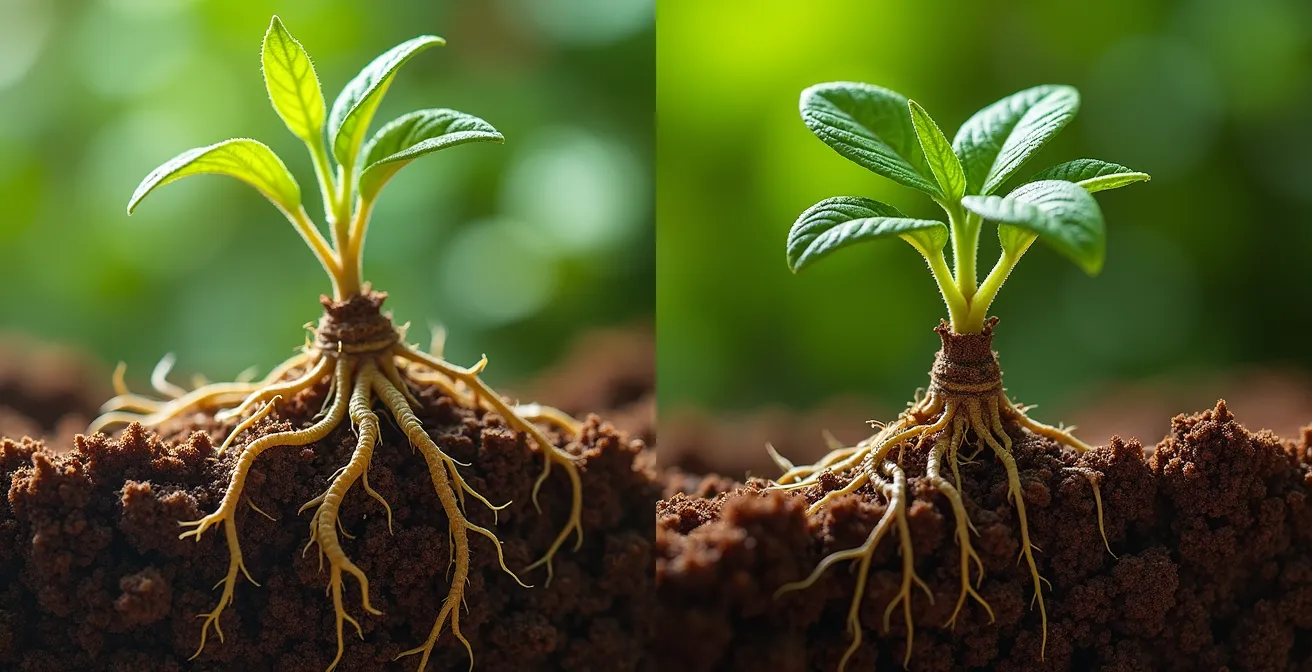
Ultimately, the most resilient plants are those whose physical structure is best suited for vertical life. A forgiving plant like a Pothos can tolerate maintenance errors in either system, while a sensitive plant like a fern will expose any flaw in your irrigation design. Choosing plants that are mechanically suited to the environment is a core principle of low-maintenance design.
Can Your Drywall Hold a Wet Living Wall System?
A common oversight is underestimating the sheer weight of a living wall, particularly its saturated load. This is not a static weight like a bookshelf; it’s a dynamic load that increases significantly after each watering cycle. Drywall alone is not a structural element; it is a cosmetic surface. Mounting a heavy, wet system directly to it without proper anchoring is a recipe for catastrophic failure.
The weight varies dramatically between systems. Hydroponic panels, often lighter when dry, still carry significant weight when the growing medium and roots are fully saturated. For instance, Miami Vertical Garden reports that their saturated EcoWall® hydroponic panels weigh approximately 12 LBS/SF (58 kg/m²). A 10×8 foot wall could therefore weigh nearly 1,000 pounds. Soil-based systems are often even heavier, and their weight is less predictable due to soil compaction and water retention over time.
The solution lies in proper engineering and anchoring. The load must be transferred from the wall system to the building’s structural frame—the studs (wood or metal) or masonry behind the drywall. This is where specific mounting hardware becomes critical. The Biome Taiga system, for example, utilizes a Z-clip that can be mounted to studs or masonry. To address installations where studs are not perfectly aligned, they provide specialized butterfly drywall anchors. This demonstrates that while direct drywall mounting is possible, it requires a purpose-designed anchoring system that distributes the load correctly, not just standard screws.
The Vapor Barrier Mistake That Rots Your Wall Behind the Plants
While a structural collapse is dramatic, the most insidious threat from a living wall is silent water damage. Constant moisture and evaporation create a high-humidity micro-environment directly against your interior wall. If this moisture penetrates the drywall, it can lead to mold, wood rot, and devastating structural decay that goes unnoticed for months or years. A properly installed, continuous vapor barrier between the living wall system and the building structure is the most critical component for long-term integrity.
This is not a step where corners can be cut. A simple plastic sheet is insufficient. Professional systems use multi-layer waterproof membranes specifically designed to prevent water penetration into the substructure. An effective system design also incorporates an air gap between the waterproof layer and the plant panels, allowing for air circulation that helps dissipate moisture. Some advanced hydroponic mediums, like Grodan stone wool, offer a key advantage here. This material is extremely water retentive, absorbing water efficiently for the plants, but it also allows for precise control, which helps in designing systems with minimal water runoff and excess moisture.
The design of the growing medium itself can contribute to moisture management. Materials with fibers that allow air to pass through to the root systems are crucial for plant health and for reducing the risk of anaerobic (low-oxygen) conditions that lead to rot. The catastrophic mistake is assuming the living wall’s own backing is sufficient protection. You must have a dedicated, professionally installed waterproofing layer on your building’s wall first.
Action Plan: Auditing Your System’s Moisture Protection
- Verify the Barrier: Confirm the installation of a dedicated, continuous waterproof membrane on the building wall, not just relying on the green wall’s backing panel.
- Check for an Air Gap: Ensure there is a physical air gap between the membrane and the plant system to promote ventilation and prevent moisture trapping.
- Inspect the Growing Medium: Analyze if the medium (e.g., felt, coir, stone wool) is designed for efficient water retention while allowing air passage to the roots.
- Review Irrigation Runoff: Audit the irrigation system for leaks or excessive runoff that could bypass containment and saturate the wall structure.
- Assess Remote Monitoring: If available, check if the system includes sensors to monitor moisture levels, providing early warnings of leaks or over-saturation.
How to Prune a 10-Foot Living Wall Without a Scissor Lift?
Maintenance is not just about keeping plants alive; it’s about physical access. A 10-foot tall living wall can quickly become an unmanageable jungle if pruning the upper sections requires specialized equipment like a scissor lift or scaffolding. This is a crucial design consideration that separates professional-grade systems from oversized DIY projects. The solution is not in longer ladders, but in system modularity.
Many modern living wall systems, both soil and hydroponic, are designed with removable panels or individual plant pods. This is a game-changing feature for maintenance. Instead of precariously trimming a vine two feet above your head, you can simply remove the specific panel or pod, bring it to a workbench, and perform detailed pruning, pest inspection, or even plant replacement at a comfortable height. Once the maintenance is complete, the panel is easily clipped back into place.
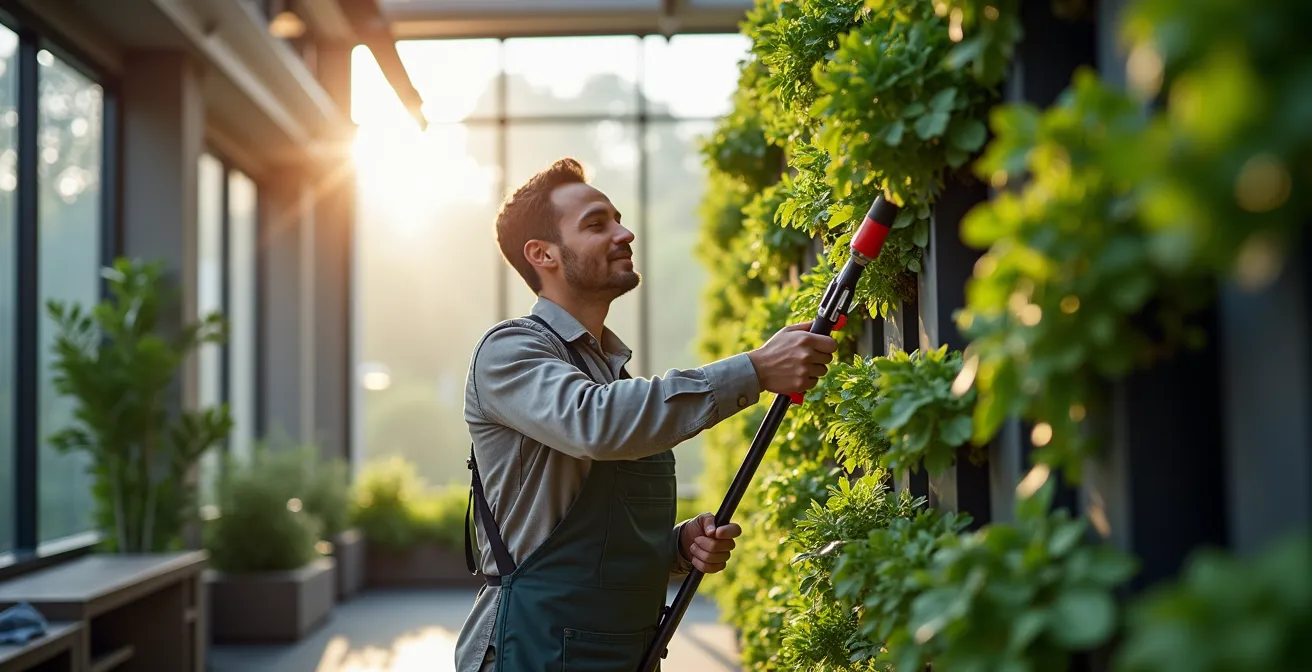
This modular approach drastically reduces the time, effort, and safety risks associated with maintaining large-scale walls. It also allows for easier evolution of the wall’s design over time. For sections that are out of reach, long-reach, lightweight pruning tools (telescopic shears) are essential. However, these are best for light trimming, not for the intensive work that becomes necessary when a plant is overgrown or needs to be replaced. The ability to “bring the wall down to you” via modular panels is the true key to sustainable, long-term maintenance of tall installations.
How to Create a DIY Self-Watering Wick System for Under $5?
While the title suggests an ultra-low-cost project, the real value is in understanding the core principle of all automated watering systems: moving water from a reservoir to the plant roots without manual intervention. The “Rain Tower” is a popular DIY vertical hydroponic system that perfectly illustrates these mechanics. It typically uses a 5-gallon bucket as a reservoir, a main tower made from a PVC fence post, and a small submersible pump. The pump, controlled by a simple outlet timer, pushes water to the top of the tower, from where it trickles down over the plant roots held in net pots.
This design contains all the elements of a large-scale commercial system, just simplified: a reservoir (bucket), a distribution network (PVC tower), and an automated pump on a timer. The principle of a wick system is even simpler: it uses capillary action through a piece of felt or rope to draw water from a reservoir up into the soil or growing medium. This is a passive, non-electric form of self-watering.
Building a robust DIY system for under $5 is challenging, as a reliable pump and timer alone will exceed that budget. However, one can construct a simple passive wick system for a few small plants using a water bottle and some synthetic cord. The key takeaway is not the price tag, but the engineering concept: creating a system that decouples plant survival from your daily attention. Whether it’s a multi-thousand-dollar commercial installation or a simple DIY project, the goal is the same: providing a consistent and reliable water source.
HEPA Purifier vs Green Wall: Which Removes Allergens More Effectively?
One of the most appealing benefits of a living wall is its potential to improve indoor air quality. However, it’s crucial to understand the mechanism. Most plants do passively filter some airborne pollutants, but their effectiveness can be overstated when compared to mechanical solutions. The real distinction lies between a standard green wall and one designed for active biofiltration.
A HEPA (High-Efficiency Particulate Air) purifier is an engineered device that mechanically traps particles like dust, pollen, and pet dander down to a very small size. It is extremely effective at removing allergens. A standard, passive green wall works differently; pollutants are primarily broken down by microbes in the plant’s root zone. The air exchange rate is slow and incidental.
An active biofiltration system, however, is a hybrid of a plant and a machine. Systems like the Rachio Biome Taiga use fans to actively pull air *through* the microbe-rich root zones of the plants. This dramatically increases the volume of air being cleaned and enhances the breakdown of pollutants, including Volatile Organic Compounds (VOCs). These advanced systems include integrated sensors to track air quality in real time, monitoring metrics like Particulate Matter (PM1.0, 2.5, 10.0) and VOCs. In this case, the living wall functions as a living, self-regenerating filter.
So, which is more effective? For removing particulate allergens like dust and pollen, a HEPA filter is the more direct and powerful tool. For breaking down gaseous pollutants like VOCs from furniture and paint, an active biofiltration green wall is a uniquely effective solution that a HEPA filter cannot replicate. The choice depends on your primary air quality goal. A passive green wall offers a modest benefit, while an active one is a serious piece of air purification technology.
Key Takeaways
- System Over Medium: Ease of maintenance is dictated by the engineering of the irrigation, structural, and waterproofing systems, not by the choice of soil vs. hydroponics.
- Automation is Non-Negotiable: A reliable, automated irrigation system is the single most critical factor for the long-term survival of any living wall.
- Weight is Dynamic: Always calculate for the “saturated load” and ensure the anchoring system transfers weight to the building’s structural frame, not just the drywall.
How to Keep a Calathea Makoyana Alive in Dry Air Conditioning?
The Calathea Makoyana, or Peacock Plant, is notoriously sensitive to low humidity, making it a perfect test case for a living wall’s environmental control capabilities. Air conditioning systems are incredibly drying, and keeping such a plant alive requires maintaining a consistently high level of ambient humidity (ideally around 60%). This is where the engineering of your living wall system becomes directly responsible for the plant’s survival.
The system type has a profound effect on the ambient humidity it generates through evaporation. As this comparative analysis on humidity generation shows, the choice of system directly impacts the micro-environment.
| System Type | Evaporation Rate | Water Consumption | Humidity Effect |
|---|---|---|---|
| Hydroponic Felt | High – exposed surface area | Higher daily consumption | Significant ambient increase |
| Soil-Based | Moderate – retained in soil | Lower daily consumption | Gentle ambient increase |
| Automated Misting | Controlled – programmable | Variable based on settings | Precise 60% maintenance |
A hydroponic system using a felt medium has a large, constantly moist surface area exposed to the air. This results in a high rate of evaporation, which significantly increases the humidity in the immediate vicinity—a major benefit for a Calathea. A soil-based system, where water is retained within the medium, will have a more moderate and less impactful effect on ambient humidity. Therefore, for the specific challenge of a dry, air-conditioned room, a hydroponic felt system inherently acts as a passive humidifier, creating a more suitable micro-climate.
This illustrates the core principle: the “easier” system is the one whose intrinsic properties best match your environmental challenges. Instead of fighting dry air with a separate humidifier, choosing a hydroponic system that naturally raises humidity is a more integrated and efficient engineering solution. It solves the plant’s primary need as a byproduct of its normal operation.
The decision between hydroponic and soil-based systems should now be clear: it is a series of engineering trade-offs. The easiest wall to maintain is the one that has been specified and built correctly, with robust systems that turn maintenance from a daily worry into a predictable, scheduled task. To ensure success, your next step should be to commission a structural and environmental assessment of your intended location.