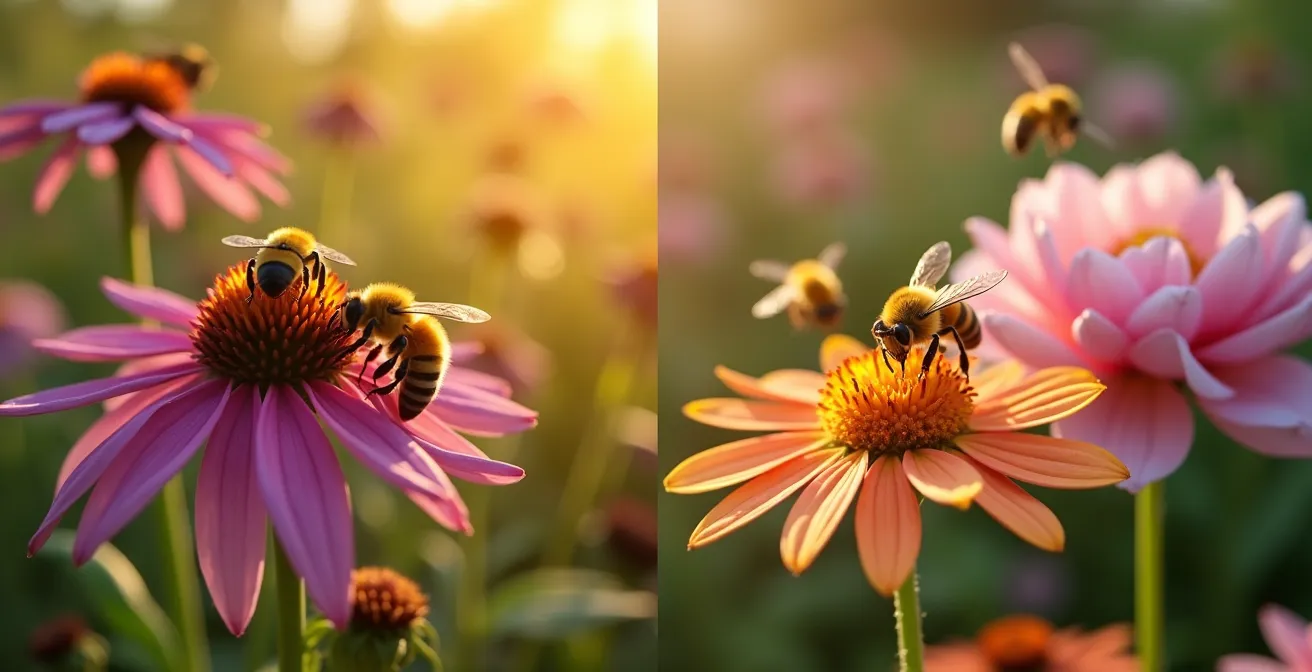
Maximizing your honey harvest isn’t about planting more flowers—it’s about engineering a high-yield nectar factory by choosing species with proven, high-energy nectar output.
- Many popular garden cultivars, especially “double flowers,” are sterile energy traps that offer little to no nectar, effectively starving pollinators.
- Common “weeds” like dandelions and productive trees like Linden provide a demonstrably superior nectar reward, measured in sugar content and daily production volume.
Recommendation: Shift your focus from simple aesthetics to “nectar economics.” Prioritize plants based on their quantifiable nectar output, sugar concentration (Brix value), and bloom succession to create a truly productive apiary garden.
For any beekeeper, the goal is clear: strong colonies and frames heavy with honey. The conventional wisdom for achieving this is simple enough: “plant more flowers.” Garden centers offer endless varieties of beautiful blooms, and the common refrain is to fill your space with color to attract pollinators. This leads many to invest in impressive-looking, highly developed cultivars, believing that a visually stunning garden is synonymous with a productive one. The debate often simplifies to a binary choice: are native plants always superior to these carefully bred cultivars?
But what if this entire approach is flawed? What if the key to abundant honey production lies not in the quantity or even the origin of the flowers, but in their quantifiable efficiency? The real question isn’t just “native vs. cultivar,” but which specific plants function as true nectar powerhouses. This requires shifting our perspective from that of a landscape designer to that of an engineer, analyzing the garden as a high-yield nectar factory. It demands we look past the petals and understand the hidden “nectar economics” at play—the daily sugar output, the accessibility of the nectar, and the risk of “energy traps” that lure bees in with no reward.
This article will deconstruct the true value of different melliferous species. We will move beyond generic advice to provide a data-driven comparison, examining the real-world nectar output of everything from humble dandelions to mighty trees. We will expose the common planting mistakes that inadvertently starve pollinators and provide actionable strategies to manage even the most aggressive nectar-rich species. By the end, you will be equipped to design a landscape based not just on what looks good, but on what truly fuels honey production.
To help you navigate this deep dive into nectar productivity, this article is structured to guide you from foundational principles to advanced management and selection strategies. The following sections break down key plant comparisons and techniques for maximizing your garden’s output.
Summary: A Beekeeper’s Guide to High-Yield Nectar Flora
- Why Leaving Dandelions Is the Best Thing You Can Do in April?
- Linden or Black Locust: Which Tree Is the Ultimate Honey Factory?
- The “Double Flower” Mistake That Starves Pollinators
- Borage and Thyme: How to Manage These Aggressive Spreaders for Bees?
- When to Sow Borage for a Continuous Blue Buffet Until Frost?
- Seeds or Nursery Transplants: Which Is Better for Short Summers?
- How to Deadhead Kalanchoe to Encourage a Second Flush of Color?
- How to Promote Pollinators in Urban Environments With Limited Ground?
Why Leaving Dandelions Is the Best Thing You Can Do in April?
In the quest for a pristine, uniform lawn, the dandelion is often public enemy number one. Yet, for a beekeeper, this ubiquitous “weed” is one of the most valuable assets of early spring. While other plants are still dormant, dandelions burst forth, providing a critical first source of high-quality nectar and pollen for colonies emerging from winter. Their value isn’t just anecdotal; it’s quantifiable. This early-season forage is essential for brood rearing, allowing the queen to ramp up egg-laying and build the colony’s population in preparation for the main summer honey flow.
The productivity of these humble flowers is staggering. Instead of viewing them as a blemish, consider them a highly efficient, no-cost cover crop for your bees. According to research on British wildflowers, dandelions produce up to 2100 micrograms of nectar sugar per flower head daily. This places them in the top tier of nectar producers, outperforming many deliberately planted garden flowers. They are, in essence, tiny, golden honey factories scattered across your landscape precisely when your bees need them most. Eradicating them in April is akin to shutting down your bees’ most reliable spring diner.
Allowing dandelions to flourish until other major nectar sources become available is a simple, zero-effort strategy to bolster colony health. They bridge the “nectar gap” of early spring, ensuring your bees have the resources to build a powerful workforce. Once plants like fruit trees and other wildflowers begin their bloom, the dandelions will naturally finish their cycle. This small act of “strategic neglect” pays significant dividends in colony strength and, ultimately, honey production. It’s a prime example of nectar economics, where a free, native resource provides a higher return on investment than many costly and labor-intensive garden additions.
Linden or Black Locust: Which Tree Is the Ultimate Honey Factory?
When it comes to producing a significant honey crop, few plants can compete with the sheer floral biomass of a mature tree. For beekeepers looking to establish a cornerstone nectar source, two top contenders are the Linden (Tilia spp.), also known as Basswood, and the Black Locust (Robinia pseudoacacia). Both can produce a heavy, sought-after honey flow, but they operate on different principles, making the choice between them a strategic one based on climate and risk tolerance.
The Black Locust is a sprinter. It offers an intense, but very brief, nectar flow early in the season, typically lasting just 7-10 days. The honey is famously light, clear, and slow to crystallize. However, this tree is notoriously fickle. A late frost can wipe out the buds, and a single rainy or windy day during the short bloom can prevent bees from foraging, resulting in zero honey for the year. It’s a high-risk, high-reward gamble.
The Linden, conversely, is a marathon runner. It blooms later, after the risk of frost has passed, and its flowering period can last for several weeks. This extended window provides a more reliable and predictable nectar flow. Furthermore, the quality of Linden nectar is exceptionally high. An analysis of Tilia species nectar shows a highly variable sugar concentration ranging from 29.5% to 77.4% Brix, indicating its potential to be an incredibly rich energy source. This reliability and richness make it a cornerstone of Nectar Flow Engineering for many apiaries.
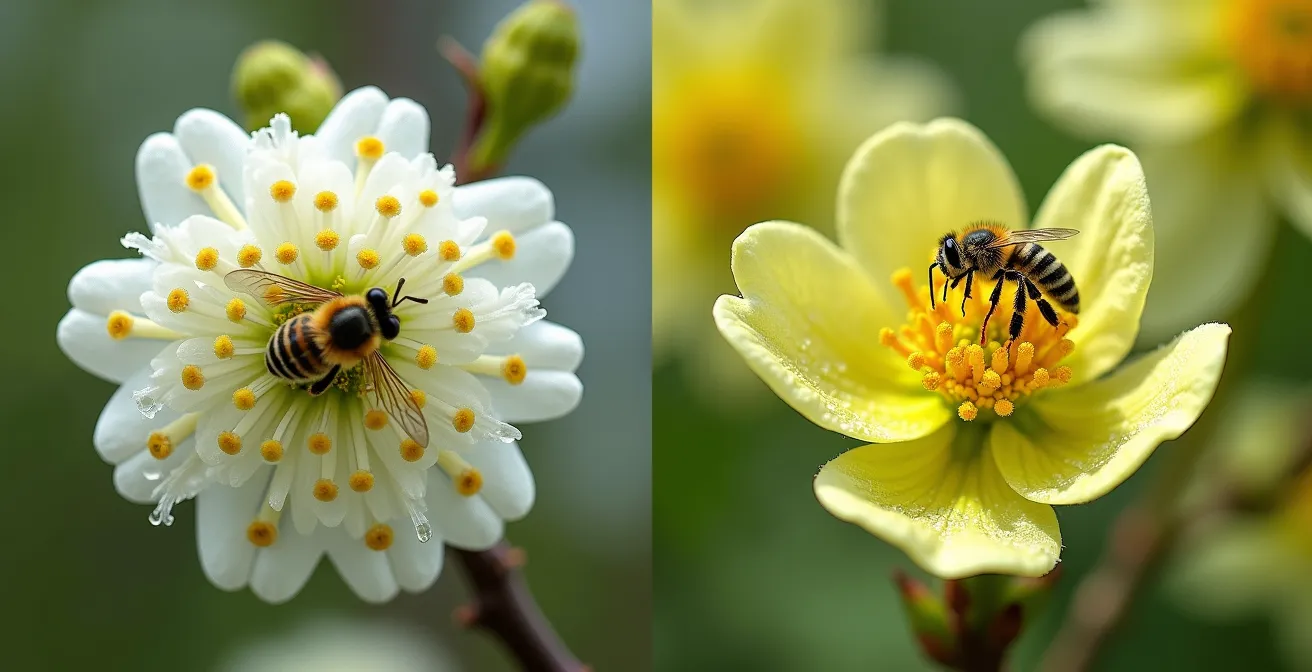
As the image illustrates, the choice depends on your strategy. The Black Locust offers a powerful but volatile burst of nectar, while the Linden provides a steadier, more dependable, and often richer stream. For a beekeeper aiming to build a resilient apiary, the Linden tree is arguably the superior “honey factory” due to its reliability and the high sugar content of its nectar, ensuring a consistent return year after year.
The “Double Flower” Mistake That Starves Pollinators
In the world of ornamental gardening, “more is more” often dictates design. This has led to the widespread popularity of “double-flowered” cultivars—plants bred to have extra layers of petals, creating a lush, rose-like appearance in flowers that are naturally single-petaled, like coneflowers or zinnias. While visually spectacular, these plants represent one of the most significant and deceptive energy traps for pollinators. From a bee’s perspective, they are often food deserts masquerading as lavish buffets.
The genetic mutation that creates the extra petals often does so at the expense of the flower’s reproductive parts: the stamens (which produce pollen) and the nectaries (which produce nectar). The dense ball of petals physically blocks access to any residual nectar that might be present, and in many cases, the flower is rendered completely sterile. As the Xerces Society, a leader in invertebrate conservation, points out, this modification is a critical failure for foraging insects.
If it has double blooms it’s an absolute no-no as they prohibit pollinators from accessing the pollen or nectar, and are almost always sterile… ‘pink double delight’, a sterile cultivar that doesn’t produce pollen and whose nectar is inaccessible.
– Xerces Society for Invertebrate Conservation
This creates a dangerous scenario. Bees, attracted by the flower’s color and size, expend precious energy trying to forage from it, only to find no reward. This is not just a missed opportunity; it’s a net energy loss for the bee and the colony. The effect is a quantifiable trap that can weaken pollinators.
The Energy Trap of ‘Lobelia x speciosa’
A striking example of this trap involves a popular cardinal flower cultivar. As highlighted by horticulturalist Karen Bussolini, while the cultivar’s flowers look identical to the native species that hummingbirds love, they contain a fraction of the reward. An analysis cited in her work reveals that the cultivar has only 20% of the nectar volume of its wild parent. The flower attracts the hummingbird with a false promise but delivers only enough energy to fuel a much smaller insect like a bumblebee. For the high-metabolism hummingbird, visiting this flower results in a critical energy deficit, a perfect illustration of an ecological trap detailed by studies on the impact of low-reward cultivars on pollinators.
For any gardener or beekeeper focused on honey production, the rule is simple: always choose the single-flowered, “wild-type” version of a plant over its double-flowered cousin. Prioritizing nectar accessibility and pollen availability over purely ornamental features is fundamental to creating a genuinely pollinator-friendly and productive landscape.
Borage and Thyme: How to Manage These Aggressive Spreaders for Bees?
While some plants fail to provide, others offer an almost overwhelming abundance. Borage (Borago officinalis) and Creeping Thyme (Thymus serpyllum) are two such nectar powerhouses. Borage is famous for its brilliant blue, star-shaped flowers that bees adore, while Thyme creates a dense, fragrant mat of purple blooms. Their value to pollinators is immense, but their aggressive, spreading nature can intimidate gardeners. However, with strategic management, this vigor can be turned into a significant advantage for both the garden ecosystem and honey production.
The key is not to fight their nature but to channel it. Borage is a prolific self-seeder, which can lead to it popping up everywhere. Instead of letting it go to seed indiscriminately, practice the “chop and drop” method. After the main flush of bloom but before the seeds fully mature, cut the plants down and leave them on the soil surface. This creates a nutrient-rich mulch and prevents a full-scale invasion, while still allowing a few volunteers for next year’s crop. Most importantly, borage is a tireless producer; its flowers are known to replenish their nectar within minutes of being visited by a bee, making it a truly continuous buffet.
Creeping Thyme spreads via runners, forming a thick ground cover. This trait can be used for natural weed suppression. Plant it along borders, in pathways, or in rock gardens where its dense growth will choke out less desirable plants. A selective pruning in early spring encourages denser, woodier growth and an even more prolific display of flowers come summer. By positioning these plants thoughtfully, their “aggressive” tendencies become valuable tools for landscape management.
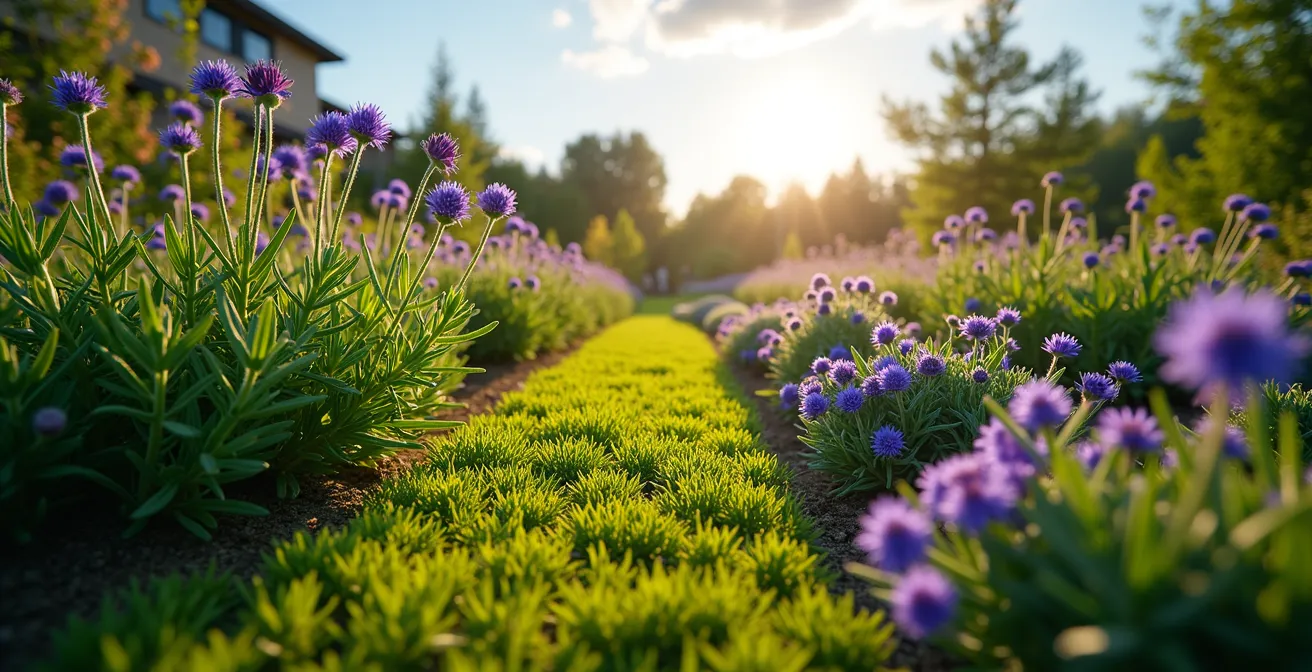
The image above demonstrates this principle of managed competition. By understanding and directing the growth habits of these vigorous species, you can create a dense, low-maintenance, and incredibly productive nectar patch that works with nature, not against it. This is a core tenet of effective Nectar Flow Engineering—leveraging a plant’s natural strengths to maximize pollinator benefit while minimizing garden workload.
When to Sow Borage for a Continuous Blue Buffet Until Frost?
Borage is a remarkable asset in a beekeeper’s garden, prized for its rapid nectar replenishment and long blooming season. However, to truly capitalize on its potential, one must move beyond a single spring planting. The secret to transforming borage from a seasonal contributor into a cornerstone of your apiary’s forage lies in succession sowing. By planting new seeds every few weeks, you can create an unbroken chain of fresh, blooming plants, ensuring your bees have a reliable, high-quality nectar source from late spring right up until the first hard frost.
This technique of Nectar Flow Engineering is simple but profoundly effective. A borage plant typically begins flowering about 6-8 weeks after sowing and will bloom profusely for several weeks before setting seed and declining. A single planting in May will provide a fantastic resource in July but leave a gap in late summer and autumn. By staggering your sowings, you ensure that as one batch of plants begins to fade, a new one is just reaching its peak flowering potential. This creates a continuous “blue buffet” that keeps your foragers busy and productive throughout the entire season.
The optimal timing for these succession sowings is dependent on your specific climate and hardiness zone. Gardeners in warmer climates can start earlier and continue later than those in regions with shorter growing seasons. The following table provides a general guideline for staggering borage plantings to achieve a continuous bloom in various North American climates, based on information adapted from guides on creating pollinator-friendly gardens.
| Hardiness Zone | First Sowing | Second Sowing | Third Sowing | Fall Sowing |
|---|---|---|---|---|
| Zone 5 | May 15 | June 15 | July 15 | – |
| Zone 6 | April 15 | May 15 | June 15 | July 15 |
| Zone 7 | March 15 | April 15 | May 15 | August 1 |
| Zone 8 | March 1 | April 1 | May 1 | September 1 |
By adopting this simple schedule, you can ensure your bees are never without this valuable resource. A small packet of seeds and a few minutes of planting each month can translate directly into heavier honey supers at the end of the season. It is a low-cost, high-impact strategy for any production-focused beekeeper.
Seeds or Nursery Transplants: Which Is Better for Short Summers?
For gardeners in regions with short growing seasons, the race against the first frost is a constant reality. This makes the choice between starting plants from seed versus buying nursery transplants a critical strategic decision. The right choice depends entirely on the specific plant’s growth habits and time to maturity. Getting this wrong can mean a beautiful plant that never gets a chance to flower, providing zero value to your bees. For a production-focused beekeeper, this is a waste of time, space, and resources.
The decision can be simplified by categorizing plants. Fast-growing annuals that germinate quickly are almost always best started directly from seed in the garden. Plants like Borage, Phacelia, and Cosmos fall into this category. They sprout and grow so rapidly that giving them a head start indoors is often unnecessary and can even lead to lanky, weak plants. Direct sowing allows them to establish strong root systems from the beginning.
Conversely, slow-to-establish perennials are prime candidates for nursery transplants. Many native wildflowers, such as Milkweed (Asclepias) or Joe Pye Weed (Eutrochium), can take more than one season to reach flowering size from seed. In a short-summer climate, buying a one- or two-year-old transplant from a local nursery guarantees you will get blooms in the first year, immediately adding to your garden’s nectar output. The same logic applies to native woody shrubs and trees, which are best established from locally-grown nursery stock.
A third category includes plants that resent root disturbance. Poppies, Larkspur, and certain native wildflowers have delicate taproots that are easily damaged during transplanting. For these species, direct seeding is non-negotiable, regardless of the season’s length. Attempting to transplant them often results in stunted growth or plant failure. Finally, spring ephemerals like crocuses are a category of their own, best planted as dormant bulbs or corms in the fall for a burst of early spring forage.
How to Deadhead Kalanchoe to Encourage a Second Flush of Color?
Kalanchoe (Kalanchoe blossfeldiana) is a popular, brightly colored succulent often sold as a houseplant, prized for its long-lasting and vibrant blooms. To encourage a second flush of flowers, the process, known as deadheading, is straightforward. Once a flower cluster begins to fade and turn brown, trace its stem down to the first set of healthy, full leaves. Using clean pruning shears or your fingers, snip the entire flower stalk off at this point. This action prevents the plant from spending energy on seed production and redirects it into growing new buds, often resulting in another round of color within a few weeks.
This practice is effective for maintaining the plant’s ornamental appeal. However, for a beekeeper or a gardener focused on supporting pollinators, a more critical question arises: is Kalanchoe even a valuable nectar source? The answer, unfortunately, is largely no. While its flowers are visually appealing, they are not well-suited for bees. The structure of the flower and the composition of its nectar are generally more attractive to butterflies or, in some species, hummingbirds. For the common honey bee, Kalanchoe offers very little reward.
This places Kalanchoe firmly in the category of plants chosen for human aesthetics rather than pollinator productivity. While there’s nothing wrong with enjoying a beautiful houseplant, it’s important not to mistake its bright colors for ecological value. For indoor spaces, especially during winter when a disoriented bee might get trapped inside, choosing a more pollinator-friendly houseplant can be a small but meaningful act of conservation. Plants like flowering Abutilon (Wax Mallow) or certain Hoya species can provide an accessible, life-saving nectar source for a trapped bee, turning your windowsill into a potential safe haven instead of a floral desert.
Key Takeaways
- Focus on “Nectar Economics”: Prioritize plants with high, quantifiable nectar output (like dandelions) over those with purely aesthetic appeal.
- Avoid “Energy Traps”: Steer clear of double-flowered cultivars, which often lack accessible nectar and pollen, wasting pollinators’ energy.
- Engineer a Continuous Bloom: Use succession sowing for long-blooming annuals like borage to provide a non-stop nectar source throughout the season.
How to Promote Pollinators in Urban Environments With Limited Ground?
Creating a pollinator-friendly habitat is not a privilege reserved for those with sprawling gardens. Urban environments, with their balconies, rooftops, and small patios, can be transformed into vital “stepping-stone” habitats that form a crucial corridor for bees and other pollinators navigating the concrete jungle. The key to success in these limited spaces is to maximize nectar density—choosing plants that pack the biggest nectar punch per square foot.
In a container garden, every inch counts. This is where the principles of Nectar Economics become paramount. A common mistake is to fill window boxes with popular but low-yield annuals like petunias. While colorful, their nectar offering is minimal. A far more productive strategy is to choose powerhouse perennials known for their exceptional nectar production. For instance, research on nectar production per square foot shows that one pot of Agastache (Anise Hyssop) can outperform an entire window box of Petunias in terms of total sugar output. Other high-density choices for containers include Salvia, Lavender, and compact varieties of Bee Balm (Monarda).
Vertical gardening is another excellent strategy. Using trellises for flowering vines like honeysuckle or clematis, or employing stacked planters, allows you to multiply your growing space. It’s also vital to select species tolerant of the unique challenges of an urban microclimate, such as the “heat island” effect. Heat- and drought-tolerant options like Lantana, Portulaca, and various Sedums will thrive where more delicate plants might fail, ensuring a reliable food source even during hot, dry spells. By making smart, data-driven plant choices, even the smallest urban space can become a vibrant and highly productive fueling station for honey bees.
Action Plan: Implementing an Urban Pollinator Corridor
- Plant highly visible, fragrant ‘beacon plants’ like lavender or bee balm at the edges of your balcony or patio to attract passing pollinators.
- Coordinate with neighbors on your block or in your building to plant complementary flowers, creating a larger, more resource-rich “stepping-stone” habitat.
- Utilize vertical gardening with trellises, wall planters, or hanging baskets to maximize nectar sources in a limited footprint.
- Select species that are tolerant of urban heat island effects, such as Lantana, Portulaca, and heat-tolerant Salvias.
- Include drought-tolerant options like Sedum ‘Autumn Joy’ or various Aeoniums to ensure a food source even when water restrictions are in place.
By implementing this strategy, your small urban space can play a significant role in supporting local pollinator populations and, if you’re an urban beekeeper, contribute directly to your honey harvest.
Frequently Asked Questions About Indoor Plants and Pollinators
Is Kalanchoe actually beneficial for pollinators?
Kalanchoe nectar is generally not preferred by bees and is better suited to butterflies or hummingbirds depending on the species. Its value for common pollinators is limited.
What are better indoor alternatives for supporting bees?
Consider indoor-flowering Abutilon, certain Hoyas, or winter-blooming heathers which provide accessible nectar sources for any disoriented bees trapped indoors during winter.
Why might a small indoor nectar source matter?
Even a suboptimal nectar source indoors can be a lifesaver for a disoriented bee trapped inside during winter, making pollinator-friendly houseplant choices a small but meaningful conservation act.