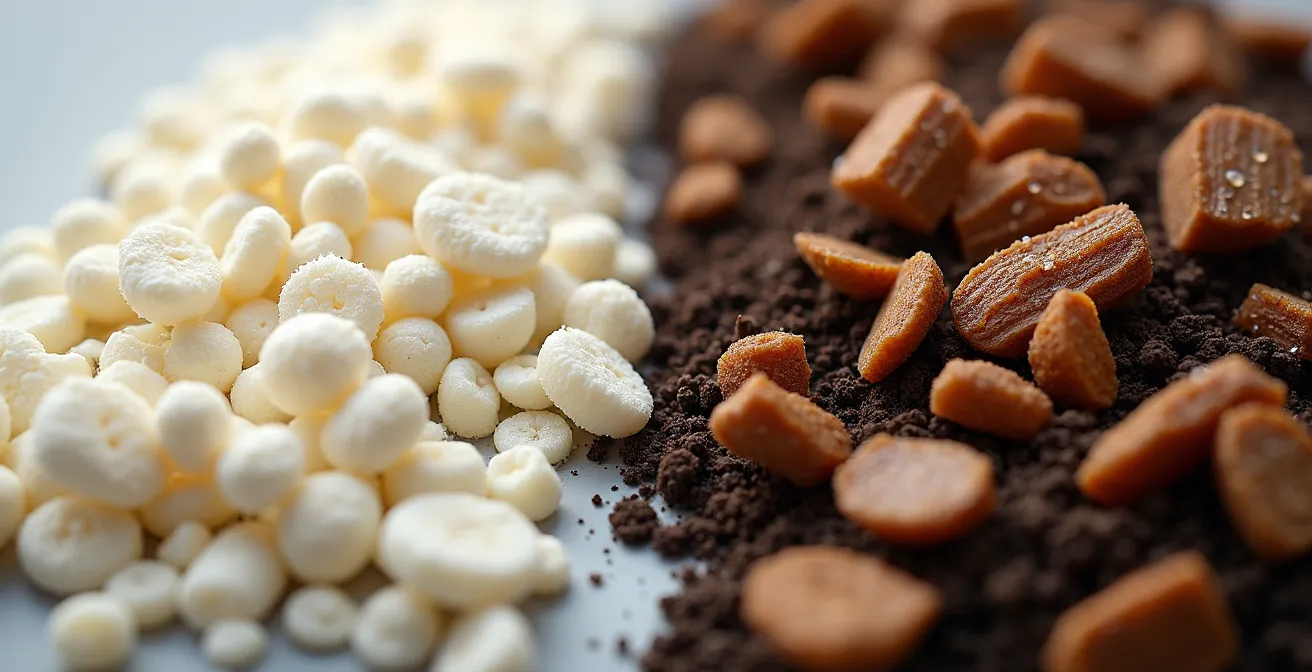
The choice between perlite and vermiculite is not a matter of preference but a calculated decision based on their distinct physical and chemical properties.
- Perlite provides permanent structural aeration due to its rigid, closed-cell nature, making it ideal for preventing compaction in heavy soils.
- Vermiculite acts as a nutrient and moisture reservoir, possessing a high Cation Exchange Capacity (CEC) that actively holds and releases essential minerals.
Recommendation: Engineer your substrate by combining them—use perlite for the physical framework and vermiculite for the chemical engine—to achieve optimal balance in your potting mixes.
For any potting mix creator, the debate between perlite and vermiculite often boils down to a simple platitude: perlite for drainage, vermiculite for retention. While not entirely false, this surface-level understanding fails to capture the intricate physics and chemistry that govern their behavior in a substrate. It overlooks the crucial roles of Cation Exchange Capacity (CEC), structural integrity under compaction, and the specific nature of water release, which are the true determinants of a successful growing medium. This approach leads to suboptimal mixes that either dry out too quickly or, worse, create anaerobic conditions that stifle root development.
Most advice focuses on what these amendments do, not why they do it. The real key to mastering soil science isn’t just knowing which to add, but understanding the fundamental mechanisms that make them work. What if the deciding factor wasn’t just water, but the amendment’s ability to hold and exchange nutrients? What if its long-term structural stability was more important than its initial water-holding capacity? This guide abandons the simplistic dichotomies and instead adopts the perspective of a substrate physicist, dissecting the granular properties of these two essential components. We will analyze their molecular structure, their interaction with nutrients, and their effect on soil pH to provide a framework for creating truly engineered growing media.
For those who prefer a visual format, the following video offers a look into plant propagation techniques, a process where the physical properties of the growing medium are absolutely critical for success.
This article will deconstruct the function of common soil amendments by examining their physical and chemical properties. We will explore how these characteristics influence everything from soil structure and nutrient availability to pH stability, providing you with the knowledge to make scientifically informed decisions for your custom potting mixes.
Summary: Perlite vs. Vermiculite: A Deep Dive into Soil Physics
- Does Gypsum Actually Loosen Clay Soil or Is It a Myth?
- The “Uncharged” Biochar Mistake That Robs Nutrients From Plants
- Azomite or Basalt: Which Remineralizes Depleted Soil More Effectively?
- Fresh vs Composted Manure: How Long Must It Age to Be Safe?
- Coco Coir Buffering: Why You Must Wash It Before Mixing?
- How to Fluff Up Clay Soil to Improve Drainage for Root Vegetables?
- Why a pH of 6.0 Is Ten Times More Acidic Than 7.0?
- Why Ignoring Soil pH Causes Nutrient Lockout in 80% of Gardens?
Does Gypsum Actually Loosen Clay Soil or Is It a Myth?
The promise of gypsum (calcium sulfate) as a “clay breaker” is a pervasive garden myth. Its function is chemical, not physical. Gypsum works by displacing sodium ions in sodic soils, a specific type of clay soil high in sodium, which causes clay particles to disperse and compact. By introducing calcium, gypsum encourages flocculation, where particles clump together to create better soil structure. However, this is not a universal solution. For the vast majority of non-sodic clay soils, gypsum provides little to no structural benefit. In fact, research shows that gypsum’s clay-loosening effects are temporary and soil-specific, often lasting only a few months.
When dealing with heavy clay, the problem is usually physical compaction, not sodium content. The solution, therefore, must be physical. This is where an amendment like perlite excels. Unlike gypsum, perlite does not chemically react with clay particles. Instead, its rigid, porous structure creates permanent air channels and improves drainage by physically separating the fine clay particles. It acts as a permanent structural amendment that will not break down over time. However, improper application can lead to unintended consequences.
Case Study: The “Clay Bowl” Effect
When amending only a small planting hole in a large area of unamended clay, a dangerous “clay bowl” effect can occur. Water drains rapidly through the highly porous amended soil but then hits the impermeable boundary of the surrounding clay. Unable to drain further, the water accumulates at the bottom, saturating the root zone and creating an anaerobic environment akin to a container with no drainage holes. This demonstrates the importance of amending a wide area to ensure proper hydrological continuity.
Therefore, before turning to any amendment, it is crucial to diagnose the root cause of compaction. A simple jar test can help determine if your soil is dispersive (a candidate for gypsum) or simply physically dense (requiring a structural amendment like perlite). For most gardeners, focusing on incorporating stable physical conditioners is a far more reliable strategy for improving clay soil structure than relying on chemical fixes with limited applications.
The “Uncharged” Biochar Mistake That Robs Nutrients From Plants
Biochar is often lauded for its incredible porosity and high surface area, which contribute to a high Cation Exchange Capacity (CEC)—the soil’s ability to hold onto and exchange positively charged nutrients (cations) like potassium, calcium, and magnesium. However, a critical misunderstanding leads many to inadvertently starve their plants. Raw, or “uncharged,” biochar has a strong affinity for nutrients. When added directly to soil, it acts like a sponge, aggressively absorbing available cations from the surrounding soil solution, effectively robbing them from plant roots in the short term.
This initial nutrient theft is why biochar must be “charged” or “inoculated” before use by co-composting it or soaking it in a rich nutrient solution like compost tea. This pre-loads its exchange sites with nutrients. Once charged, it transforms from a nutrient thief into a long-term nutrient bank, slowly releasing minerals back into the soil over time. This contrasts sharply with vermiculite, which has a naturally high CEC and comes ready to participate in nutrient exchange without any pre-treatment. Vermiculite’s crystalline structure inherently possesses exchange sites that are immediately available to buffer and supply nutrients.
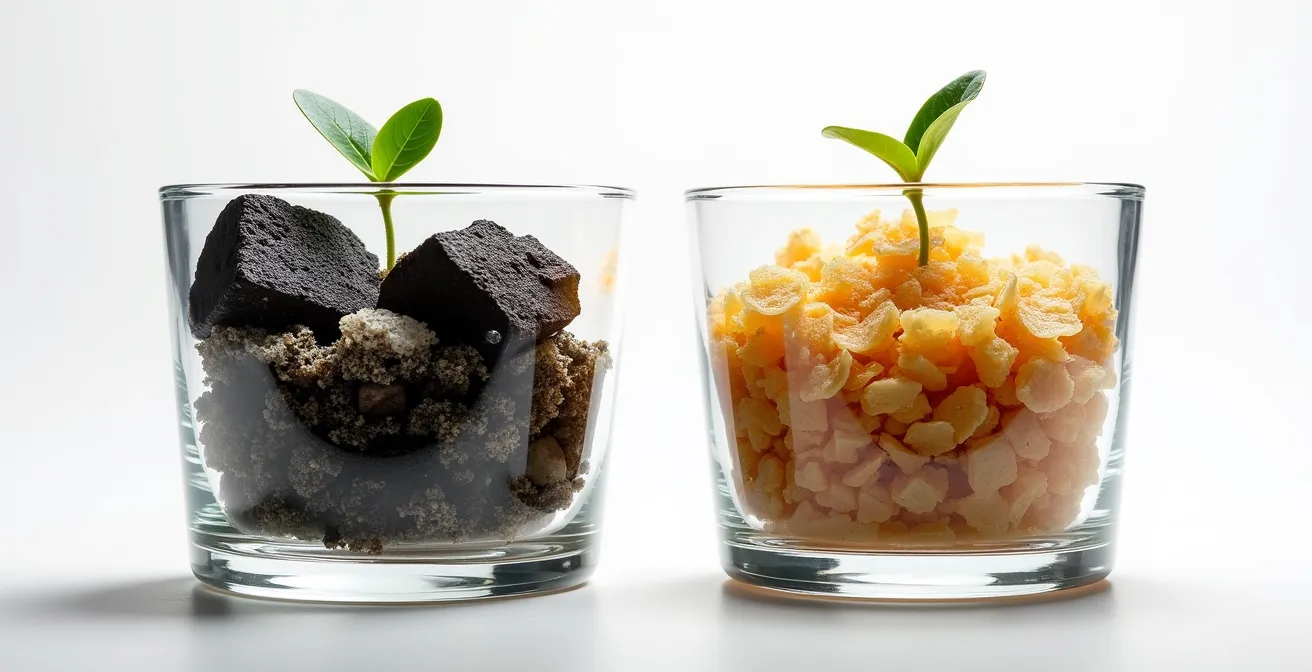
The table below provides a clear comparison of the CEC values and nutrient behavior, illustrating why understanding an amendment’s initial state is critical for its effective use. Vermiculite offers immediate exchange capabilities, while biochar’s potential is only unlocked after a crucial charging phase.
| Amendment Type | CEC Range (cmol/kg) | Nutrient Behavior | Key Characteristic |
|---|---|---|---|
| Uncharged Biochar | 10-27 | Absorbs/steals nutrients initially | Must be ‘charged’ before use |
| Charged Biochar | 46-152 (after treatment) | Releases nutrients slowly | Long-term nutrient storage |
| Vermiculite | 100-150 | Immediately available exchange | Passive magnet for cations |
Azomite or Basalt: Which Remineralizes Depleted Soil More Effectively?
When soil is depleted, amendments like azomite and basalt rock dust are often used to reintroduce a broad spectrum of trace minerals. These materials act like a slow-release multivitamin, gradually breaking down to supply elements that are essential for plant enzyme function. Azomite, a volcanic ash, provides a wide array of trace elements, while basalt offers silica and iron in addition to other minerals. The choice between them often depends on the specific deficiencies of the soil. However, simply adding minerals is only half the battle; the soil must also have the capacity to hold onto them.
This is where the concept of Cation Exchange Capacity (CEC) becomes paramount again. Without sufficient exchange sites, many of the positively charged mineral ions (cations) released by these remineralizers can be leached away by water before plants can absorb them. This is where an amendment like vermiculite demonstrates its superior value beyond simple water retention. Vermiculite is not just a structural addition; it is an active chemical component. Its high CEC acts as a docking station for nutrients.
As experts note, this capacity is a defining feature. According to Antonangelo et al. in a study published in Frontiers in Soil Science:
The porous structure and high surface area of biochar provide abundant binding sites for cations, contributing to increased CEC which affects retention and availability of essential nutrients.
– Antonangelo et al., Frontiers in Soil Science
While this quote refers to biochar, the principle is identical and even more pronounced for vermiculite. As an active participant in soil chemistry, vermiculite’s high CEC provides essential mineral storage, attracting and holding cations like potassium, magnesium, and calcium. It even contains its own stores of potassium and magnesium, acting as both a storage facility for added minerals and a slow-release source itself. Therefore, pairing a remineralizing agent with a high-CEC amendment like vermiculite creates a synergistic system where minerals are not just added, but are also retained and made available to plants over the long term.
Fresh vs Composted Manure: How Long Must It Age to Be Safe?
Using fresh or “hot” manure in a garden is a significant risk. It contains high levels of ammonia and other nitrogen compounds that can burn plant roots, and it may harbor harmful pathogens like E. coli. Proper composting is essential to stabilize these nutrients and eliminate pathogens. The aging process, which can take anywhere from six months to a year, relies on aerobic bacteria to break down organic matter, a process that requires a careful balance of moisture and oxygen. The challenge is maintaining sufficient aeration throughout the pile to prevent anaerobic “cold spots” where pathogens can survive and decomposition stagnates.
This is a physical problem that can be solved with physical amendments. Incorporating perlite or vermiculite into a manure pile can drastically accelerate the composting process and improve its safety.
- Perlite’s Role (Aeration): Adding perlite at a 20-30% volume creates a permanent network of air channels. Its rigid structure prevents the pile from compacting under its own weight, ensuring oxygen can penetrate deep into the core. This promotes faster, hotter, and more consistent aerobic decomposition, which is key to killing pathogens and weed seeds.
- Vermiculite’s Role (Nutrient & Moisture Retention): While perlite provides air, vermiculite acts as a sponge. It absorbs excess moisture and, crucially, captures ammonium and other volatile nitrogen compounds that would otherwise be lost to the atmosphere as gases. This retains more of the manure’s nutrient value in the final compost.
By using these amendments, you are engineering a more efficient bioreactor. Perlite provides the physical scaffolding for air, while vermiculite manages the chemical and hydrological balance. The result is a safer, more nutrient-rich compost that is ready in a fraction of the time. The structural integrity of perlite is particularly valuable as a risk mitigation tool, ensuring aeration and drainage and reducing the risk of anaerobic pathogen survival even in incompletely composted material.
The choice of amendment thus depends on the primary goal: use perlite to solve a physical problem (compaction and lack of air) and use vermiculite to solve a chemical one (nutrient and water loss). For the fastest and most complete composting, a combination of both is often the ideal solution.
Coco Coir Buffering: Why You Must Wash It Before Mixing?
Coco coir, a popular peat moss alternative, is prized for its water retention. However, raw, unbuffered coir presents a significant chemical challenge. It comes naturally saturated with sodium and potassium ions attached to its cation exchange sites. When you add a calcium-based fertilizer (like Cal-Mag), a process called cation exchange occurs: the coir releases its potassium and sodium into the soil solution while grabbing onto the calcium and magnesium, locking them up and making them unavailable to the plant. This is why high-quality coir is “buffered” by the manufacturer—a process of rinsing it with a calcium nitrate solution to pre-load the exchange sites with calcium and wash away excess salts.
Even after buffering, coir’s water handling properties are unique. It holds a tremendous amount of water, but its fine, fibrous structure can also hold water too tightly, making it less available to plant roots compared to other media. This is where understanding water availability vs. water retention becomes critical. The ideal substrate doesn’t just hold water; it releases it to the roots on demand. This is why the “triple mix”—a combination of coir, perlite, and vermiculite—is so effective.
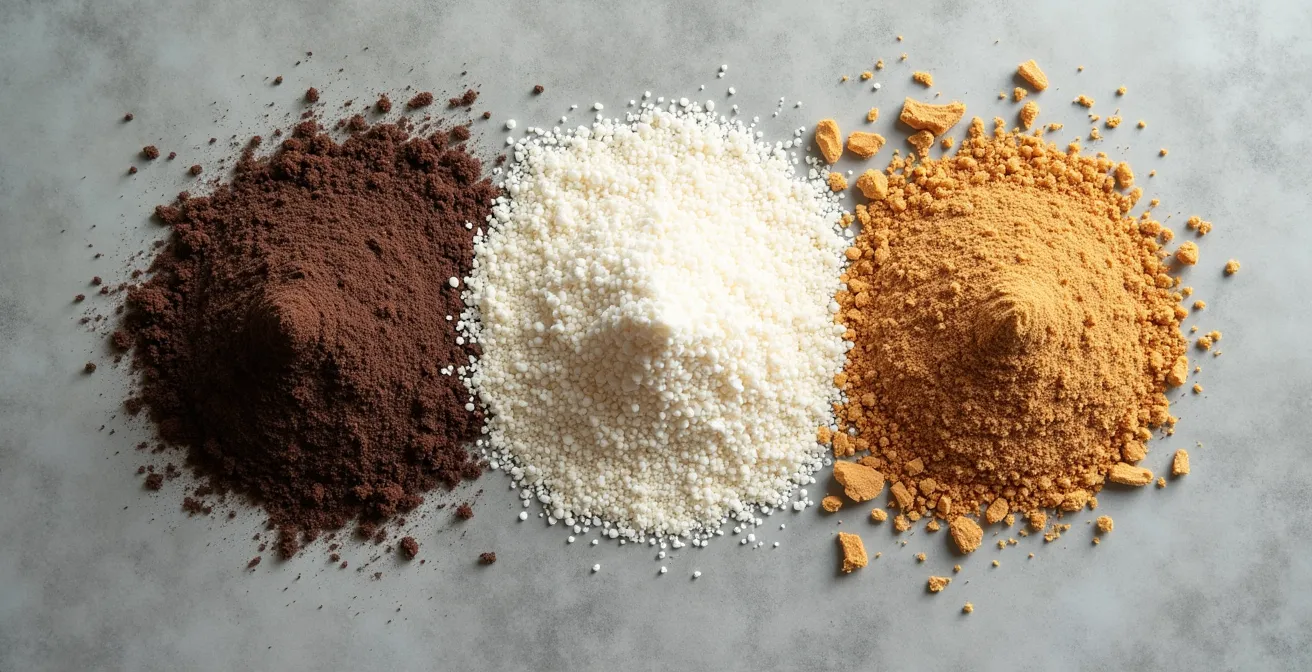
This blend creates a physically and chemically balanced medium. Research into soilless mixes has shown that an ideal formula combines these elements for optimal results. A proven ratio is composed of 6 parts peat moss (or coir), 1 part perlite, and 1 part vermiculite to create a balance of drainage, aeration, and moisture. The table below illustrates how each component contributes a unique property to the final mix.
| Medium | Water Retention | Water Availability | Best Use Case |
|---|---|---|---|
| Coco Coir | Very High | Moderate (holds too tightly) | Base medium needing amendments |
| Vermiculite | High | High (readily releases) | Moisture-loving plants |
| Perlite | Low-Moderate | High (drains quickly) | Aeration and drainage |
| Triple Mix | Balanced | Optimal | Universal growing medium |
How to Fluff Up Clay Soil to Improve Drainage for Root Vegetables?
Growing root vegetables like carrots and parsnips in heavy clay soil is a physical challenge. The dense, compacted structure of clay offers strong resistance to root expansion, resulting in stunted or forked growth. Furthermore, its poor drainage can lead to waterlogged conditions and root rot. The goal is to “fluff up” the soil, creating a light, friable texture that allows roots to grow unimpeded and excess water to drain away. This requires a permanent structural amendment, as temporary solutions like tilling provide only short-lived relief before the clay resettles.
Perlite is the superior choice for this task. Its rigid, glass-like structure allows it to act as a physical bridging agent. The individual particles of perlite do not compress. When mixed into clay, they create a stable, porous framework, holding the fine clay particles apart and maintaining permanent air pockets. This structural integrity is something vermiculite, with its softer, accordion-like structure, cannot provide. Under the pressure of heavy clay, vermiculite can compress, reducing its aerating capacity. As noted by horticulturalist Kevin Espiritu, “Because vermiculite absorbs more water than perlite, it doesn’t aerate the soil as well. This results in less oxygen reaching the plant roots.”
For effective amendment, volume is key. A light dusting of perlite will have no effect. To create a meaningful change in soil physics, experts recommend a significant volumetric addition. For garden beds, a common guideline is to work 25-30% perlite by volume into the top 6 inches of soil. This creates a sufficient network of pores to dramatically improve both drainage and aeration, providing the ideal environment for robust root development. The perlite’s inert nature also means it will not alter the soil’s pH, offering a purely physical solution to a physical problem.
Why a pH of 6.0 Is Ten Times More Acidic Than 7.0?
Understanding soil pH is fundamental to nutrient management, yet many fail to grasp the scale on which it operates. The pH scale is logarithmic, not linear. This means that for every one-point decrease on the scale, the acidity increases by a factor of ten. Therefore, a soil with a pH of 6.0 is ten times more acidic than a neutral soil with a pH of 7.0. A soil at pH 5.0 is one hundred times more acidic than a soil at pH 7.0. This exponential relationship explains why even small shifts in pH can have dramatic effects on nutrient availability and plant health.
Soil amendments play a crucial role not only in structure but also in pH management. Different amendments have different inherent pH levels and varying abilities to buffer, or resist changes in, pH. According to soil amendment pH data, perlite has a pH range of 6.6 to 7.5, making it effectively neutral, while vermiculite also has a neutral pH of 7.0. However, their buffering capacity differs. Perlite is chemically inert and has virtually no buffering capacity. Vermiculite, due to its cation exchange properties, has a moderate ability to buffer against pH swings, particularly against increasing acidity.
This knowledge allows for a strategic approach to building potting mixes. If you are starting with an acidic base like peat moss (pH 3.0-4.5), including vermiculite can help raise and stabilize the pH in the desired range. Conversely, if you need to maintain the existing pH and simply want to add aeration, the inert nature of perlite makes it the perfect choice. Properly managing pH is not about chasing a perfect number, but about creating a stable environment where nutrients remain available.
Action Plan: Strategic pH Buffering with Amendments
- Assess your base medium’s pH to establish a baseline before adding any amendments.
- Use perlite when you require purely physical aeration without altering the substrate’s pH, as it is chemically inert.
- Incorporate vermiculite when you need both moisture retention and a moderate capacity to buffer against drops in pH, especially in acidic mixes.
- For highly alkaline soils (above pH 7.5), use perlite for structure, as vermiculite can sometimes contribute to a slight increase in pH.
- After mixing your final substrate, test the pH again to verify it has stabilized within the target range for your specific plants.
Key Takeaways
- The primary function of amendments is to solve physical (structure) or chemical (nutrient/pH) problems in a substrate.
- Perlite provides permanent physical aeration, while vermiculite offers chemical buffering and nutrient retention via its high Cation Exchange Capacity (CEC).
- Engineering a successful growing medium involves combining amendments strategically to balance water retention, water availability, aeration, and nutrient storage.
Why Ignoring Soil pH Causes Nutrient Lockout in 80% of Gardens?
The single most critical factor governing nutrient availability in any soil or substrate is its pH. You can add all the premium fertilizers and amendments in the world, but if the pH is outside the optimal range for your plants (typically 6.0 to 7.0), those nutrients will become chemically “locked out” and unavailable for root uptake. At a high pH (alkaline conditions), essential nutrients like phosphorus, iron, and manganese form insoluble compounds and precipitate out of the soil solution. At a low pH (acidic conditions), elements like aluminum can become soluble to toxic levels, while calcium and magnesium become less available.
This phenomenon is the silent killer in many gardens, where plants show signs of deficiency even in seemingly fertile soil. A classic example is blossom end rot in tomatoes, often misdiagnosed as a simple calcium deficiency. While a lack of calcium can be the cause, it is frequently a case of calcium lockout due to incorrect pH or inconsistent watering that prevents its uptake. When pH is too high to use lime (which would raise it further), gypsum can be a solution. It provides soluble calcium without affecting the overall pH, directly addressing the lockout problem. However, this is a targeted chemical intervention, not a structural one.
This underscores the importance of choosing amendments with their pH effects in mind. Using vermiculite in an acidic peat-based mix helps buffer the pH into a more favorable range, unlocking nutrients that would otherwise be unavailable. Using the inert perlite ensures that you are only affecting the physical structure, not the delicate chemical balance. An incorrect choice can inadvertently push the pH into a lockout zone. Therefore, the first step in any substrate formulation or soil diagnosis should be a reliable pH test. It is the master key that determines whether all other inputs will be effective or wasted.
To truly master your growing medium, begin thinking like a substrate physicist. Test your components, understand their fundamental properties, and combine them with purpose to engineer the precise physical and chemical environment your plants need to thrive.