
The secret to managing a giant Monstera isn’t restriction; it’s architecture. By understanding and directing its natural growth, you can transform it from an unruly beast into a vertical living sculpture.
- Master vertical training by identifying the plant’s “back” and using a moss pole to guide its ascent.
- Engineer the pot with structural ballast at the base to prevent a top-heavy plant from tipping over.
- Use strategic pruning, not just to reduce size, but to encourage a fuller, more controlled shape.
Recommendation: Instead of fighting your plant’s sprawl, choose one architectural technique from this guide—like installing a pole correctly—and start sculpting your Monstera’s vertical ambition today.
You brought it home as a charming, manageable plant with a few heart-shaped leaves. Now, it’s a verdant monster in a silent, slow-motion takeover of your living room. The Monstera deliciosa, the icon of tropical interiors, has a secret: its goal isn’t just to be pretty, it’s to conquer. For the apartment dweller, this explosive growth can quickly shift from a point of pride to a source of spatial anxiety. The joy of a thriving plant is overshadowed by its sheer, sprawling dominance.
The common advice often feels like a losing battle: “prune it back,” “tie it to the wall,” or the ever-vague “give it a moss pole.” These are reactive chores, not a cohesive strategy. They treat the Monstera as a problem to be contained rather than a natural force to be understood and directed. This approach fails to address the plant’s fundamental biology—its unyielding drive to climb towards the light.
But what if the key wasn’t to fight its growth, but to become its architect? The true solution lies in shifting your mindset from plant owner to spatial botanist. By mastering the structural mechanics of potting, the science of vertical support, and the art of strategic pruning, you can sculpt its ambition. This guide rejects temporary fixes and instead provides an architectural framework to transform your Monstera into a magnificent, gravity-defying living sculpture that enhances your small space instead of overwhelming it.
We will deconstruct the essential elements of Monstera management, from encouraging its iconic split leaves to engineering its stability. You will learn not just *what* to do, but the structural and biological *why* behind each action, empowering you to make bold, intelligent decisions for your green companion.
Summary: A Guide to Sculpting Your Monstera for Apartment Living
- Why Your Monstera Leaves Have No Holes Despite Being 2 Years Old?
- How to Train a Monstera on a Moss Pole for Vertical Growth?
- Coco Coir vs Sphagnum Moss: Which Pole Promotes Better Aerial Root Grip?
- The Potting Mistake That Causes Top-Heavy Monsteras to Tip Over
- When to Chop and Propagate a Leggy Monstera for a Bushier Look?
- How to Mix a Chunky Soil Blend That Alocasia Roots Love?
- Ficus Tree or Hanging Pothos: Which Best Fills Vertical Dead Space?
- Why Decorative Variegated Foliage Is Worth the High Price Tag?
Why Your Monstera Leaves Have No Holes Despite Being 2 Years Old?
The iconic splits and holes in a Monstera leaf, known as fenestrations, are not a given. They are a sign of maturity. If your two-year-old plant still only produces solid, heart-shaped leaves, it’s not a failure on your part; it’s a signal from the plant that its current conditions aren’t convincing it to grow up. In the wild, these splits allow wind to pass through and let light filter down to lower leaves. For your plant to “decide” it’s large enough to need them, it must feel secure and energized.
Three critical factors govern this transition from juvenile to adult foliage. First is bright, indirect light. Insufficient light forces the plant into a state of “etiolation”—weak, stretched-out growth as it desperately searches for the sun. This wastes energy on horizontal sprawl instead of vertical maturity. Second is vertical support. A Monstera that is allowed to hang or trail believes it’s still on the dark forest floor. One that climbs, however, mimics its natural ascent up a tree trunk, triggering hormonal changes that lead to mature, fenestrated leaves. Finally, an appropriately sized pot with adequate nutrients is essential. Cramped roots cannot support the energy demands of a large, mature plant.
The visual difference between juvenile and mature leaves is a clear indicator of the plant’s life stage. The journey from a solid leaf to one with elegant fenestrations is a direct reflection of providing the right architectural and environmental cues.

As you can see, the progression is a direct result of the plant having enough energy and support to invest in its adult form. A plant owner’s five-year journey documented how a small Monstera, given a bright window and space to grow, completely transformed a dining room, showing the incredible potential when conditions are met. This is the growth architecture you are aiming to control.
How to Train a Monstera on a Moss Pole for Vertical Growth?
A moss pole is not merely a stake; it is an architectural element that convinces your Monstera it has found a tree to climb. This triggers its vertical ambition, encouraging larger leaves and a more manageable upward growth habit. However, simply inserting a pole into the pot is not enough. The technique is crucial for success and relies on understanding the plant’s anatomy.
First, you must identify the “front” and “back” of your Monstera. The front is where the leaves emerge. The back is the opposite side, where small, brown nubs or long, stringy aerial roots grow from the stem. It is the back of the plant that must be placed directly against the moss pole. This is a non-negotiable rule of Monstera architecture, as the aerial roots will only grow into the support they are facing.
When installing, soak the pole thoroughly and position it deep in the pot for stability. Secure the main, thicker stems against the moist moss using soft plant ties or velcro tape—never wire, which can cut into the stem. The tension should be just enough to support the plant without strangling it. Over time, as new aerial roots emerge, they will burrow into the moist pole, anchoring the plant themselves. At this point, you can remove the initial ties. This process transforms a sprawling plant into a tidy, vertical column of foliage.
Action Plan: Securing Your Monstera for Vertical Ascent
- Identify the ‘back’ of your Monstera where aerial roots emerge; this is the side that MUST face the pole.
- Use soft materials like green gardening velcro or fabric strips to secure the stem, avoiding any damage to the petioles (leaf stalks).
- Apply proper tension: ensure the connection is tight enough to offer support but loose enough not to constrict growth.
- For young plants, initially secure only the base of the stem and allow it to latch on naturally as it grows upwards.
- Once aerial roots have firmly attached to the pole (typically within a few weeks), remove the temporary ties to prevent future restriction.
Coco Coir vs Sphagnum Moss: Which Pole Promotes Better Aerial Root Grip?
Choosing the right material for your support pole is a key architectural decision that impacts both maintenance and your plant’s ability to grip. The two dominant choices are sphagnum moss and coco coir, and each has distinct structural properties that cater to different needs and environments.
Sphagnum moss is the superior choice for promoting aerial root grip. Its fibrous, absorbent texture is like a sponge, holding a significant amount of water. When you mist the pole, sphagnum stays damp for an extended period. This high humidity environment is precisely what triggers aerial roots to grow and burrow deep into the pole, seeking moisture. This strong attachment creates a very secure, integrated structure where the plant and pole become one. The downside is that sphagnum can break down over time and may require more frequent misting to remain effective, as a dry sphagnum pole offers no benefit.
Coco coir, on the other hand, is prized for its durability and rot resistance. Made from coconut husk fibers, it provides a rough, sturdy surface for aerial roots to cling to. However, it is far less absorbent than sphagnum. It dries out very quickly and does not create the same humid microclimate that so effectively entices aerial roots. While a Monstera will still use a coir pole for physical support, the roots are more likely to cling to the surface rather than deeply embedding themselves. This makes coir a lower-maintenance option, but one that offers less biological encouragement for a truly symbiotic attachment. For the spatial botanist aiming for maximum vertical integration, sphagnum is the architecturally superior material, despite its higher upkeep.
The Potting Mistake That Causes Top-Heavy Monsteras to Tip Over
As your Monstera’s vertical ambition takes hold, a new problem emerges: instability. A tall, leafy plant in a standard plastic nursery pot becomes dangerously top-heavy. The common reaction is to size up to a bigger pot, but this often exacerbates the problem by encouraging even more top growth without addressing the foundational issue. The solution is not just a bigger pot, but a smarter potting strategy based on principles of structural engineering.
The critical mistake is using a uniform, lightweight potting mix throughout the entire container. The key to stability is creating structural ballast. This means engineering the pot’s center of gravity to be as low as possible. You achieve this by creating a layered soil system. The bottom third of the pot should be filled with heavy materials like lava rock or pumice. This heavy base acts as an anchor, making the entire structure significantly more resistant to tipping. The middle layer can be your standard chunky aroid mix, and the top layer a slightly more moisture-retentive mix for the surface roots.
Pot selection is equally important. Avoid tall, narrow plastic planters. Instead, choose “squat” pots that are wider than they are tall, and opt for heavy materials like ceramic or terracotta. This wider base, combined with the internal ballast, creates an unshakeable foundation. This is especially critical when you consider that mature Monsteras can grow to an impressive seven-to-eight-foot height indoors, making stability a paramount safety concern. Proper potting is not just horticulture; it’s preventative engineering.
When to Chop and Propagate a Leggy Monstera for a Bushier Look?
Sometimes, despite your best efforts, a Monstera becomes “leggy”—long, bare stems with leaves clustered only at the ends. Or perhaps it has simply outgrown its designated vertical space. In these cases, pruning is necessary. But an architectural approach to pruning is not about random hacking; it’s about a strategic reset based on the plant’s biology.
Monsteras exhibit a trait called apical dominance. The main growing tip (the apical bud) produces hormones called auxins that suppress the growth of buds lower down on the stem. This is an efficient evolutionary strategy to reach sunlight quickly without wasting energy on side shoots. To get a bushier plant, you must interrupt this process. By cutting the main stem, you remove the source of the suppressing hormones, which signals the dormant lateral buds below the cut to finally activate and grow. This is how you force the plant to become fuller from the base.
The “Chop and Extend” technique is particularly effective for small spaces. Instead of discarding the cutting, you root it in water and then plant it back into the same pot as the mother plant. This instantly creates a multi-stemmed, much bushier appearance from a single base, doubling the foliage without doubling the footprint. Knowing exactly where to cut is crucial for success. You must always cut the stem just above a node—the small, raised ring on the stem where leaves and aerial roots emerge. This is the plant’s growth point.
This image demonstrates the precise location for a cut, ensuring the remaining node can activate and the cutting has a node to produce new roots.
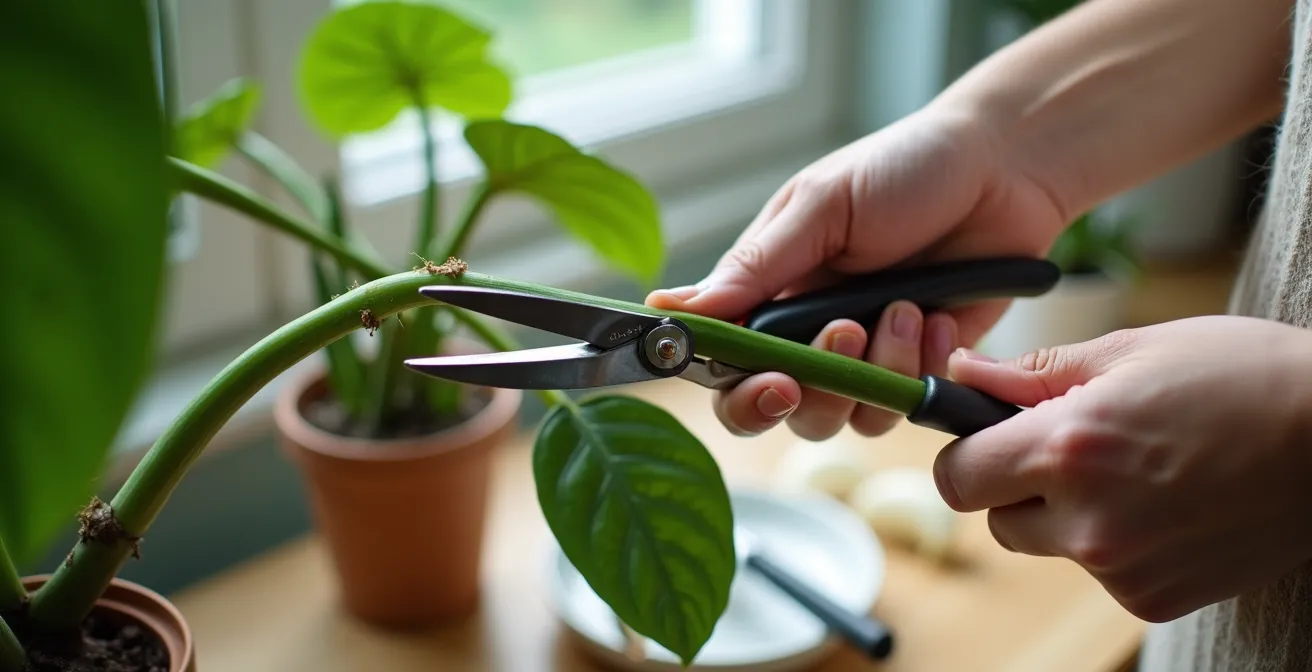
Whether you’re performing a hard reset on an overgrown plant or an aesthetic trim to maintain shape, understanding the science behind the snip turns a simple chore into a powerful act of botanical sculpture. You are not just cutting the plant; you are directing its future form.
How to Mix a Chunky Soil Blend That Alocasia Roots Love?
While this article focuses on Monstera architecture, understanding the soil needs of other aroids, like Alocasia, provides a powerful lesson in contrast. It highlights why a generic “potting mix” is insufficient and how soil engineering must be tailored to a plant’s specific root system. An Alocasia’s needs are fundamentally different from a Monstera’s, and seeing why helps clarify the unique requirements of our climbing giant.
Alocasia possess fine, water-sensitive roots that are prone to rot in dense, soggy soil. Their ideal mix, therefore, prioritizes consistent drainage and moisture retention. It uses a high percentage of peat or coir (around 40%) to hold water, balanced with a generous amount of perlite or fine pumice (30%) to keep the mix light and airy. In contrast, a Monstera has thick, semi-epiphytic roots built for anchoring and climbing. Its soil needs are less about moisture retention and more about creating large air pockets and providing structural stability.
As a leading plant care specialist notes in the Indoor Plant Soil Engineering Guide, this principle of tailoring soil can be adapted for stability. They state:
The use of heavy inorganic materials like pumice in specialized mixes can be adapted to add weight and ballast to a Monstera pot, preventing it from tipping over.
– Plant Care Specialist, Indoor Plant Soil Engineering Guide
This comparative table clearly shows how the recipe for each plant’s soil is engineered for completely different functions, from root health to physical support.
| Component | Monstera Mix | Alocasia Mix | Key Difference |
|---|---|---|---|
| Bark Chunks | 40-50% large pieces | 20% fine grade | Monstera needs larger air pockets |
| Perlite/Pumice | 20% throughout | 30% evenly mixed | Alocasia needs more consistent drainage |
| Heavy Materials (lava rock) | 20% in bottom third only | 10% throughout | Monstera uses as ballast for stability |
| Peat/Coir | 10-20% | 40% | Alocasia prefers more moisture retention |
| Root Type Supported | Thick semi-epiphytic | Fine water-sensitive | Completely different root systems |
Ficus Tree or Hanging Pothos: Which Best Fills Vertical Dead Space?
When confronted with a blank wall or an empty corner in a small apartment, the default solutions are often a static Ficus tree for height or a cascading Pothos for shelving. While effective in their own right, a well-architected Monstera deliciosa offers a far more dynamic and impactful solution for filling vertical space. It combines the best attributes of both, offering height, spread, and a controllable, sculptural quality.
A Ficus lyrata (Fiddle Leaf Fig) provides instant verticality but is notoriously static and prone to dramatic leaf drop when stressed. A hanging Pothos offers beautiful cascading growth but only covers space downwards and can become sparse on top over time. A trained Monstera, by contrast, is a living, adaptable sculpture. Guided by a pole, its growth is directed vertically, while its large, fenestrated leaves spread horizontally, covering a significant area with lush foliage. Its expansion is rapid but, as we’ve seen, entirely manageable with the right architectural techniques.
The power of the Monstera lies in its scalability. Even for those in the tiniest apartments, the impact can be significant. As one case study on plant synergy notes, even just one or two Monstera leaves in a vase can bring the tropics home when a full plant won’t fit. This adaptability makes it a superior choice for the strategic interior botanist. The following table breaks down the pros and cons of each approach to vertical space management.
| Plant Type | Vertical Coverage | Growth Control | Management Issues | Space Efficiency |
|---|---|---|---|---|
| Ficus Tree | Static height only | Minimal pruning needed | Dramatic leaf drop when stressed | Good for corners |
| Hanging Pothos | Cascades downward only | Regular trimming required | Gets sparse on top over time | Excellent for shelves |
| Trained Monstera | Directed vertical + foliage spread | Manageable with techniques from article | Rapid expansion (solvable) | Best overall coverage |
| Combined Planting | Multi-directional coverage | Requires coordination | Complex care needs | Maximum impact |
Key Takeaways
- Monstera fenestration (leaf splits) is a sign of maturity, triggered by bright indirect light and vertical support.
- Training requires securing the “back” of the plant (where aerial roots emerge) to a moist moss pole.
- Prevent tipping in tall plants by using a wide, heavy pot and adding “structural ballast” (lava rock, pumice) to the bottom third of the soil.
Why Decorative Variegated Foliage Is Worth the High Price Tag?
After exploring every architectural trick to manage the vigorous growth of a standard green Monstera deliciosa, there is one final, counter-intuitive strategy: choosing a plant that is naturally less vigorous. For the apartment botanist with limited space but a taste for the spectacular, the high price tag of a variegated Monstera—like the ‘Thai Constellation’ or ‘Albo’—is not just for aesthetics. It’s payment for a built-in growth regulator.
The beautiful white or cream splashes on variegated leaves are sectors of cells that lack chlorophyll. Chlorophyll is the engine of photosynthesis, the process that converts light into energy for growth. With less engine power, the entire plant operates at a slower pace. As noted by horticulturalist Garden Betty:
Variegated plants in general, including Monsteras, are known to be more challenging to grow than their green counterparts. They’re also slower growers. They lack chlorophyll, which means less photosynthesis, fewer nutrients, slower growth, and a less forgiving plant.
– Garden Betty, 5 Must-Know Tips for Growing a Beautiful Thai Constellation Monstera
This slower growth is a significant advantage in a small living room. Research confirms that variegated varieties like the Thai Constellation grow significantly slower than their all-green relatives. While a standard Monstera might require pruning and repotting annually, a variegated specimen may be content in its space for two or three years. This makes it an ideal “living sculpture” that maintains its form and scale with far less intervention. The high initial cost can be viewed as an investment in long-term manageability and reduced maintenance, a trade-off that many a space-conscious plant lover will find well worth it.
Begin today by identifying your Monstera’s ‘back’ and planning its ascent. Your living sculpture awaits, ready to be shaped by your newfound architectural vision.