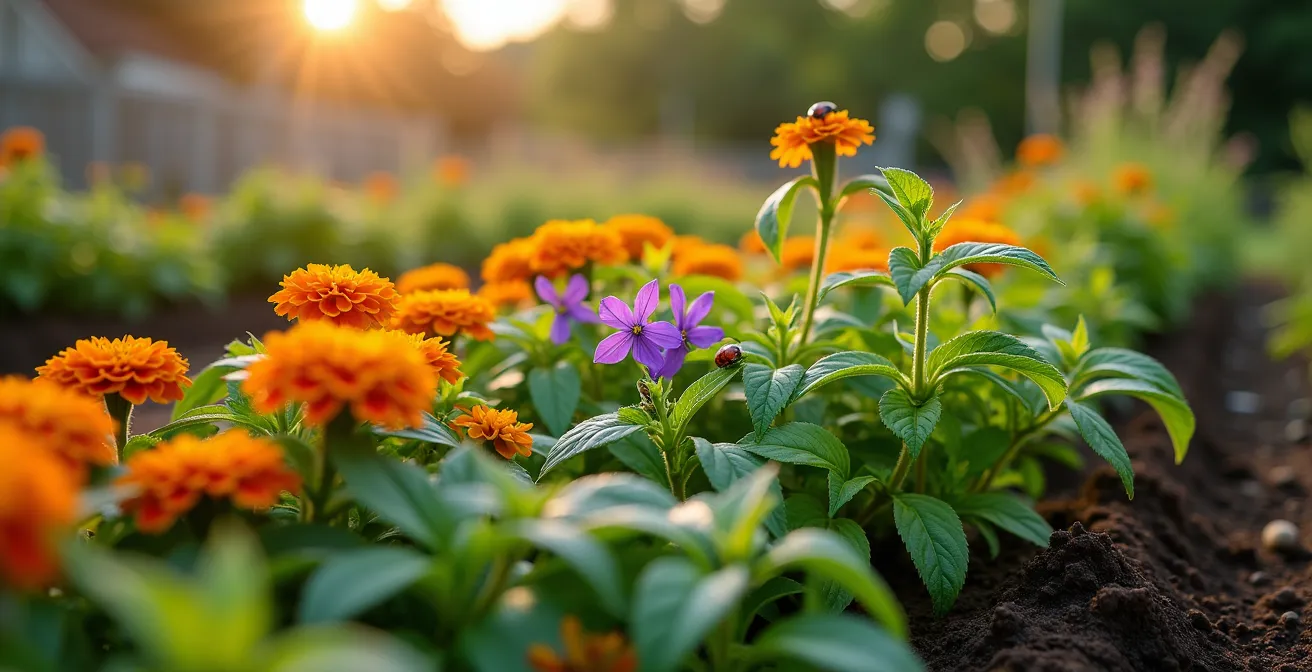
Effective aphid control isn’t about planting a few “good neighbors”; it’s about engineering a strategic garden ecosystem that actively manages pests.
- Sacrificial “trap crops” are used to deliberately lure pests away from your valuable vegetables.
- Certain plants can create a “chemical fence” that actively repels or masks your main crops.
- Proactively building a habitat to breed beneficial insects *before* pests arrive is the cornerstone of natural defense.
Recommendation: Shift your mindset from random plant pairings to designing a holistic, bio-intensive system of offense, defense, and habitat creation.
There’s a unique frustration every vegetable gardener knows: the sight of a once-thriving cabbage or tomato plant suddenly covered in a teeming colony of aphids. In the fight for a healthy, chemical-free harvest, this is a common battle. The conventional wisdom passed down through gardening forums and neighborly advice often sounds simple: “plant marigolds to keep pests away” or “just release some ladybugs.” While not entirely wrong, this advice treats the garden like a simple checklist, missing the deeper ecological principles at play.
These piecemeal tactics are often reactive and fail to address the root cause of pest outbreaks. They overlook the complex, invisible web of relationships happening above and below the soil. The truth is, a resilient, pest-free garden doesn’t happen by accident or by planting a single “magic” flower. It’s the result of a deliberately designed, living system.
So, what if the key wasn’t just finding a plant that aphids dislike, but orchestrating a complete environment that makes their survival difficult and their predators’ lives easy? This is the core of a bio-intensive approach. It’s a strategic mindset that uses plants not just as companions, but as tools for defense, diversion, and habitat engineering. This guide moves beyond simple pairings to explore the specific strategies—the why and the how—that turn your garden into a sophisticated, self-regulating defense system against aphids.
To master this approach, we will explore the precise mechanisms behind these plant relationships. This article breaks down the essential strategies you need to understand, from creating chemical barriers and sacrificial traps to building a standing army of beneficial insects. Let’s delve into the details.
Summary: A Systemic Approach to Natural Aphid Control
- Why Marigolds Actually Repel Pests From Tomatoes?
- How to Sacrifice Nasturtiums to Save Your Cabbage Crop?
- Basil or Dill: Which Is the Better Companion for Cucumbers?
- The Planting Mistake of Placing Beans Near Onions
- When to Plant Alyssum to Attract Hoverflies Before Aphids Arrive?
- Why Your Bought Ladybugs Flew Away Immediately and How to Keep Them?
- The Monoculture Mistake That Invites Pest Swarms
- Nematodes or Ladybugs: Which Biological Control Saves Lawns From Grubs?
Why Marigolds Actually Repel Pests From Tomatoes?
The advice to plant marigolds with tomatoes is one of the oldest in the companion planting playbook, but its effectiveness relies on understanding the science, not just the superstition. Marigolds, specifically French Marigolds (Tagetes patula), are not just a pretty border; they are miniature chemical factories. Their roots exude a compound called thiophene, a natural biocidal agent that is particularly effective against root-knot nematodes in the soil. While this is a major benefit, their power against aphids works through a different, above-ground mechanism.
The pungent scent of marigolds acts as a powerful deterrent. It functions as a “chemical fence,” confusing and repelling pests like aphids and tomato hornworms that locate their host plants by smell. By interplanting marigolds densely around your tomatoes, you create an aromatic barrier that masks the attractive scent of the tomato plants, making it harder for pests to find their target. It’s a strategy of olfactory camouflage. However, this effect is not passive; it requires specific planting techniques to be truly effective. Simply scattering a few plants won’t create a strong enough barrier. A dense, established perimeter is essential for creating the protective shield your tomatoes need.
Your Action Plan: Maximizing Marigold Effectiveness
- Choose French marigolds (Tagetes patula) specifically for their high thiophene production and strong scent.
- Plant marigolds in a dense border around your tomatoes, spacing them 6-8 inches apart to create a continuous ‘chemical fence’.
- Allow the marigolds to become established for 2-3 weeks before you transplant your tomato seedlings into the bed.
- At the end of the season, chop the entire marigold plant (stems, leaves, and flowers) and till it directly into the soil.
- Let the decomposing marigold matter work its biofumigation magic for 2-3 weeks before planting your next crop in that spot.
How to Sacrifice Nasturtiums to Save Your Cabbage Crop?
While some companion plants work by repelling pests, others employ a more cunning strategy: sacrifice. Nasturtiums are the ultimate “trap crop” for aphids, especially those that plague brassicas like cabbage, broccoli, and kale. Instead of warding pests away from your main crop, you plant nasturtiums to deliberately attract them. This is the art of sacrificial gardening, where one plant takes the hit to protect a more valuable one.
Nasturtiums are highly attractive to aphids and cabbage white butterflies. Pests will flock to the lush leaves and bright flowers of the nasturtium, leaving your precious cabbages relatively untouched. Your nasturtium becomes an “aphid magnet,” concentrating the pest population in one predictable, manageable area. Once the nasturtium plant is heavily infested, it can be removed from the garden and destroyed, taking the entire pest colony with it. This method prevents the aphid population from ever reaching a critical level on your food crops.
The visual below starkly illustrates this concept in action, showing a dense aphid colony focused on the sacrificial plant.
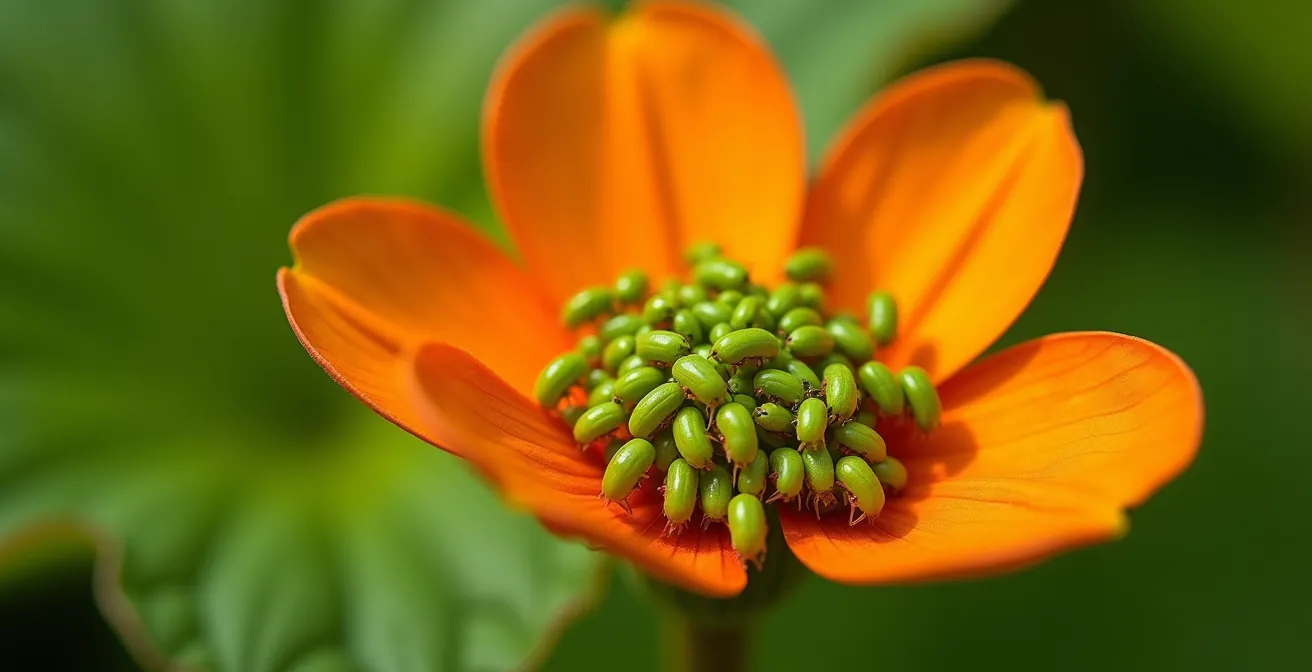
As the image shows, the nasturtium becomes the focal point for the infestation. This strategic diversion is a powerful, non-toxic way to manage pests. A case study from a guide on companion planting confirms this tactic; an analysis on effective trap crops highlights that nasturtiums’ bright flowers and distinct scent are often more attractive to pests like aphids than the cabbage itself, thus protecting the main crop from damage.
Basil or Dill: Which Is the Better Companion for Cucumbers?
When protecting cucumbers, the choice between basil and dill isn’t about one being “better,” but about choosing the right strategy for your garden’s needs. Both are excellent companions, but they function in fundamentally different ways. Basil plays defense, while dill plays offense by recruiting allies. Understanding this distinction is key to deploying them effectively.
Basil, with its strong, pungent oils, acts primarily as a repellent. Its scent interferes with the ability of pests like cucumber beetles and some aphid species to locate the cucumber plants. As one expert source on aphid control explains, “Basil’s strong scent disrupts the olfactory receptors in aphids and has a repellent effect, which will keep your plants free of aphids.” By interplanting bushy basil varieties among your cucumber vines, you create a confusing scent cloud that helps hide your crop. This is a direct, defensive action.
Dill, on the other hand, works indirectly. Its tall, umbel-shaped flowers are not designed to repel aphids but to attract their most ferocious predators. It is a powerful magnet for beneficial insects such as ladybugs, parasitic wasps, and hoverflies, whose larvae are voracious aphid consumers. Planting dill is not about protecting the cucumber plant directly, but about building a beneficial insect nursery nearby, ensuring a standing army of predators is ready to tackle any aphid outbreak. The following table breaks down their strategic differences.
| Characteristic | Basil | Dill |
|---|---|---|
| Primary Function | Pest repellent & scent-masking | Beneficial insect attractor |
| Target Pests | Cucumber beetles, aphids | Attracts predators of aphids |
| Growth Pattern | Bushy, compact (12-24 inches) | Tall, upright (3-4 feet) |
| Bloom Time | Mid to late summer | Early summer |
| Best Placement | Interplanted between cucumber rows | Border plantings |
| Additional Benefits | Continuous protection through summer | Early season beneficial insect establishment |
The Planting Mistake of Placing Beans Near Onions
While much of companion planting focuses on beneficial relationships, understanding antagonistic pairings is just as critical. The classic mistake of planting beans (or any legume) next to members of the allium family (onions, garlic, leeks) illustrates a powerful, negative biological interaction known as allelopathy. This isn’t just a case of plants competing for light or water; it’s a form of underground chemical warfare.
The problem lies in the soil microbiome. Legumes like beans form a crucial symbiotic relationship with Rhizobia bacteria. These bacteria colonize the beans’ roots, forming nodules where they perform nitrogen fixation—converting atmospheric nitrogen into a form the plant can use. This is what makes legumes such fantastic soil builders. However, allium plants release biochemical compounds into the soil that are antimicrobial. These compounds inhibit or kill the beneficial Rhizobia bacteria. As companion planting research confirms, Allium plants release chemicals that inhibit Rhizobia bacteria essential for nitrogen fixation in legumes. Without their bacterial partners, the beans struggle to thrive, leading to stunted growth and poor yields.
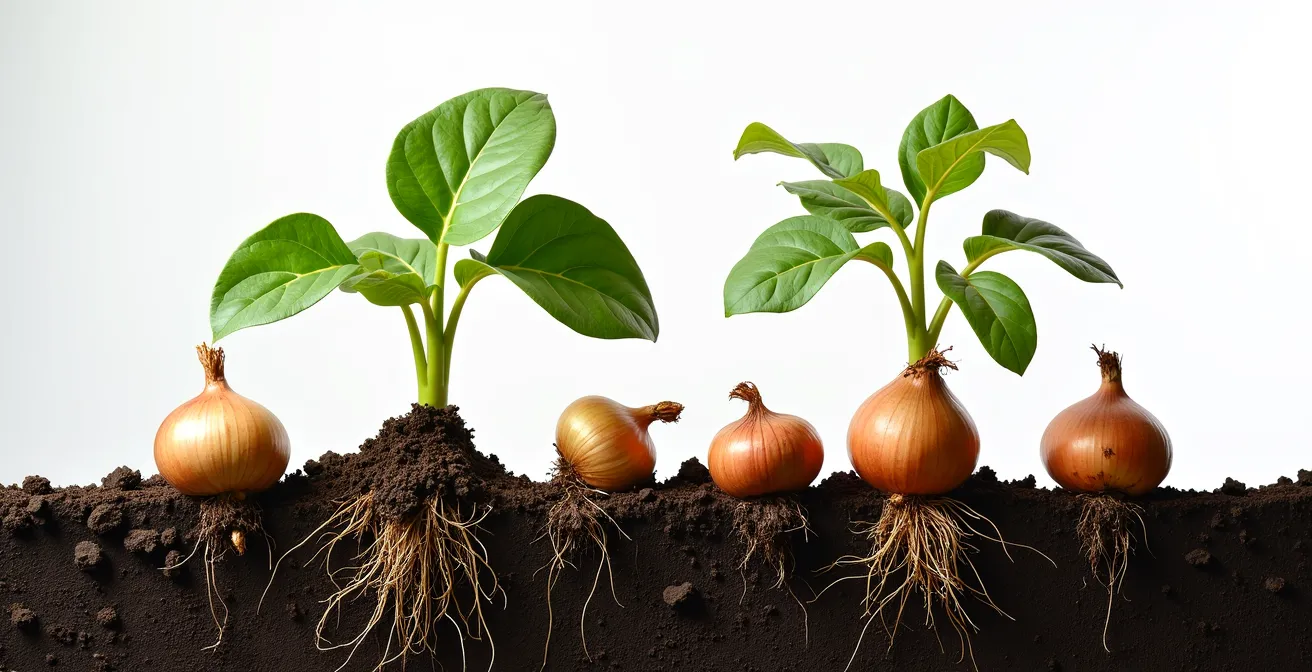
This antagonistic relationship highlights that a successful garden design must account for these negative interactions. It’s not enough to know what to plant together; you must also know what to keep apart. Other well-documented antagonistic pairings to avoid include:
- Brassicas (cabbage, broccoli) near strawberries
- Fennel near most vegetables, as it is highly allelopathic
- Sunflowers near pole beans
- Black walnut trees near vegetable gardens due to juglone toxicity
When to Plant Alyssum to Attract Hoverflies Before Aphids Arrive?
The most effective biological pest control is proactive, not reactive. Instead of waiting for an aphid infestation and then trying to attract predators, the superior strategy is to build a “beneficial insect nursery” early in the season. Sweet alyssum (Lobularia maritima) is a superstar for this purpose. Its tiny, nectar-rich flowers are an irresistible food source for hoverflies (also known as syrphid flies), one of the most effective aphid predators in the garden.
The key to this strategy is timing. Hoverfly larvae are the voracious consumers of aphids, but the adult hoverflies need pollen and nectar to fuel their egg-laying. By planting alyssum early, you provide a food source for the adult hoverflies long before the aphid populations begin to explode in the warmer weather. This encourages them to stick around, mate, and lay their eggs in your garden. By the time aphids arrive, a new generation of hoverfly larvae is already in place, ready to hunt. Pest management experts recommend starting alyssum 4-6 weeks before the last frost for optimal hoverfly attraction timing. This can be done by starting seeds indoors and transplanting them out as soon as the danger of hard frost has passed.
Alyssum works best when planted as “insectary strips” or “beneficial insect highways” interwoven between crop rows. This creates corridors of food and shelter that support a diverse range of beneficials throughout the season, including parasitic wasps and ladybugs. Combining it with other plants like yarrow, cosmos, and buckwheat creates a robust, season-long habitat that forms the foundation of a self-regulating garden ecosystem.
Why Your Bought Ladybugs Flew Away Immediately and How to Keep Them?
Releasing a container of purchased ladybugs into the garden is often seen as a quick fix for an aphid problem, but it frequently ends in disappointment as the cheerful beetles fly away within hours. The failure of this tactic stems from a misunderstanding of the ladybug’s life cycle and needs. The secret to effective ladybug-based pest control isn’t the adults; it’s their larvae.
As the experts at Garden Design magazine point out, the common perception is backward:
Adult lady beetles (ladybugs) don’t eat nearly as many aphids as they do in their larval stage, which is why many people are disappointed with the lack of control they see after releasing purchased live ladybugs… There needs to be a large enough aphid population to keep the ladybugs fed long enough to mate and lay eggs — because it’s the larvae that eat the most aphids.
– Garden Design, How to Get Rid of Aphids Naturally
The adult ladybugs you release have one primary goal: to find a food source, mate, and find a safe place to lay eggs. If your garden doesn’t immediately offer a dense aphid buffet and the right habitat, their instinct is to fly elsewhere to find one. The real goal is not to keep the adults, but to convince them to lay eggs so their alligator-like, aphid-devouring larvae hatch in your garden.
To make your garden a 5-star ladybug hotel they won’t want to leave, you must provide the complete package of food, water, and shelter. This means moving beyond a single pest outbreak and creating a permanent, inviting habitat. Key elements include:
- A reliable food source: Plant a “sacrificial” patch of nasturtiums or calendula to maintain a small, steady aphid population.
- Nectar and pollen: Include flowering plants like dill, fennel, yarrow, and sweet alyssum to feed the adult beetles.
- A water source: Place shallow dishes with pebbles and water to provide a safe place for them to drink.
- Shelter: Use low-growing groundcovers and mulch to offer protection from predators and the elements.
- A pesticide-free zone: Avoid all sprays, even organic ones like neem oil, which can harm beneficial insects.
The Monoculture Mistake That Invites Pest Swarms
All the companion planting strategies in the world will struggle to be effective within a flawed garden design. The single biggest strategic error that invites overwhelming pest infestations is monoculture—the practice of planting large blocks of a single type of crop. A neat row of 20 cabbage plants may look tidy, but to a pest, it looks like an all-you-can-eat buffet with a giant neon sign.
Monocultures make it incredibly easy for pests to find their target. Once they locate one host plant, they can move to the next with minimal effort, leading to population explosions that can quickly spiral out of control. Furthermore, a monoculture lacks the ecological complexity that supports beneficial insects. There are no alternative food sources or shelter, so predator populations can’t establish themselves. In contrast, polyculture, or interplanting, creates a confusing and hazardous environment for pests. By mixing vegetables, herbs, and flowers, you disrupt the visual and chemical signals that pests use to locate their food. Scientific studies demonstrate that diverse plantings can disrupt pest colonization and create habitats for natural enemies.
An effective garden is a diverse one. The constant rotation and intermixing of plant families confuse pests that overwinter in the soil or emerge looking for their specific host. A great tactic is to practice intensive succession planting, not just year-to-year, but within the same season. As one plant’s production wanes, it becomes more susceptible to pests. The best strategy is to remove it promptly and plant something from a different family in its place. This continuous rotation keeps pests on their toes and maintains a high level of garden health and diversity, which is the ultimate defense against pest swarms.
Key takeaways
- A diverse garden (polyculture) is inherently more resilient to pests than a single-crop planting (monoculture).
- Effective pest control is a systemic approach combining defense (repellents), offense (trap crops), and support (predator habitats).
- Understanding the life cycles of both pests and their predators is crucial for timing your interventions correctly.
Nematodes or Ladybugs: Which Biological Control Saves Lawns From Grubs?
As we broaden our view from the vegetable patch to the entire garden ecosystem, including the lawn, the principle of using the right tool for the job becomes paramount. A common question involves tackling lawn grubs: should one use beneficial nematodes or ladybugs? The answer reveals the core concept of target specificity in biological control. Ladybugs are useless against grubs for one simple reason: they operate in entirely different environments.
Ladybug larvae are voracious predators of soft-bodied insects like aphids and scale, which live on the foliage of plants (above ground). Lawn grubs are the larvae of beetles like the Japanese beetle, and they live in the soil, feeding on grass roots (below ground). Releasing ladybugs to control grubs is like sending a hawk to catch a fish—they are not equipped for the environment. The correct biological control for grubs is beneficial nematodes. These are microscopic soil-dwelling roundworms that actively hunt down and parasitize grubs, killing them from within. They are an incredibly effective, targeted solution for a below-ground problem.
This highlights the importance of correctly identifying both the pest and its location before choosing a biological control agent. Each agent has a specific set of targets and an environment in which it thrives. Deploying the wrong one is a waste of time and money and undermines the principles of a bio-intensive system. The following table provides a simplified guide to matching the right control to the right pest problem.
| Biological Control | Target Pest | Location | Effectiveness |
|---|---|---|---|
| Beneficial Nematodes | Grubs, root weevils | Below ground/soil | High (85-95%) |
| Ladybugs | Aphids, scale insects | Above ground/foliage | Moderate (60-70%) |
| Bacillus thuringiensis (Bt) | Caterpillars | Foliage | Very High (95%) |
| Parasitic wasps | Aphids, whiteflies | Above ground | High (75-85%) |
| Green lacewings | Aphids, mites, thrips | Above ground | High (70-80%) |
By shifting from random pairings to a strategic, multi-layered system of defense, sacrifice, and habitat building, you transform your garden from a passive victim into an active, resilient ecosystem. Start today by analyzing your garden not as a collection of individual plants, but as a whole system, and begin designing the interconnections that will provide a natural, lasting defense against pests.