The high price of variegated plants reflects their status as unstable, living art, where the collector’s skill is the primary factor in preserving their value.
- Unstable genetics, as seen in the Monstera Albo, demand active pruning to prevent the valuable variegation from reverting to plain green.
- White, chlorophyll-lacking tissues are exquisitely beautiful but fragile, requiring precise light and humidity control to prevent irreversible browning and decay.
Recommendation: Select your plant based on your risk tolerance: the genetically stable ‘Thai Constellation’ for predictable beauty or the volatile ‘Albo’ for higher potential reward and a greater challenge to your curatorial skills.
For the discerning plant collector, the moment of decision is a familiar one: standing before a plant with foliage so exquisitely patterned it seems hand-painted, yet bearing a price tag that rivals a piece of fine art. The hesitation is understandable. Why would a single leaf, a cutting, or a small plant command hundreds, sometimes thousands, of dollars? The common answers—rarity, slow growth, high demand—are true, but they are surface-level explanations that miss the fundamental point. They fail to capture the essence of what you are truly acquiring.
Investing in high-end variegated foliage is not merely a purchase; it is an entry into a curatorial role. You are not just buying a plant; you are becoming the steward of a piece of unstable genetic art. The value is not static. It is a dynamic quality that depends directly on your knowledge, care, and intervention. Unlike a painting that hangs unchanged on a wall, a variegated plant is a living sculpture locked in a constant biological struggle against its own beauty. The very mutation that creates its breathtaking white, cream, or yellow splashes is a genetic flaw—a vulnerability.
But what if the key to justifying this investment lies not in ignoring this fragility, but in embracing it? What if the high price is a fair reflection of the skill required to maintain this delicate biological balance? This guide moves beyond the simple economics of supply and demand. We will explore the genetic realities of variegation, the specific environmental controls needed to protect your investment from browning or reversion, and the strategic decisions that separate a novice owner from a skilled curator. We will dissect the risks and rewards, enabling you to manage your collection not just with passion, but with the precision of an investor protecting a valuable asset.
This article provides a detailed framework for understanding and preserving the value of your variegated collection. We will delve into the critical aspects of care and genetics that every serious collector must master.
Summary: A Deep Dive into the Value of Variegated Plants
- Why Your Variegated Plant Is Turning All Green Again?
- How to Balance Light Intensity to Keep White Patches From Browning?
- Thai Constellation or Albo: Which Variegation Is Genetically Stable?
- The Humidity Mistake That Melts White Leaves Faster Than Green Ones
- How to Select the Right Node to Ensure Variegation in Cuttings?
- Direct Sun vs Bright Indirect: Which Actually Fuels Growth?
- Why Your Monstera Leaves Have No Holes Despite Being 2 Years Old?
- How to Manage a Monstera Deliciosa in a Small Living Room?
Why Your Variegated Plant Is Turning All Green Again?
The most heartbreaking moment for any collector is witnessing a prized, highly variegated leaf give way to a new, solid green one. This phenomenon, known as reversion, is not a sign of failure but a manifestation of the plant’s fundamental biology. Many of the most sought-after variegated plants, particularly the Monstera deliciosa ‘Albo Variegata’, possess what is called a chimeric mutation. This means the plant is composed of two distinct genetic cell types: one that can produce chlorophyll (green tissue) and one that cannot (white tissue). These two cell lines are in a constant, invisible battle for dominance.
The green, chlorophyll-producing cells are far more efficient and vigorous. They are the plant’s powerhouses, converting light into energy through photosynthesis. The white cells, while aesthetically prized, are essentially freeloaders; they contribute nothing to the plant’s energy budget. From a survival standpoint, the plant has a strong incentive to favor its more productive green cells. If given the chance, it will dedicate more resources to green growth, effectively “phasing out” the variegation. It’s a sobering reality that the very trait we value is a biological liability. In fact, some research shows that plants with over 50% variegation have significantly higher mortality rates due to this energy deficit.
This is where the collector’s role as a curator becomes paramount. As noted in a risk analysis of the Monstera Albo, the unstable nature of this mutation means owners must actively manage the plant’s growth. To preserve the investment, one must be vigilant and strategic. Any stem or new growth that emerges as fully green must be promptly and carefully pruned away. This intervention prevents the more vigorous green cells from taking over and signals to the plant to continue producing the mixed-genetics growth that constitutes its value. It is rare for an Albo to revert completely, but without this curatorial pruning, the risk of significant aesthetic and financial depreciation is very real.
How to Balance Light Intensity to Keep White Patches From Browning?
While reversion is the risk of losing variegation, the more immediate and common threat to a collector’s investment is browning. Seeing crisp, architectural white patches on a leaf turn a mushy, unsightly brown is a clear sign of environmental stress. The primary culprit is almost always improper lighting. The white tissues of a variegated plant are its most vulnerable feature precisely because they lack chlorophyll. This absence of green pigment means they have zero defense against direct sunlight. While green parts can handle some direct sun, the white parts will scorch almost immediately, leading to permanent cell death that appears as brown spots.
This creates a delicate paradox for the collector. The plant as a whole needs ample bright light to generate enough energy to support its non-productive white leaves. Insufficient light encourages reversion to green as the plant desperately tries to increase its photosynthetic capacity. Yet, too much direct light will burn and destroy the very variegation you are trying to sustain. The key is to find the perfect equilibrium: maximum bright, indirect light. Think of the light filtering through a sheer curtain in an east-facing window, or the dappled light under a large tree canopy. This provides the intensity needed for energy production without the damaging, focused rays of direct sun.
Observing the plant is critical. If you notice new leaves are coming in smaller with less variegation, the plant is likely asking for more light. Conversely, if you see brown, crispy edges or spots on the white sections, you must reduce the light intensity or move the plant further from the light source. It is a continuous, responsive process of adjustment. The value of your plant is directly tied to your ability to read these subtle cues and provide the precise lighting conditions that allow its fragile beauty to thrive.
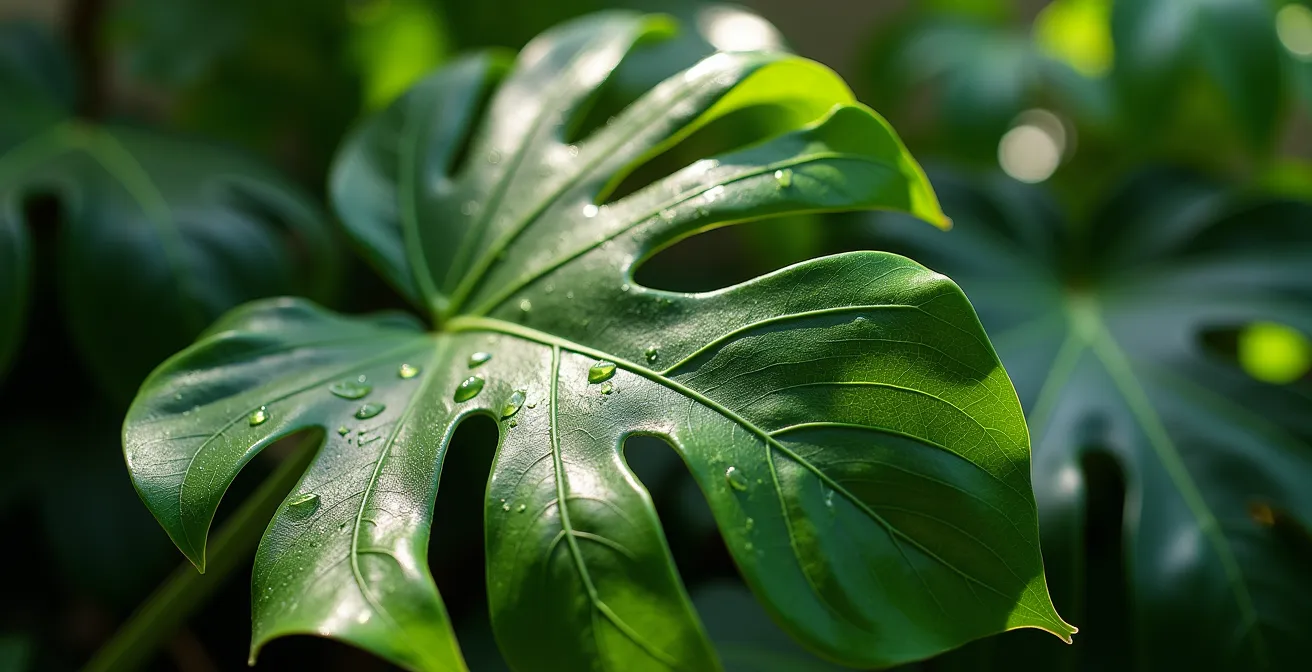
As this image demonstrates, the damage is often localized to the most sensitive white areas, a clear indicator of light stress. Mastering the nuances of light is a non-negotiable skill for preserving the aesthetic integrity and value of your collection.
Thai Constellation or Albo: Which Variegation Is Genetically Stable?
In the world of high-end Monsteras, the ‘Albo Variegata’ and ‘Thai Constellation’ represent two different investment philosophies, rooted in their genetic origins. The choice between them is a strategic one for any collector, balancing risk, reward, and aesthetic preference. The fundamental difference lies in the stability of their variegation. The Monstera ‘Albo’ is a product of a natural chimeric mutation, an unpredictable genetic fluke. As discussed, this makes its variegation unstable and prone to reversion. Each new leaf is a genetic lottery, capable of producing stunning “half-moon” patterns, large blocks of white, or, disappointingly, solid green.
The Monstera ‘Thai Constellation’, in contrast, is a product of human intervention. It was created in a laboratory in Thailand via tissue culture, and its variegation is a stable part of its genetic code. The speckled, star-like patterns are consistent throughout the plant and will not revert to green. This genetic stability makes it a much more predictable and reliable grower. In fact, according to grower experiences, propagation of the Thai Constellation has a higher success rate precisely because every cutting is guaranteed to carry the variegated trait.
This genetic distinction creates two very different investment profiles. A recent comparative analysis of the two varieties highlights these differences clearly.
| Feature | Thai Constellation | Monstera Albo |
|---|---|---|
| Genetic Stability | Stable (lab-created, tissue culture) | Unstable (natural chimeric mutation) |
| Reversion Risk | Very low | Moderate to high |
| Variegation Pattern | Consistent speckled | Unpredictable blocks/half-moons |
| Investment Profile | Blue-chip stock | High-risk, high-reward |
| Growth Rate | Faster | Slower |
Choosing an ‘Albo’ is like investing in a high-risk, high-reward stock; the potential for a breathtakingly unique pattern is immense, but so is the risk of its value diminishing through reversion. It requires constant curatorial vigilance. The ‘Thai Constellation’ is akin to a blue-chip stock: stable, reliable, and a safer bet for preserving its aesthetic form over time. Your choice as a collector depends on your appetite for risk and the degree of hands-on management you are willing to undertake.
The Humidity Mistake That Melts White Leaves Faster Than Green Ones
After mastering light, the next environmental factor that demands a collector’s precision is humidity. The delicate white tissues of variegated plants are not only susceptible to sun scorch but are also acutely sensitive to moisture imbalances. The common mistake is to treat all leaves equally. However, as one analysis on plant care points out, white leaf tissue has no chlorophyll, which means the plant must work harder to sustain these metabolically “expensive” leaves. This inherent fragility makes them the first to show signs of stress from improper humidity, often in the form of browning, yellowing edges, or even “melting.”
Many beginners, in an attempt to increase humidity, resort to misting their plants. This is a critical error for prized variegated specimens. Misting provides only a fleeting boost in ambient humidity and, more dangerously, leaves water droplets sitting on the delicate leaf surface. On white tissue, this can lead to the rapid development of fungal or bacterial spots, which appear as unsightly brown-black marks. A far superior strategy is to manage the ambient environment. The optimal humidity level for most variegated aroids like Monsteras is between 40% and 60%. This range is humid enough to prevent the leaves from drying out and developing crispy brown edges, but not so damp as to encourage fungal diseases.
Achieving this stable environment is a hallmark of an advanced collector. The most effective method is using a humidifier, which consistently releases a fine vapor that raises ambient humidity without directly wetting the leaves. Other passive methods include grouping plants together—as they transpire, they collectively raise the humidity in their immediate vicinity—or placing them on pebble trays filled with water. The key is to create a consistent, buoyant humidity that supports the plant’s most fragile parts, rather than subjecting them to the shock of direct water application.
How to Select the Right Node to Ensure Variegation in Cuttings?
For the serious collector, propagation is not just about creating more plants; it is the ultimate test of skill and the primary method of realizing a return on the initial investment. A single high-value plant can yield several equally valuable offspring, but only if the propagation is executed with knowledge and precision. With unstable chimeric plants like the Monstera Albo, you cannot simply take any cutting and expect it to produce a beautifully variegated new plant. The genetic information for the new growth is contained within the auxiliary bud at the node, and its potential is often hinted at in the stem itself.
One must learn to read the stem like a blueprint for future growth. As the experts at Plant Vault note, this is a critical step in the process.
The variegation pattern visible in the stem often indicates the potential patterns in future growth.
– Plant Vault Experts, What is Plant Variegation Guide
This means you must inspect the stem at each node, looking for a good distribution of green and white tissue. A node on a completely green section of the stem will almost certainly produce a reverted, all-green plant. Conversely, a node on a completely white section of the stem may fail to root or survive at all, as it lacks the chlorophyll needed to generate energy. The ideal cutting has a node with a balanced mix of green and white striping on the stem, indicating that the auxiliary bud contains both sets of genetic material.
This strategic selection is crucial for maximizing your return on investment. It requires a careful assessment of the mother plant and a willingness to make calculated decisions about which parts to propagate. The following checklist outlines a professional approach to node selection.
Action Plan: Selecting a Node for Maximum Propagation ROI
- Examine the stem: Look for visible variegation patterns that run through the stem, not just on the leaf. A striped stem is a strong positive indicator.
- Locate the auxiliary bud: Identify the small bump at the node where new growth will emerge and assess the color distribution around it.
- Select for balance: Choose a node with a healthy mix of green and white tissue on the stem to increase the odds of a balanced, variegated new plant.
- Preserve the mother plant: Avoid cutting the most aesthetically pleasing section of the parent plant. Prioritize propagating from less critical areas to maintain the mother plant’s value.
- Propagate insurance nodes: Consider taking a cutting from a less-variegated (but still viable) node as a backup. It may produce a less spectacular plant, but it provides a higher chance of successful rooting.
Direct Sun vs Bright Indirect: Which Actually Fuels Growth?
A common misconception among general plant owners is that more light universally equals more growth. For collectors of variegated plants, this oversimplification is a costly one. As we’ve established, the white parts of a variegated leaf are incapable of photosynthesis and are highly susceptible to burning. Therefore, direct sun is not a fuel for growth; it is a source of damage. The engine of a variegated plant’s growth is exclusively in its green tissues, and this engine must be fueled by a specific type of light: bright, indirect light.
The goal is to provide the green parts with as much usable energy as possible without scorching the white parts. This means placing the plant where it receives bright, ambient light for most of the day, but is shielded from the sun’s direct, unfiltered rays. This could be near a window covered with a sheer curtain, several feet back from a very sunny window, or in a room with skylights. When the plant receives the correct intensity of indirect light, the green parts can photosynthesize at their maximum capacity. This generates the necessary energy to not only fuel new growth but also to sustain the metabolically “useless” white tissues.
For the serious collector in a less-than-ideal lighting situation, technology offers a perfect solution. As noted in a guide on variegated plant care, grow lights are a game-changer. They provide the full spectrum of light that plants need for robust growth, but without the harmful, high-intensity UV radiation of direct sunlight. A high-quality LED grow light allows a collector to have absolute control over light intensity and duration, creating the perfect, customized environment to fuel growth while completely eliminating the risk of sunburn. This level of control is often what separates a thriving, valuable collection from one that is merely surviving.
Why Your Monstera Leaves Have No Holes Despite Being 2 Years Old?
Fenestration—the development of the iconic splits and holes in Monstera leaves—is a sign of a healthy, maturing plant. For a collector, it is a celebrated milestone. So, it can be perplexing when a two-year-old variegated Monstera still only produces solid, juvenile leaves. This delay is not necessarily a sign of poor care but is another direct consequence of the plant’s variegation. Because a significant portion of its leaves cannot photosynthesize, the plant’s overall energy production is significantly reduced compared to its all-green counterparts.
Maturity in a Monstera is a function of age and, more importantly, energy accumulation. The plant will only invest the substantial resources required to produce large, fenestrated leaves when it has a surplus of energy and feels stable and well-supported. As professional growers often report, variegated Monsteras consistently reach this stage later than all-green varieties. Their reduced chlorophyll content acts as a natural brake on their development, slowing their journey to maturity. Patience is therefore a required virtue for the variegated plant collector.
However, you can take active steps to encourage maturation. The single most effective action is to provide climbing support. In their natural habitat, Monsteras are climbers. As they climb, the plant receives signals that it is secure and has access to better light, which triggers the transition to mature leaf forms. A moss pole or simple trellis provides this essential support. As the plant latches on with its aerial roots, it gains a sense of stability that encourages it to invest in larger, fenestrated leaves. Combining this support with optimal light, humidity, and nutrition is the most effective way to accelerate its development and bring out the mature characteristics that add to its character and value.
Key Takeaways
- Value is in Instability: The high price of plants like Monstera Albo is tied to their unstable genetics, making the owner’s skill in managing reversion a key part of the investment.
- Light is a Paradox: Variegated plants require bright light to survive but direct sun will destroy their most valuable (white) tissues. Mastering bright, indirect light is essential.
- Curate, Don’t Just Water: Active pruning of reverted green growth, strategic node selection for propagation, and precise humidity control are curatorial tasks, not just gardening chores.
How to Manage a Monstera Deliciosa in a Small Living Room?
A mature, beautifully variegated Monstera is a stunning living sculpture, but it can also be an imposing presence, quickly outgrowing a designated corner. For the collector in a smaller space, managing its size is a crucial long-term strategy, not to inhibit its health, but to gracefully integrate its grandeur into the home. This is not about stunting the plant, but about guiding its growth with an artistic and practical eye. The overall market analysis reveals a booming indoor plant market, projected to grow significantly, meaning more collectors will face the challenge of integrating large specimen plants into modern living spaces.
One effective technique is to be strategic with pot size. Keeping the plant slightly root-bound can naturally slow its growth rate without harming its health. This gentle constraint signals the plant to focus on maintaining its current form rather than expanding rapidly. Another powerful strategy is to think vertically. Installing a wall-mounted trellis or using ceiling hooks allows you to guide the vines upward and outward, transforming the plant from a bulky floor specimen into a breathtaking piece of living wall art. This not only saves floor space but also displays the leaves beautifully.
Pruning is also a tool for shaping, not just for managing variegation. Strategic pruning can encourage bushier, more compact growth while simultaneously providing valuable nodes for propagation—a win-win for the collector. If you are starting your collection, consider the plant’s natural growth habit. A Monstera ‘Thai Constellation’ generally has a more compact and less sprawling habit than an ‘Albo’, making it a more manageable choice for smaller rooms. By combining these techniques, a collector can maintain a large, valuable specimen for years, ensuring it remains a magnificent centerpiece rather than an unmanageable burden, all while preserving its aesthetic and financial worth.
Embrace the role of a curator. The value of these magnificent plants is not just in their purchase price, but in the ongoing story of their care. Begin your journey with a piece of living art that rewards your knowledge, patience, and meticulous attention.