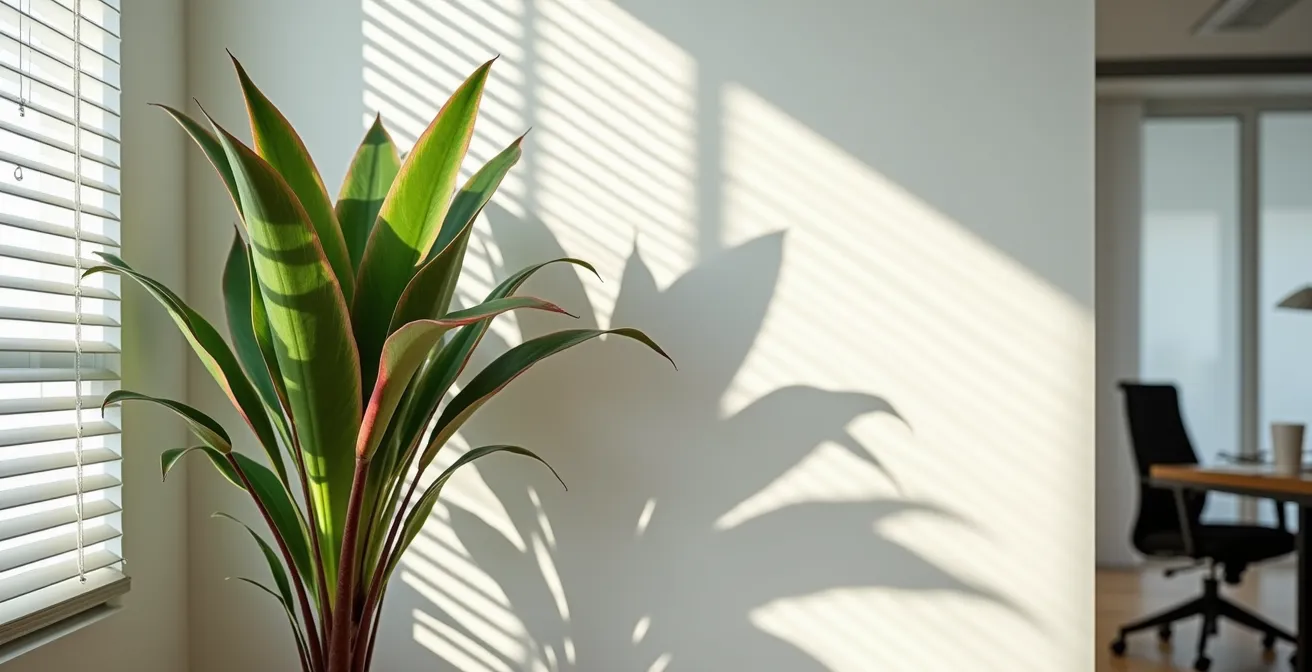
The Dracaena isn’t just a plant; it’s a high-performance, low-cost botanical asset uniquely suited to the modern, light-deficient office.
- It demonstrates exceptional tolerance to low light and common office neglect, outperforming many other species.
- Its primary failure points—overwatering and tap water chemicals—are easily managed with simple, data-driven protocols.
Recommendation: Instead of ad-hoc plant buying, implement a selection and maintenance strategy based on Dracaena varieties to maximize workplace wellness ROI with minimal resource drain.
The modern office, often a landscape of cubicles and screens bathed in artificial light, presents a significant challenge to corporate wellness. The desire to introduce nature is universal, but the reality is often a series of wilting, neglected plants. The common advice is simply to “add more greenery,” but this often leads to wasted budget and a visible symbol of failure on a windowsill. We’re told that certain plants are “low-maintenance,” a platitude that masks the specific environmental mismatches that doom them in a corporate setting.
But what if the solution wasn’t just about choosing a hardy plant, but about treating it as a strategic botanical asset? What if we moved beyond the generic “don’t overwater” and applied pragmatic, data-driven principles to its care? This is where the Dracaena genus truly excels. Its resilience is legendary, but its success in a dim office is not magic; it’s a science of understanding its specific thresholds for water, light, and nutrients.
This guide abandons the green-thumb myths and provides a corporate wellness consultant’s framework for deploying the Dracaena effectively. We will analyze the precise reasons for common failures, provide diagnostic tools for revival and maintenance, and offer a cost-benefit analysis for its integration. By understanding the “why” behind its needs, you can turn a simple plant into a reliable, measurable tool for enhancing the workspace environment.
This article provides a complete operational guide to selecting, maintaining, and understanding the Dracaena as a strategic asset. Below is a summary of the key areas we will cover to ensure your office greenery thrives.
Summary: Why Dracaena Is the Best Choice for Offices With No Direct Sunlight?
- Why Tap Water Causes Brown Tips on Your Dracaena Leaves?
- How to Revive a Dracaena That Has Been Dry for 4 Weeks?
- Dracaena Marginata or Fragrans: Which Fits Better in a Narrow Corner?
- The Watering Habit That Rots Dracaena Stems in Low-Light Conditions
- When to Behead a Leggy Dracaena to Force New Branching?
- Desk Plants or Green Walls: Which Boosts Employee Productivity More?
- Why You Would Need 100 Plants to Replicate NASA’s Air Purifying Results?
- What Are the Key Factors for Botanical Vitality When Plants Stop Growing?
Why Tap Water Causes Brown Tips on Your Dracaena Leaves?
One of the most common signs of distress in an office Dracaena is the appearance of brown, crispy leaf tips. While often mistaken for a watering issue, the primary culprit is frequently the water quality itself. Dracaena species are particularly sensitive to chemicals commonly found in municipal tap water, specifically fluoride and chlorine. These elements accumulate in the leaf tips over time, causing tissue death and the characteristic browning. For an office manager, this is a critical piece of operational intelligence: the problem isn’t the employee’s watering schedule, but the resource being used.
Understanding this sensitivity is the first step toward effective and preventative care. Rather than reacting to the symptom, you can implement a simple protocol to provide cleaner water. This not only preserves the aesthetic of your botanical assets but also reduces the need for plant replacement. The solution doesn’t require expensive systems; it leverages resources likely already present in your office environment.
Here is a simple, three-step protocol to mitigate water quality issues in a standard office setting:
- Let tap water sit in an open container for 48 hours. This allows the majority of the chlorine to dissipate into the air before the water is used on the plant.
- Use filtered water from the office water cooler. Most commercial filtration systems effectively remove both fluoride and chlorine, making this the most convenient and effective solution.
- Collect rainwater when possible. For offices with accessible outdoor space, collecting rainwater provides a completely chemical-free and nutrient-rich watering option.
How to Revive a Dracaena That Has Been Dry for 4 Weeks?
Discovering a Dracaena that has been completely neglected for an extended period—a common occurrence after holidays or in low-traffic office areas—can seem like a lost cause. The soil is bone-dry, and leaves may be drooping or yellowing. However, due to their hardy nature, many Dracaenas can be revived from this state of extreme dehydration. The key is to rehydrate the root ball thoroughly and gradually, avoiding the shock of a sudden deluge from the top, which can lead to runoff without proper absorption in compacted, hydrophobic soil.
The most effective method for this situation is “bottom-watering.” This technique allows the soil to slowly draw water up through the pot’s drainage holes via capillary action, ensuring the entire root system is evenly and deeply saturated without compacting the soil further. It is a highly effective emergency-response protocol for severely neglected botanical assets.
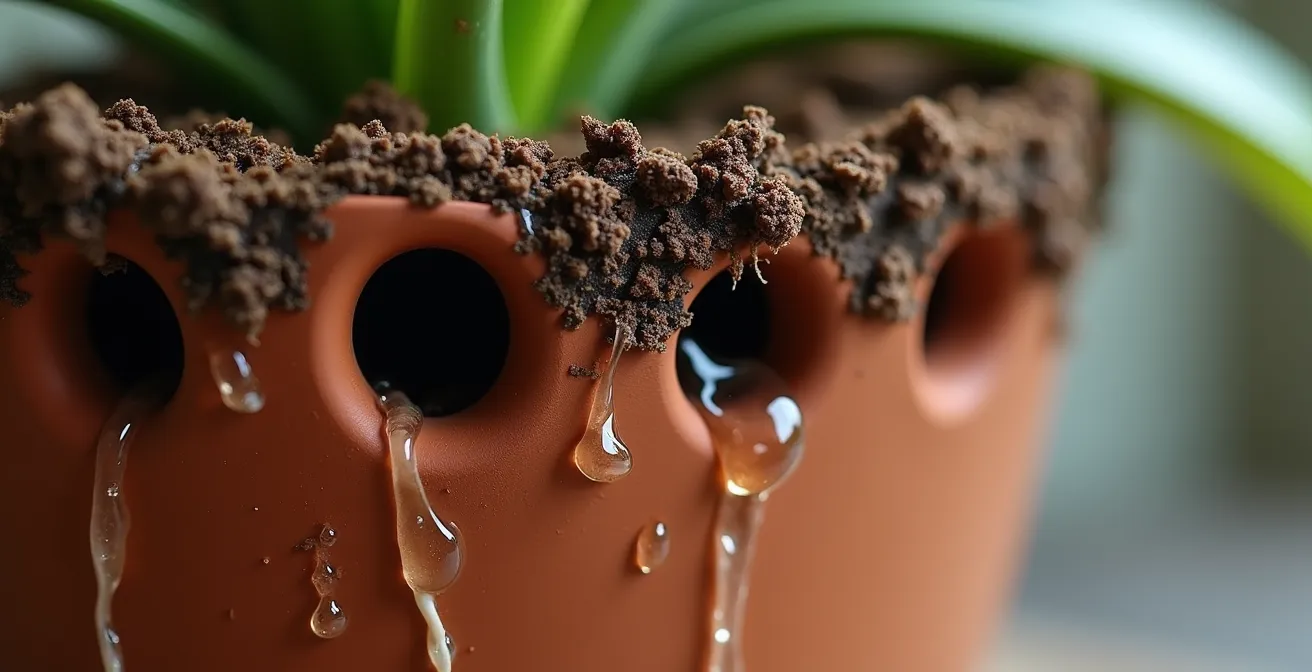
To implement this revival protocol, follow these precise steps to maximize the chances of recovery:
- Check for Viability: Before you begin, gently scratch a small patch of bark on the main stem. If you see green tissue underneath, the plant is still alive and has a high chance of recovery.
- Prepare the Soak: Place the pot inside a basin, sink, or bucket filled with 3-4 inches of room-temperature, filtered water.
- Allow for Absorption: Let the plant soak for 30-45 minutes. You’ll know it’s done when the top surface of the soil becomes visibly moist.
- Drain Completely: Remove the plant from the basin and allow all excess water to drain from the pot for at least 15-20 minutes. This is crucial to prevent root rot.
- Be Patient: Place the plant back in its low-light spot and wait. It may take 2-3 weeks to see new growth emerge from the top nodes. Some leaf drop during this recovery period is normal.
Dracaena Marginata or Fragrans: Which Fits Better in a Narrow Corner?
Selecting the right plant for a specific space is a strategic decision, not just an aesthetic one. For narrow office corners or areas between workstations, the choice of Dracaena variety has significant implications for long-term maintenance and spatial harmony. The two most common candidates, Dracaena marginata (Dragon Tree) and Dracaena fragrans (Corn Plant), have distinctly different growth patterns. Understanding these differences is crucial for any office manager looking to optimize their interior plantscaping for both beauty and practicality.
D. marginata is known for its slender, sculptural stems and sparse, spiky foliage, making it a natural fit for tight vertical spaces. Conversely, D. fragrans tends to be bushier, with wider leaves and a more horizontal spread that can quickly crowd a narrow corner. A critical factor for low-light offices is also phototropism—the plant’s tendency to lean towards a light source. A high-phototropism plant in a corner will require constant rotation to prevent it from looking lopsided.
This comparative table breaks down the key decision-making factors for selecting the right botanical asset for a constrained space.
| Feature | Dracaena Marginata | Dracaena Fragrans |
|---|---|---|
| Growth Pattern | Vertical, sculptural | Bushier, horizontal spread |
| Space Footprint | Narrow (2-3 ft width) | Wider (3-4 ft width) |
| Light Tolerance | Moderate to bright indirect | Very low light tolerant |
| Phototropism | High – leans dramatically | Low – maintains position |
| 5-Year Growth | 6-10 ft tall, minimal width | 4-6 ft tall, dense foliage |
| Best For | Creating vertical accent | Filling corner space |
Furthermore, an analysis from interior plantscaping professionals provides a compelling real-world data point. They report that Dracaena ‘Janet Craig’, a variety of D. fragrans, had the lowest replacement rate in office environments with minimal natural light. This success was attributed to its exceptional adaptation, with the primary maintenance issue being overwatering rather than light deficiency, proving its superior resilience in challenging office conditions. For a narrow corner, the D. marginata is the spatial winner, but for overall survivability in the darkest spots, evidence points to D. fragrans.
The Watering Habit That Rots Dracaena Stems in Low-Light Conditions
The single most common reason a Dracaena fails in a low-light office is not neglect, but misplaced diligence: overwatering. In a bright environment, a plant uses water for photosynthesis and transpiration. In a dim office, these processes slow down dramatically. This is the central, non-negotiable principle of low-light plant care.
Low light = less photosynthesis = the plant ‘drinks’ water very slowly
– Bloomscape Plant Care Experts, Dracaena Care Guide
When a plant is watered on a fixed schedule (e.g., “every Friday”) without regard for its actual needs, the soil remains saturated. The roots are deprived of oxygen and begin to die, leading to stem and root rot. This anaerobic decay, caused by bacteria thriving in the waterlogged soil, will quickly kill the plant from the base up. The most dangerous habit, therefore, is watering on a schedule instead of watering based on a physical check of soil moisture. In low-light conditions, a Dracaena might only need water every 3-4 weeks, not weekly.
To prevent this catastrophic failure, it’s essential to train staff or office members to perform a quick diagnostic check before ever picking up a watering can. This moves care from a routine-based guesswork to a data-driven action.
Your 5-Point Stem Rot Prevention Audit
- The Wobble Test: Gently grasp the stem at the soil line and check for stability. Any give or wobble is a primary indicator that root rot has begun, even before visible symptoms appear.
- The Sniff Test: A healthy plant’s soil smells earthy. If you detect a musty, swampy, or foul odor, it signals anaerobic decay in the root zone.
- Visual Stem Check: Look for soft, mushy, or blackening tissue on the stem, starting from the base and moving upward. This is a late-stage sign of advanced rot.
- The Soil Dryness Test: The most crucial prevention step. Insert a finger or a wooden dowel deep into the soil. Do not water unless the top 75% of the soil volume is completely dry.
- Abandon the Schedule: The core principle of prevention is to never water on a fixed schedule. Always test soil moisture first and only water when the plant requires it.
When to Behead a Leggy Dracaena to Force New Branching?
Over time, a Dracaena in a low-light office may become “leggy”—a term for a plant that has grown a long, bare stem with only a tuft of leaves at the very top. This is a natural response to suboptimal light, as the plant stretches in search of an energy source. While not necessarily unhealthy, this appearance can be undesirable in a professional setting. The strategic intervention for this is a process called “beheading,” or topping. This involves cutting off the top of the plant to encourage it to produce new branches and become fuller and more compact.
This pruning is not an act of damage but a proven horticultural technique to rejuvenate the plant’s form. The key is to perform it correctly to ensure swift recovery and promote healthy new growth. Timing is critical; the procedure should be done during the plant’s active growing season (spring or summer) when it has the most energy to heal and branch out. Performing this in winter can shock the plant when it is dormant.
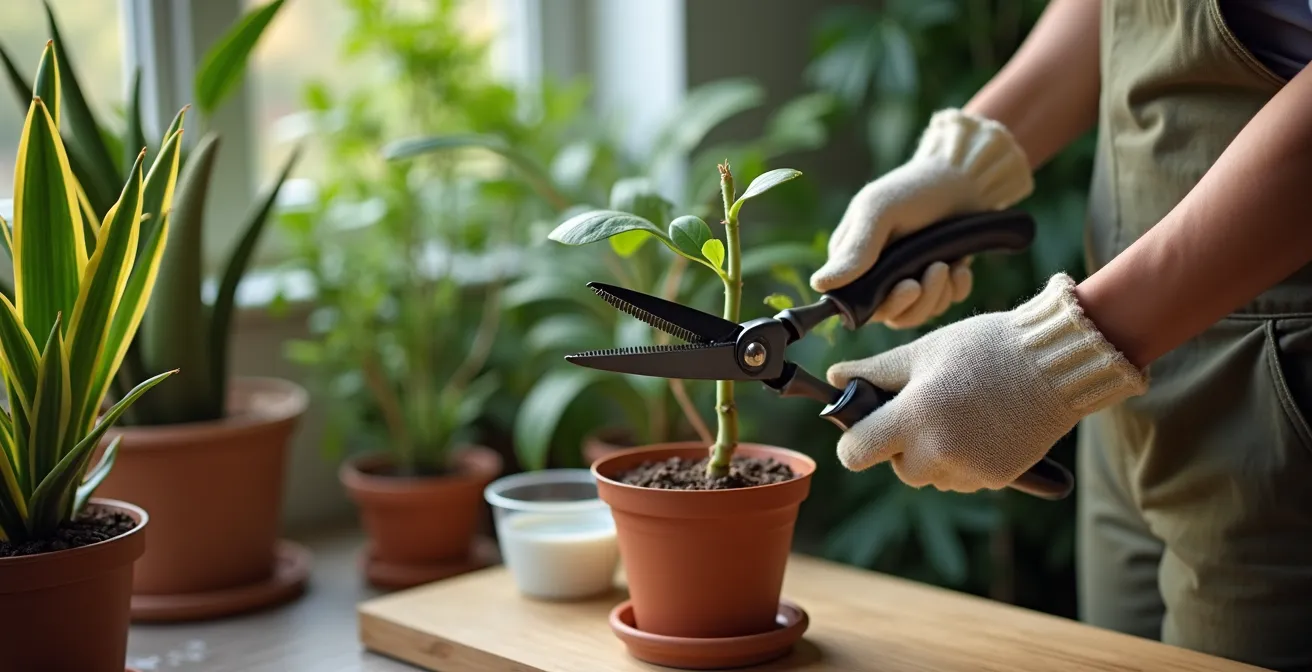
Executing this procedure transforms a lanky, awkward plant back into a lush botanical asset. As a bonus, the “head” that is removed can be easily propagated in water to create a second plant, maximizing the return on your initial investment.
- Timing is Everything: Perform the cut in spring or early summer during the active growth season for the fastest and most robust recovery.
- Select the Cut Location: Identify the point on the stem where you want new growth to emerge. Ensure you leave at least 6 inches of bare stem below your intended cut.
- Prepare Your Tool: Use a sharp, clean knife or pruning shears. According to a guide from Gardening Know How on Dracaena care, it’s essential to sterilize the blade with rubbing alcohol to prevent introducing infection to the open wound.
- Make the Cut: Create a clean cut straight across or at a slight 45-degree angle. The angle can help prevent water from pooling on the cut surface.
- Propagate the Top: Place the cut top portion in a glass of water. Roots will typically form within a few weeks, giving you a new plant for free.
Desk Plants or Green Walls: Which Boosts Employee Productivity More?
When considering an investment in corporate wellness through biophilia, a key decision is scale. Should the budget be allocated to individual desk plants for employees or to a large, architectural green wall? Both options have merit, but they serve different purposes and come with vastly different cost and maintenance profiles. As a corporate wellness consultant, it’s vital to analyze this choice not just on aesthetics but on a pragmatic cost-benefit basis.
Individual desk plants offer a sense of personal ownership and control, which has a powerful psychological impact. Employees can care for their “own” plant, fostering a connection that can reduce stress and improve focus in their immediate workspace. Green walls, on the other hand, improve the collective ambiance and have a more significant impact on room-wide air quality and aesthetics, but lack that personal connection. As expert Ruth K. Raanaas of the Norwegian University of Life Sciences states:
Office plants are a very cost-effective way to keep employees working to their full potential
– Ruth K. Raanaas, Norwegian University of Life Sciences
This “cost-effective” aspect is where the analysis becomes critical for office managers. While a green wall is visually impressive, its initial cost and ongoing professional maintenance requirements are orders of magnitude higher than a desk plant program.
This table provides a clear cost-benefit analysis to guide your investment decision, based on data regarding office plant programs.
| Factor | Individual Desk Plants | Green Walls |
|---|---|---|
| Initial Cost/Employee | $20-50 | $200-500 |
| Maintenance | Employee responsibility | Professional service needed |
| Psychological Impact | Personal ownership & control | Collective ambiance improvement |
| Space Required | Desktop only | Full wall installation |
| Air Quality Impact | Localized micro-climate | Room-wide improvement |
| Best For | Individual focus & burnout | Overall morale & aesthetics |
The data suggests that for targeted productivity and wellness boosts at the individual level, a desk plant program featuring hardy species like Dracaena offers a significantly higher ROI. Green walls serve a valuable purpose for branding and overall morale, but desk plants provide a more direct and personal psychological benefit for a fraction of the cost.
Why You Would Need 100 Plants to Replicate NASA’s Air Purifying Results?
The Dracaena’s reputation as a top-tier office plant is often bolstered by its inclusion in NASA’s famous Clean Air Study. It’s true that NASA places Dracaena plants in the Top 10 for their ability to remove volatile organic compounds (VOCs) like benzene and formaldehyde from the air. In their controlled tests, these plants showed impressive results, removing a high percentage of pollutants. However, translating this data to a real-world office environment requires critical context.
The core misunderstanding stems from the study’s methodology. The NASA research was conducted in small, airtight chambers—essentially sealed boxes with no air exchange. In this environment, the plant’s natural metabolic processes had a significant, measurable impact on the static air volume. A typical office, however, is the complete opposite. Modern HVAC systems are designed to exchange the entire volume of air 6-8 times per hour, constantly diluting any air-purifying effect the plants might have.
To replicate the pollutant removal rates seen in the NASA lab, you would need a dense jungle of plants—estimates range from 100 to 1000 plants in a small office—to compete with the power of the building’s ventilation system. So, while a few Dracaenas will not turn your office air pristine, they do provide a more localized and psychologically powerful benefit. They create a “personal oxygen and humidity bubble” around an individual’s workspace. This productivity microclimate may not change the room’s overall air quality, but the visual cue of a healthy, living thing provides a proven psychological lift, reducing stress and improving concentration in the employee’s immediate vicinity.
Key Takeaways
- The Dracaena’s primary weakness in offices is not low light, but poor water quality (tap water chemicals) and improper watering frequency (overwatering).
- Strategic selection matters: choose Dracaena marginata for narrow vertical spaces and Dracaena fragrans for superior hardiness in the lowest light conditions.
- Reviving a neglected Dracaena is often possible with the bottom-watering method, and rejuvenating a leggy one via “beheading” is a simple way to restore its form and value.
What Are the Key Factors for Botanical Vitality When Plants Stop Growing?
Sometimes, an office Dracaena doesn’t die; it simply stops growing. It exists in a state of stasis, neither thriving nor visibly declining. This stagnation indicates that the plant has fallen below its vitality threshold. While it has enough resources to survive, it lacks what it needs for active growth. For a corporate wellness program, a stagnant plant is a missed opportunity. Diagnosing the cause of this stasis is key to restoring its function as a vibrant, positive element in the workspace.
Several factors can contribute to this stalled growth. The most common are depleted nutrients, insufficient root space, chronic underwatering, or inadequate light quality. Even a “low-light” plant has a minimum requirement, and many office fluorescent lights lack the full spectrum needed for robust photosynthesis. As noted in one case study, Dracaenas under standard office lights often enter a state of minimal growth until a full-spectrum bulb is added or they are moved closer to a window, which can restart active growth within weeks. As the experts at STUMP note, these plants have “stuck around and stood the test of time in fluorescent-lit offices,” but surviving is not the same as thriving.
To move a plant from stagnation back to vitality, a systematic diagnostic check is required. This checklist helps identify the limiting factor that needs to be addressed.
- Light Check: Even a low-light Dracaena needs a minimum of 2-4 hours of bright, indirect light to thrive. If growth has completely stopped, try moving it to a brighter location.
- Nutrient Status: After 1-2 years in the same pot, the soil’s nutrients will be depleted. In the spring, top-dress the soil with a layer of fresh compost or use a balanced liquid fertilizer diluted to half-strength.
- Root Space: A root-bound plant has no room to grow. Check the bottom of the pot for roots circling the base. If it’s congested, repotting into a container 1-2 inches larger in diameter is necessary, typically every 2-3 years.
- Water Pattern: While overwatering is a greater risk, chronic underwatering can also cause the plant to enter a dormant state to conserve resources. Ensure a consistent, “dry-then-drench” watering pattern.
- Seasonal Dormancy: It is natural for growth to slow or stop entirely during the fall and winter months. If the plant is otherwise healthy, this is normal and not a cause for concern.
By implementing these data-driven strategies, you can transform your office plant program from a hopeful experiment into a reliable, high-ROI component of your corporate wellness initiative. Start today by auditing your existing plants and creating a care protocol based on need, not schedule.