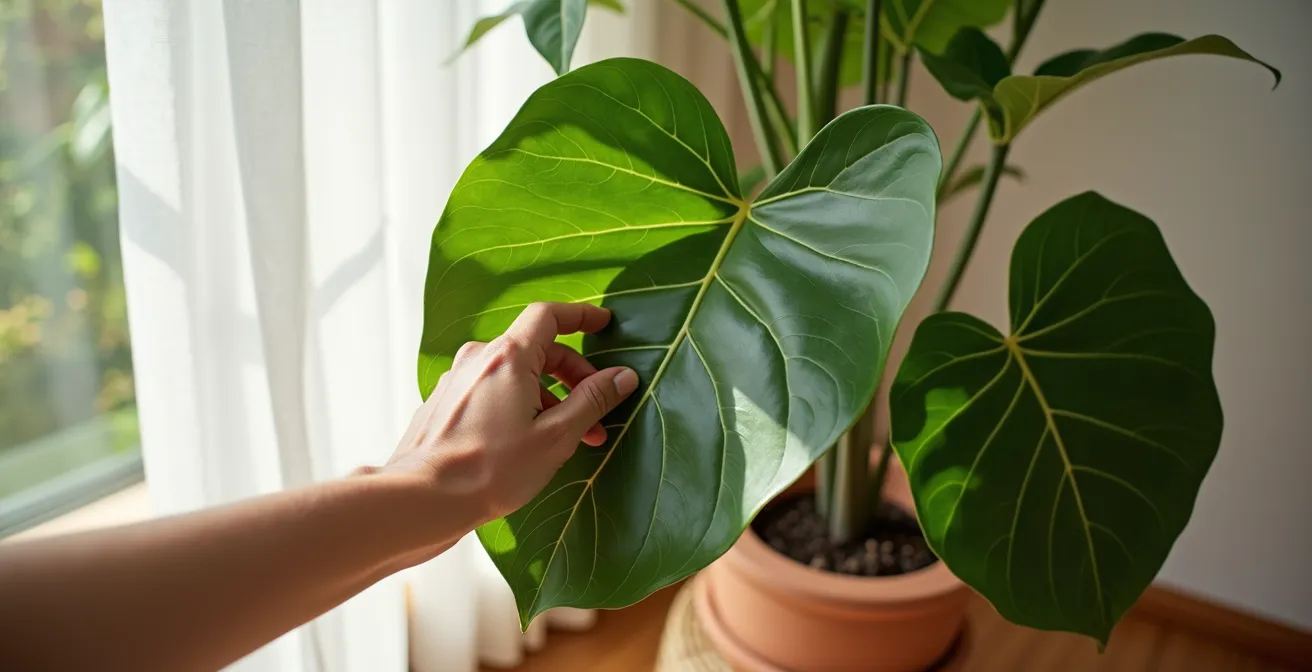
Your Ficus Lyrata isn’t dropping leaves because of your watering schedule, but because of a hidden environmental mismatch that makes that schedule lethal.
- Consistent watering in poorly aerated soil leads to root suffocation, the true precursor to root rot.
- Invisible stressors like air conditioning drafts, blocked leaf pores, and low humidity cause the plant to show symptoms of overwatering, even when the soil is dry.
Recommendation: Stop focusing on the calendar and start thinking like a plant doctor. Use simple diagnostic tests to understand your plant’s environment before you water again.
You follow the rules. You water on a schedule, provide what seems like a bright spot, and yet, the leaves keep dropping. One by one, your beautiful and expensive Ficus lyrata is thinning out, leaving you frustrated and confused. The most common advice you’ll find is a simple, maddening verdict: “overwatering.” But how can that be when you’re so careful? This cycle of confusion is familiar to many Fiddle Leaf Fig owners and highlights a fundamental misunderstanding of its needs.
The truth is, leaf drop is rarely a problem of watering *frequency* alone. More often, it’s a symptom of a deeper, hidden environmental issue. Your “regular watering” becomes the final blow to a plant already weakened by other stressors. These culprits are often invisible: poor soil aeration causing oxygen starvation at the roots, subtle drafts from a nearby vent causing thermal shock, or even the “helpful” leaf shine product that is slowly suffocating its foliage. The problem isn’t your schedule; it’s the environment that your schedule interacts with.
But what if the key wasn’t to find a magic watering schedule, but to develop a diagnostic mindset? This guide reframes the problem. Instead of treating the symptom (leaf drop), we will diagnose the underlying environmental causes. We’ll move beyond generic advice and provide you with the specific tools and knowledge to understand what your Ficus is truly experiencing. You’ll learn to read the signs, test your environment, and intervene with precision, transforming from a frustrated owner into a confident plant doctor.
As correcting these issues often involves checking the root system, understanding how to handle your plant is key. For those who prefer a visual guide, the following video offers a clear, step-by-step tutorial on repotting, an essential skill for any Ficus owner dealing with potential root-bound or soil-related problems.
To systematically address these issues, this guide is structured to help you investigate each potential problem area. By examining the soil, the plant’s placement, its foliage, and its nutritional needs, you can accurately pinpoint the source of stress and apply the correct remedy. The following sections break down these diagnostic steps into manageable parts.
Summary: Diagnosing the True Cause of Fiddle Leaf Fig Leaf Drop
- How to Identify Root Rot in a Ficus Before It Kills the Tree?
- Window vs Corner: Where Should You Place a Ficus to Avoid Draft Shock?
- The Leaf Shine Mistake That Blocks Pores and Suffocates Ficus Trees
- How to Increase Humidity for a Ficus Without Ruining Your Wood Floors?
- When to Resume Fertilizing After a Winter Dormancy Period?
- The Vent Placement Error That Desiccates Foliage in 24 Hours
- Why Do Veins Stay Green While Leaves Turn Yellow?
- How to Master Indoor Horticulture Without Expensive Equipment?
How to Identify Root Rot in a Ficus Before It Kills the Tree?
Root rot is the most feared diagnosis, but it doesn’t happen overnight. It is the end result of a prolonged period of oxygen starvation in the soil. When soil is too dense or a pot has poor drainage, water fills all the air pockets. Even with a “regular” watering schedule, the roots are constantly sitting in a stagnant, low-oxygen environment, causing them to suffocate and die. These decaying roots then become a breeding ground for fungi and bacteria, leading to the condition we call root rot. The first symptom is not a rotten smell, but a complete halt in the plant’s growth.
The key is to catch the underlying conditions before the rot becomes systemic. Healthy soil should smell earthy and clean; a sour, swampy, or foul odor near the drainage holes is a major red flag that anaerobic bacteria are active. Another early indicator is the size of new growth. If new leaves emerge significantly smaller than previous ones, or if growth stops entirely for months during the growing season, it’s a sign the root system is struggling to support the plant. Don’t wait for brown spots on the leaves; by then, the damage is already severe. Instead, learn to spot the subtle, early signs of an unhealthy root environment.
Action Plan: 3-Step Root Rot Early Detection
- Perform the ‘Sniff Test’: Check the soil odor near the drainage holes. Healthy soil smells earthy, while rot produces a sour, swampy smell indicating bacterial activity.
- Monitor Growth Patterns: Watch for a complete halt in new growth or if new leaves are emerging 50% smaller than previous ones. This signals the roots are compromised.
- Conduct a Drainage Test: After watering, time how long it takes for water to drain through. If it takes over 60 seconds, the soil is too compacted, leading to oxygen starvation.
By proactively checking these three indicators, you can diagnose poor soil health and intervene by repotting into a better-draining medium long before irreversible root rot sets in. This shifts the focus from reacting to a dying plant to maintaining a healthy foundation.
Window vs Corner: Where Should You Place a Ficus to Avoid Draft Shock?
A Ficus lyrata’s large leaves make it extremely sensitive to its surrounding airflow. What feels like a minor draft to you can feel like a hurricane to your plant, causing a condition known as thermal shock. This occurs when the plant is exposed to sudden temperature fluctuations, such as cold air from a drafty window in winter or a direct blast from an air conditioning vent in summer. The plant reacts defensively by dropping leaves to conserve resources, a symptom easily mistaken for a watering issue. The ideal location is a delicate balance: close enough to a window for bright, indirect light but far enough away to be insulated from temperature swings and direct air currents.
To find the sweet spot, you must become a detective of your home’s microclimates. The “incense stick test” is a simple but effective method: light an incense stick or a match and observe the smoke’s path around the proposed plant location. If the smoke wavers or is pushed aggressively, you’ve found an invisible draft. As a rule, keep the plant a minimum of three feet away from all heating and AC vents, exterior doors, and poorly sealed windows. Studies confirm that Ficus lyrata thrives within a stable indoor temperature range between 60-85°F, and avoiding sudden deviations from this range is paramount.

This image illustrates the concept perfectly. The ideal zone is not pressed against the window nor directly in the path of a vent, but in a protected area that still receives ample ambient light. A corner can seem ideal, but if it’s near a vent or drafty window, it can be a death trap. The goal is stable, bright, and still air. If a vent is unavoidable, installing a simple magnetic vent deflector can redirect airflow towards the ceiling, away from your plant’s foliage.
The Leaf Shine Mistake That Blocks Pores and Suffocates Ficus Trees
The desire for glossy, picture-perfect leaves leads many owners to use commercial leaf shine products. This is a critical mistake. A Ficus leaf is not just a decorative surface; it’s a living organ covered in thousands of tiny pores called stomata. These pores are essential for photosynthesis, allowing the plant to “breathe” by taking in carbon dioxide and releasing oxygen. When you apply oily or waxy leaf shine sprays, you are effectively clogging these vital pores. This suffocates the leaf, severely hampering its ability to photosynthesize and leading to a slow decline. The plant behaves as if it’s not getting enough light, even in a bright room, and will begin to shed leaves to survive.
The same problem occurs with a simple accumulation of household dust. A dusty leaf is a shaded leaf. As the New York Botanical Garden’s research guide on Ficus lyrata explains, this buildup has a direct impact on plant health. In their expert analysis, they state:
Without this care, the accumulating dust interferes with photosynthesis and your plant will behave as though it is getting too little light.
– New York Botanical Garden, NYBG Research Guide on Ficus Lyrata
The correct approach is not to add a synthetic shine but to restore the leaf’s natural luster through gentle cleaning. A simple wipe-down with a soft, damp cloth every one to two weeks is all that is needed. For added pest prevention, you can use a DIY solution of a few drops of neem oil and a mild castile soap mixed in water. When cleaning, always support the underside of the leaf with one hand while gently wiping the top surface with the other to prevent tearing, especially on delicate new growth.
How to Increase Humidity for a Ficus Without Ruining Your Wood Floors?
Ficus lyrata are native to the warm, humid rainforests of West Africa. Modern homes, with their central heating and air conditioning, are often far too dry. This creates a state of constant “microclimate warfare” where the plant is losing moisture through its leaves (transpiration) faster than its roots can absorb it. This leads to brown, crispy leaf edges and, eventually, leaf drop. While environmental data confirms the optimal range for a Fiddle Leaf Fig is between 30-65% humidity, many homes sit well below this, especially in winter. The common advice to “mist your plant” is largely ineffective; it provides only a fleeting moment of humidity and can encourage fungal spots on the leaves without addressing the root cause.
The challenge is to raise ambient humidity effectively without creating a mess or causing water damage to wood floors and furniture. Fortunately, there are several safe and superior methods to misting. Grouping plants together creates a natural humidity micro-environment as they all transpire. Using a pebble tray is another classic method, but it must be done correctly: place the pot on top of a tray of pebbles filled with water, ensuring the bottom of the pot is sitting on the stones, not in the water itself. This prevents the soil from wicking up excess moisture while allowing the evaporating water to humidify the surrounding air.
For a significant and controlled boost, a room humidifier is the most effective solution. The following table compares various methods, highlighting their effectiveness and safety for indoor use.
| Method | Humidity Increase | Floor Safety | Cost |
|---|---|---|---|
| Double-pot pebble tray | 5-10% | Excellent | $5-10 |
| Plant grouping | 10-15% | Excellent | Free |
| Room humidifier | 20-30% | Good with placement | $30-100 |
| Bathroom placement | 30-40% | Excellent | Free |
By choosing a method that suits your space and budget, you can provide your Ficus with the consistent humidity it craves, putting an end to the crispy edges and stress-induced leaf drop, all while keeping your floors safe and dry.
When to Resume Fertilizing After a Winter Dormancy Period?
Fertilizer is food for a growing plant, not medicine for a sick one. This is the most important rule of feeding a Ficus lyrata. During the shorter, darker days of winter, the plant’s growth naturally slows or stops completely. This is a dormancy period, and attempting to feed it is not only wasteful but harmful. The unused fertilizer salts build up in the soil, which can burn the sensitive roots and lead to further stress and leaf drop. As the Bloomscape Plant Care Team wisely advises, “No fertilizer is necessary during the winter when plant growth naturally slows.” This simple rule prevents one of the most common causes of off-season decline.
The signal to resume fertilizing is not a date on the calendar, but a sign from the plant itself. As spring approaches and the days lengthen, look for the first signs of new growth. This often appears as small, reddish-brown sheaths protecting tiny, swelling leaf buds at the top of the plant or along the stem. This is your cue that the plant is exiting dormancy and is ready for fuel. Rushing this process can shock the still-slumbering root system. Instead, ease the plant back into its feeding schedule.
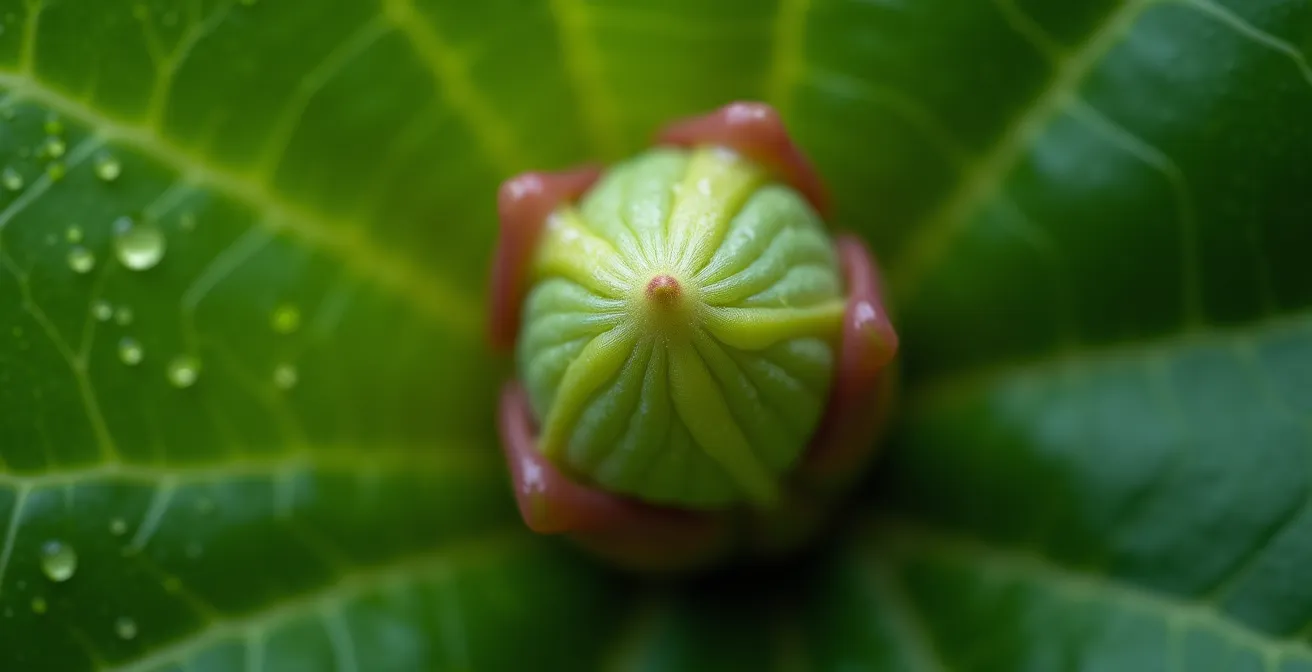
A safe re-entry schedule involves starting slow. For the first one or two feedings, use a balanced liquid fertilizer (a 3-1-2 NPK ratio is ideal for Ficus) diluted to a quarter of its recommended strength. If the plant responds well with no signs of leaf burn (crispy brown edges), you can increase to a half-strength dose for the next couple of feedings. After a month of this gradual re-introduction, you can resume a normal monthly feeding schedule at full strength throughout the active growing season of spring and summer.
The Vent Placement Error That Desiccates Foliage in 24 Hours
Perhaps the most lethal and least obvious environmental threat to a Ficus lyrata is a poorly placed HVAC vent. The air forced out of heating and air conditioning systems is exceptionally dry—often drastically so. While your plant craves a humid environment, the air from a vent creates a localized desert. This direct, constant stream of dry air acts like a blow-dryer on the plant’s leaves, causing rapid desiccation. The plant’s stomata lose moisture far faster than the roots can replace it, causing leaves to quickly dry out, turn brown, and drop. This can happen with shocking speed, often within 24 to 48 hours of exposure.
The disparity between the plant’s needs and its environment can be extreme. As expert Jennifer Green notes, ‘You should never put your fiddle plant near any devices that emit heat.’ This is because indoor climate measurements reveal a stark contrast: a home’s forced-air system can produce air with less than 10% humidity, while the plant requires closer to 50% to thrive. This creates an unsustainable moisture deficit that no amount of correct watering can overcome. The plant will exhibit all the signs of being underwatered—crispy, dropping leaves—leading the owner to water it more, which can then compound the problem by waterlogging the already-stressed roots.
The solution is simple but absolute: audit your plant’s location in relation to every vent in the room. This includes floor vents, wall registers, and ceiling diffusers. The plant must be moved out of the direct path of airflow. If moving the plant is not an option, the only alternative is to install a vent deflector. These inexpensive plastic covers attach magnetically over the vent and redirect the airflow away from the plant, usually towards the ceiling. It’s a small change that can be the difference between a thriving Ficus and a bare stick.
Why Do Veins Stay Green While Leaves Turn Yellow?
When you see a Ficus leaf turning yellow while its veins remain a stark, dark green, you are witnessing a specific cry for help. This pattern, known as interveinal chlorosis, is a classic sign of a nutrient deficiency, but it’s not as simple as just needing more fertilizer. More often than not, it points to a problem of nutrient *lockout*. This means the necessary nutrients (typically magnesium or iron) are present in the soil, but the plant is unable to absorb them. The most common cause is an incorrect soil pH. Ficus lyrata prefers slightly acidic soil; if your soil or tap water is too alkaline (with a pH above 7.0), it chemically locks up these essential micronutrients, making them unavailable to the plant’s roots.
Diagnosing yellow leaves can be complex, as the Oak Hill Gardens Expert Team points out: “Yellow leaves are slightly trickier as this can indicate one of several issues: too much water, a lack of sun, or not enough fertilizer. Further complicating this is the fact that yellow leaves on a fig may mean a bacterial infection.” However, the distinct pattern of green veins is your primary clue that points toward a nutrient lockout. Before reaching for more fertilizer—which could worsen the problem—your first step should be to address potential pH and micronutrient issues.
The treatment protocol is a process of elimination. First, address a potential magnesium deficiency, which is very common. An easy way to do this is with an Epsom salt (magnesium sulfate) drench: mix one teaspoon of Epsom salt into a gallon of water and water your plant thoroughly. Apply this once a month. If your tap water is very hard and alkaline, consider switching to filtered or rainwater. If the yellowing persists after a month or two of magnesium treatment, the issue may be an iron deficiency. At that point, you can add a chelated iron supplement to the soil, which provides iron in a readily available form for the plant.
Key Takeaways
- Leaf drop is a symptom of environmental mismatch, not just a watering schedule problem. Investigate the environment first.
- The most critical diagnostic tools are your senses: the smell of the soil, the feel of the air, and close observation of new growth.
- Simple, inexpensive tools like a wooden chopstick or a basic moisture meter are more effective than expensive gadgets for mastering watering.
How to Master Indoor Horticulture Without Expensive Equipment?
Becoming an expert caretaker for a Ficus lyrata does not require a costly arsenal of smart pots and digital sensors. The most powerful tools at your disposal are free: your powers of observation and a commitment to consistency. The core of mastering indoor horticulture lies in understanding the fundamental needs of your plant—light, water, and humidity—and learning to assess them with simple, analog methods. Instead of relying on a calendar, learn to rely on direct feedback from the plant and its soil.
One of the single most effective and inexpensive tools you can own is a basic moisture meter. It takes the guesswork out of watering by telling you the moisture level at the root ball, not just at the surface. As one successful plant parent shared, this simple device was a game-changer:
I did something life changing which was purchase a moisture meter. It literally cost me less than $10 off Amazon Prime and to this day I think it has been my greatest plant care purchase.
Even without a moisture meter, you can achieve the same result with a simple wooden chopstick or dowel. Insert it deep into the soil, all the way to the bottom of the pot. Leave it for a minute, then pull it out. If it comes out clean and dry, it’s time to water. If it comes out with damp soil clinging to it, wait. This method gives you a true reading of the conditions where it matters most: at the roots. Combine this with a simple notebook to log when you water, when you see new growth, and any environmental changes. This data log will quickly reveal patterns and make you an expert on your specific plant’s needs.
By adopting this diagnostic mindset—testing your soil, auditing your airflow, and observing your plant’s subtle cues—you can move beyond the frustration of leaf drop. The next step is to consistently apply these principles, transforming your approach from reactive panic to proactive, confident care for your Ficus lyrata.