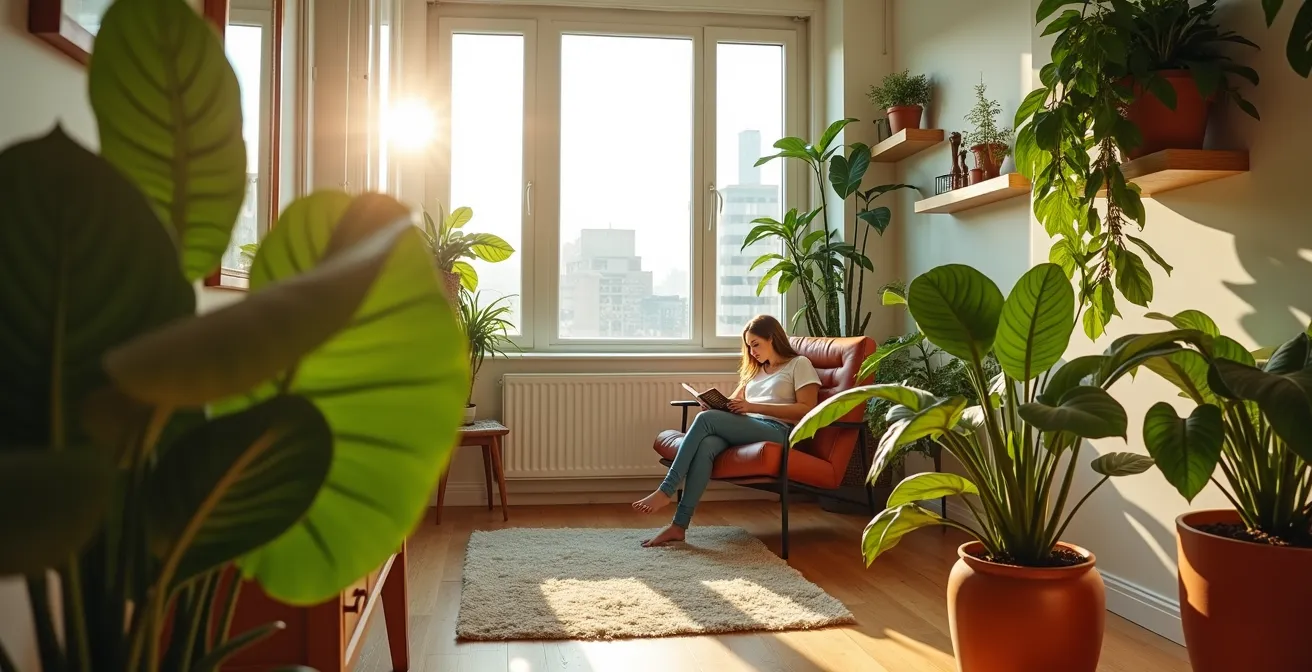
The true mental health benefit of nature in an urban apartment comes not from owning plants, but from designing a cohesive biophilic system.
- Physiological stress is measurably reduced by interacting with real, living plants, an effect not replicated by artificial ones.
- Strategic layout, sensory textures, and light management are more critical than the sheer number of plants.
Recommendation: Shift your focus from collecting plants to choreographing a multi-sensory natural environment within your home.
For the city dweller, the hum of traffic and the hard lines of concrete can create a profound sense of disconnection from the natural world. In the search for a personal sanctuary, many turn to houseplants, hoping to infuse their living space with a touch of green. The common advice is simple: add plants to purify the air, enjoy the calming color green, and your well-being will improve. While well-intentioned, this approach often misses the fundamental reason why nature is so restorative.
The secret to unlocking significant mental wellness benefits isn’t just about placing a few pots on a windowsill. It’s about moving beyond passive decoration and becoming the active designer of a responsive, living ecosystem within your own four walls. It requires a deeper understanding of how we, as biological beings, interact with the natural world on a sensory and psychological level. What if the key wasn’t the presence of plants, but the creation of a complete biophilic system that engages sight, touch, and even sound?
This is where the paradigm shifts from plant ownership to spatial choreography. It’s a method that involves sculpting with light, layering textures to invite touch, and arranging greenery not just for aesthetics, but to create targeted restorative micro-zones. This guide will walk you through the core principles of designing, not just decorating with, nature. We will explore how to turn any urban apartment, regardless of its limitations, into a vibrant sanctuary that actively supports your mental health.
This article provides a detailed roadmap for transforming your apartment into a therapeutic biophilic space. The following sections will guide you through the essential strategies, from the scientific basis of using real plants to the art of sensory design.
Summary: How to Create a Vibrant Biophilic Space
- Real Plants vs High-Quality Faux: Which Truly Lowers Cortisol Levels?
- How to Maximize Natural Light for a Gloomy North-Facing Living Room?
- The Layout Mistake That Turns a Green Oasis Into a Cluttered Jungle
- How to Layer Plant Textures to Create a Calming Sensory Experience?
- When to Move Indoor Plants to the Balcony: The Temperature Thresholds
- How to Arrange Plants to Create a Localized Clean Air Zone?
- Desk Plants or Green Walls: Which Boosts Employee Productivity More?
- How to Design a Sensory Garden to Reduce Anxiety and Boost Mental Wellness?
Real Plants vs High-Quality Faux: Which Truly Lowers Cortisol Levels?
In the quest for a low-maintenance green aesthetic, many are tempted by the realism of modern artificial plants. While high-quality faux plants can certainly provide visual comfort and color, they lack the one crucial element that impacts our physiology: life. The psychological benefits of biophilia are not just about seeing green; they are deeply tied to our innate connection to living, growing organisms. The subtle, almost imperceptible changes in a real plant—a new leaf unfurling, a slight turn towards the light—signal life and vitality to our subconscious, which can have a profound calming effect. Artificial plants, for all their perfection, remain static and cannot trigger this same deep, restorative response.
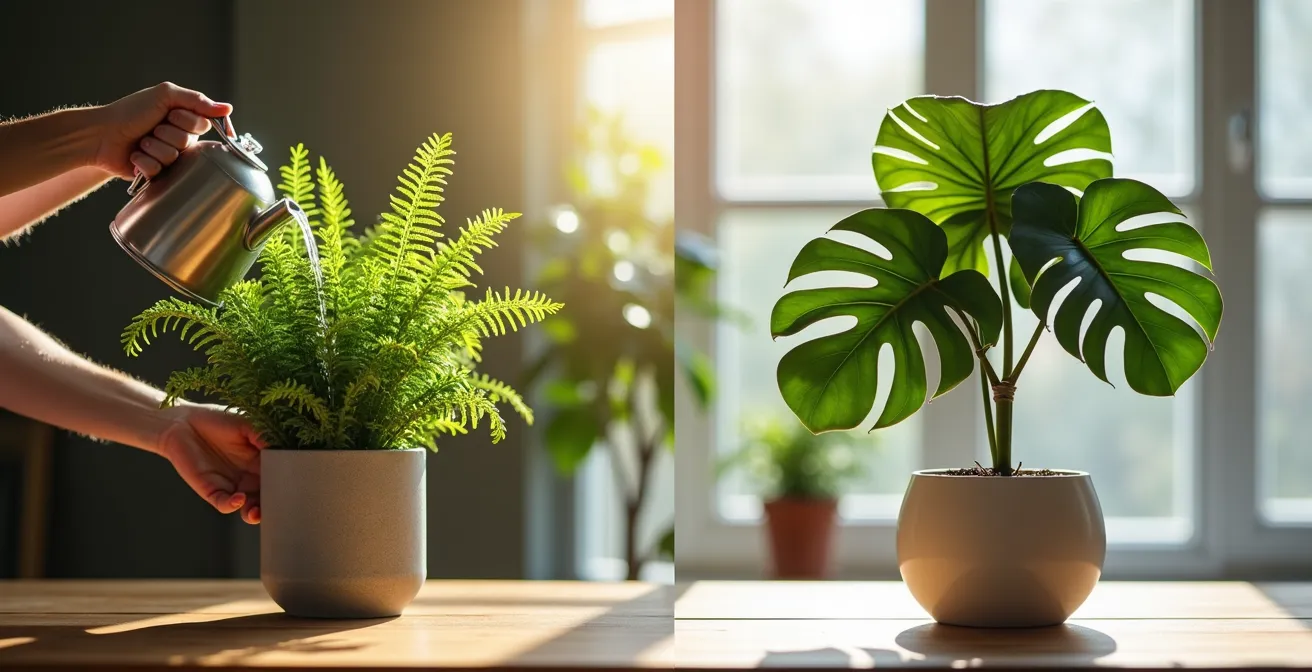
The difference is not just philosophical; it’s physiological. The simple act of caring for a living thing, of engaging in a nurturing routine, actively lowers stress. This interaction creates a feedback loop of positive reinforcement that a plastic plant can never offer. While a fake plant might initially trick the eye, it fails to engage the deeper, biological connection that our minds and bodies crave.
Case Study: The Japanese Office Worker Experiment
This principle is backed by scientific evidence. Researchers at the University of Hyogo in Japan conducted a study on office workers, finding that participants who simply kept a small plant on their desk and observed it for three minutes experienced a measurable reduction in stress. According to the study on psychological and physiological stress, participants showed a significant decrease in their pulse rates, a clear indicator of a lowered physiological stress response. This demonstrates that active engagement with a living plant, even for a brief period, provides tangible mental health benefits.
This evidence reinforces the idea that for a true biophilic system to be effective, it must be alive. The subtle responsibilities and visible growth of real plants are not a burden, but a core part of their therapeutic power.
How to Maximize Natural Light for a Gloomy North-Facing Living Room?
A north-facing room, with its cool, indirect light, is often seen as a death sentence for an aspiring indoor garden. However, this is a misconception. The challenge is not an absence of light, but a need for light sculpting—a strategic approach to managing and amplifying every available lumen. The key is to transform from a passive plant owner into an active manipulator of your environment. As noted in the Thompson & Morgan Houseplant Lighting Guide, plants with glossy, variegated, or silvery leaves physically reflect and scatter ambient light, making the entire space feel brighter. Species like the ZZ Plant (Zamioculcas zamiifolia) or a Rubber Plant (Ficus elastica) act like small, living mirrors.
The next step is strategic placement. Forget lining up plants on the windowsill. Instead, think in three dimensions. Create a tiered system: place larger, more shade-tolerant floor plants (like a Cast Iron Plant) further into the room. Use stands to elevate medium-sized plants to mid-level, and reserve the precious window area for smaller plants that can thrive in lower light, such as many varieties of Pothos or Philodendron. This creates visual depth and ensures that no single plant blocks another’s access to light.
Finally, enhance your space to support your plants. Painting walls in a light, reflective color can dramatically increase the ambient light level. More powerfully, placing a large mirror on the wall opposite your primary window effectively doubles the light source for your plants, bouncing it deep into the room. Regular maintenance, such as wiping dust off leaves and rotating plants every few weeks, ensures they can photosynthesize at maximum efficiency. With these strategies, a north-facing room can become a lush, thriving oasis, proving that it’s not the amount of light you have, but how you use it.
The Layout Mistake That Turns a Green Oasis Into a Cluttered Jungle
There’s a fine line between a restorative green sanctuary and a chaotic, stressful jungle. The most common mistake urban dwellers make is focusing on acquisition rather than curation. Simply adding more and more plants without a coherent plan leads to visual clutter, which negates the intended calming effect. The goal is to achieve a sense of “prospect and refuge”—a core biophilic principle where you have clear, open sightlines (prospect) combined with cozy, protected corners (refuge). When plants are randomly placed or crowded together, they block visual flow and create a sense of confinement, not peace. This answers the common question of “how many plants is too many”—it’s not about the number, but the spatial choreography.
A curated oasis uses intentional negative space. Each plant is given room to breathe, allowing its unique shape and form to be appreciated. This contrasts sharply with a cluttered layout where overlapping foliage creates a single, messy mass. The solution lies in vertical layering and cohesive container choices. By using a three-tier system of floor, mid-level, and hanging plants, you draw the eye upward and create a dynamic, interesting space rather than a single, crowded horizontal plane. Furthermore, sticking to a limited palette of 2-3 complementary pot styles creates a sense of unity and intention, turning a random collection into a designed feature.
This thoughtful arrangement also has practical benefits. A well-spaced layout ensures each plant is accessible for watering and care, preventing the neglect that can happen when some plants are hidden behind others. Research on office environments, for instance, shows optimal plant density is about one plant visible from each desk and one per 100 square feet, emphasizing visibility and space over sheer quantity.
The following table illustrates the key differences between a layout that induces stress and one that promotes tranquility. As design guides often illustrate, the transition from clutter to curation is about making deliberate choices.
| Layout Aspect | Cluttered Jungle | Curated Oasis |
|---|---|---|
| Plant Spacing | Plants crowded together, overlapping foliage | Intentional negative space between plants |
| Vertical Usage | All plants at same height level | Three-tier system: floor, mid-level, hanging |
| Visual Flow | Blocked sightlines, no clear focal points | Clear ‘prospect’ views with ‘refuge’ corners |
| Container Choice | Mismatched sizes and colors | Cohesive palette with 2-3 complementary styles |
| Maintenance Access | Difficult to reach individual plants | Easy access paths for watering and care |
How to Layer Plant Textures to Create a Calming Sensory Experience?
A truly restorative biophilic space engages more than just the eyes. Our connection to nature is deeply tactile, and by consciously layering different plant textures, you can create a rich, multi-sensory experience that promotes mindfulness and reduces anxiety. This practice, which can be called sensory layering, moves beyond simple visual appeal and invites interaction. The goal is to create a symphony of textures that your hands—and your mind—can explore.
Start by creating contrast. Juxtapose plants with dramatically different leaf surfaces. Imagine placing the soft, velvety leaves of a Calathea next to the smooth, waxy surface of a ZZ plant. The contrast makes each texture more distinct and interesting. Add a third layer with the feathery, delicate fronds of an Asparagus Fern or the tough, architectural spikes of a Snake Plant. This variety encourages you to slow down, to notice details, and to engage with your plants on a physical level. This tactile interaction is a powerful grounding technique, pulling your focus away from abstract worries and into the present, physical moment.
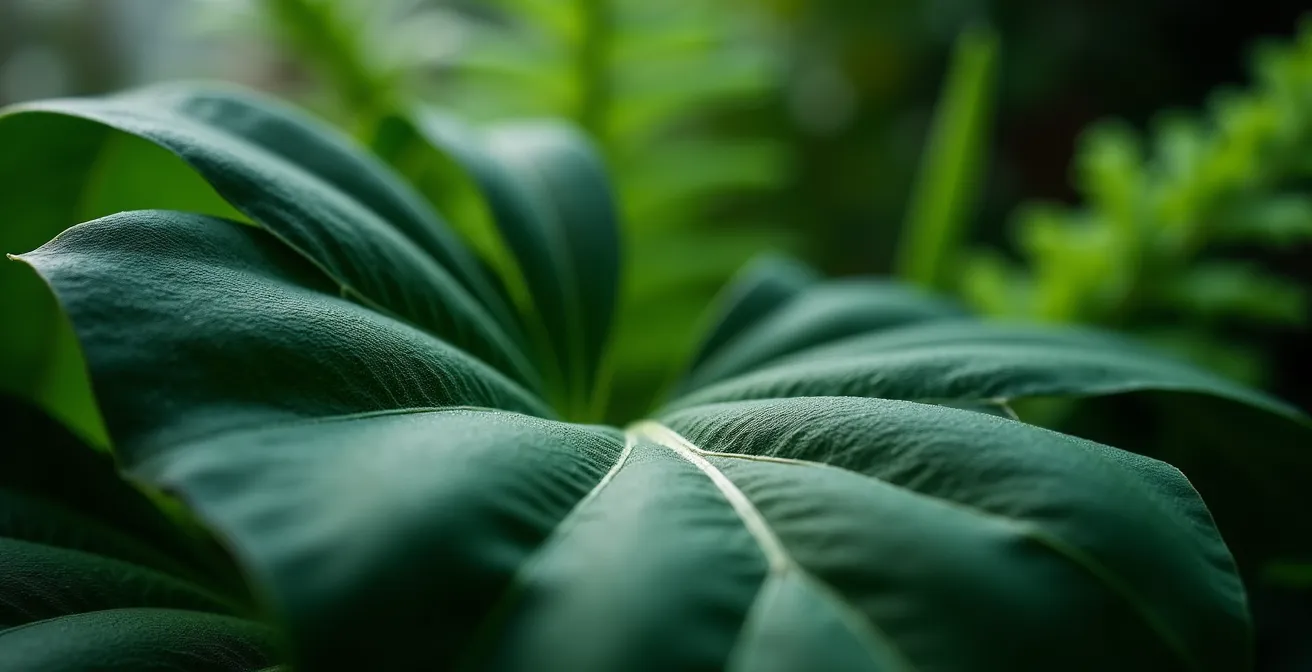
The arrangement of these textures is also key. Place highly tactile plants like Lamb’s Ear (Stachys byzantina), with its woolly leaves, along pathways or near a favorite armchair where you are likely to brush against them. The unexpected touch serves as a gentle, sensory interruption to a stressful day. The composition should feel natural and inviting, not like a formal museum display. By thinking like a landscape designer for your interior, you can create a journey of touch that complements the visual beauty of your indoor garden, turning it into a truly immersive and therapeutic environment.
When to Move Indoor Plants to the Balcony: The Temperature Thresholds
For apartment dwellers blessed with a balcony, giving indoor plants a “summer vacation” outdoors can promote vigorous growth, vibrant color, and overall health. However, the transition from the stable indoor climate to the variable outdoor environment can be a shock to a plant’s system. The most critical factor to manage is temperature. A sudden drop or spike can cause leaf scorch, wilting, or even kill a sensitive plant. The golden rule is to wait until the risk of frost has completely passed and nighttime temperatures are consistently above 50-55°F (10-13°C).
Even with safe temperatures, a direct move is too abrupt. Plants need to be “hardened off”—a process of gradual acclimatization over 7 to 14 days. Start by placing your plants in a shady, protected spot on the balcony for just a few hours on the first day. Each subsequent day, gradually increase their exposure to outdoor conditions, slowly introducing them to more direct sunlight and longer durations outside. This allows their leaves to develop a thicker cuticle to protect against the sun’s stronger rays and wind.
Be mindful of your specific balcony’s microclimate. A south-facing balcony will be much hotter and brighter than a north-facing one. Most houseplants, accustomed to the filtered light of an interior, will do best with morning sun and afternoon shade. You may need to use taller plants or a shade cloth to protect more delicate species. Also, remember that plants on a balcony will dry out much faster due to increased sun and wind, so you will need to adjust your watering schedule accordingly. Finally, before bringing them back inside in the fall, thoroughly inspect them for any pests that may have hitched a ride, and reverse the hardening-off process to re-acclimate them to indoor life.
How to Arrange Plants to Create a Localized Clean Air Zone?
The idea that houseplants can purify indoor air is well-known, but often misunderstood. While a single plant has a negligible effect on an entire room, a strategic cluster of specific plants can create a localized clean air zone, particularly around your primary living or working area. This concept, rooted in the science of phytoremediation, is about concentrating the air-purifying power of plants where you will benefit from it most. The scientific basis is robust; according to NASA research on phytoremediation, plants can absorb harmful volatile organic compounds (VOCs) like formaldehyde and benzene through tiny pores in their leaves.
To create an effective clean air “bubble,” focus on both density and diversity. Position a group of 3-5 air-purifying plants within a few feet of where you spend the most time, such as your desk chair or your favorite reading nook. The goal is to surround yourself. Place plants at varying heights—one on the floor, one on the desk, perhaps a hanging plant nearby—to maximize their interaction with the air in your immediate breathing zone. High-transpiration plants, like the Areca Palm or Boston Fern, are excellent choices as they move more air through their foliage.
Combine different types of purifiers for a comprehensive approach. For example, pair a Spider Plant, known for its effectiveness against formaldehyde, with English Ivy, which is excellent at removing benzene. Plants like the Snake Plant and Pothos are particularly valuable because they perform crassulacean acid metabolism (CAM), meaning they release oxygen at night, making them ideal for bedrooms. By curating a small, powerful team of plants and placing them strategically, you move from passively hoping for cleaner air to actively designing a personal, restorative breathing zone.
Action Plan: Your Breathing Zone Cluster Strategy
- Identify your primary space: Select the area where you spend the most sedentary time (desk, reading chair, bedside).
- Select a team of 3-5 plants: Choose from high-performers like Snake Plants, Spider Plants, Peace Lilies, and Boston Ferns.
- Create a multi-level arrangement: Position plants on the floor, on surfaces, and hanging to surround your breathing zone.
- Combine for comprehensive cleaning: Mix plants known for removing different toxins (e.g., formaldehyde absorbers with benzene absorbers).
- Ensure proper care: Keep leaves dust-free and soil healthy to maximize their air-purifying efficiency.
Desk Plants or Green Walls: Which Boosts Employee Productivity More?
In the modern workplace, both at home and in the office, greenery is increasingly recognized as a tool for enhancing focus and productivity. The debate often centers on two popular solutions: personal desk plants or large, impressive green walls. While both contribute to a biophilic environment, their impact on individual productivity differs significantly, hinging on the psychological principle of ownership. A green wall is a powerful statement piece, excellent at improving overall air quality and making a large-scale aesthetic impact. Research from IFSA shows that active green walls can be significantly more effective at removing particulate matter and VOCs than individual plants.
However, when it comes to personal productivity, the humble desk plant often holds the edge. The key factor is engagement and control. University of Exeter research found that adding plants to previously bare offices resulted in a 15% increase in productivity. The study’s lead psychologist, Dr. Craig Knight, highlights the reason for this significant boost in his findings:
The productivity boost is significantly higher when an employee has personal ownership and responsibility for a desk plant. This sense of control and nurturing is a powerful psychological factor often missing with large, professionally maintained green walls.
– Dr. Craig Knight, University of Exeter workplace psychology study
This sense of personal stewardship—watering the plant, watching it grow, and feeling responsible for its well-being—creates a micro-restorative routine that breaks up the monotony of work and fosters a deeper connection. A green wall, typically maintained by a third party, is part of the background environment. A desk plant is a personal companion. For the individual seeking to boost their own focus and satisfaction in their workspace, the evidence suggests that the personal, interactive nature of a desk plant provides a more potent psychological benefit, even if its air-purifying capacity is smaller in scale.
Key takeaways
- True biophilic design is a system, not a collection of objects; it requires a strategic approach to space, light, and sensory elements.
- Direct interaction with living plants provides measurable physiological benefits, such as stress reduction, that artificial plants cannot replicate.
- The layout and spacing of plants (“spatial choreography”) are more critical for creating a calming atmosphere than the sheer quantity.
How to Design a Sensory Garden to Reduce Anxiety and Boost Mental Wellness?
We have explored light, layout, and air quality, but the ultimate expression of a therapeutic biophilic space is a sensory garden. This doesn’t require a large yard; a highly effective sensory journey can be designed in a small corner or even on a one-meter-squared balcony. The goal is to synthesize all our senses—sight, smell, touch, sound, and even taste—to create a fully immersive, grounding experience. This is the pinnacle of the biophilic system, where each element is chosen for its specific sensory contribution to reduce anxiety and promote wellness. Studies have consistently found that active engagement with gardening, even on a small scale, significantly lowers stress levels.
To design your own mini-sensory garden, consciously select plants for each sense. For smell, include fragrant herbs like rosemary or lemon balm; crushing a leaf between your fingers releases essential oils known to reduce cortisol. For touch, incorporate plants with unique textures, like the velvety leaves of a Prayer Plant or the fuzzy surface of Lamb’s Ear, inviting gentle interaction. For sound, choose plants that create subtle noise, such as ornamental grasses that will rustle in the breeze on a balcony or the gentle click of a Prayer Plant’s leaves as they move at night.
For sight, move beyond green and add pops of color with flowering plants like a Peace Lily or a vibrant Bromeliad to serve as focal points. Finally, for taste, include an edible element. Growing a small pot of mint or basil provides an interactive reward—the ability to harvest something you’ve nurtured for a cup of tea or a meal. This act of harvesting and tasting closes the sensory loop, connecting you to the plant in a deeply primal way. By layering these sensory elements, you create a rich, complex environment that demands your presence and attention, providing a powerful antidote to the digital fatigue and disconnection of modern urban life.
To truly transform your living space into a restorative sanctuary, the next logical step is to begin planning your own biophilic system, starting with an assessment of your light and space.